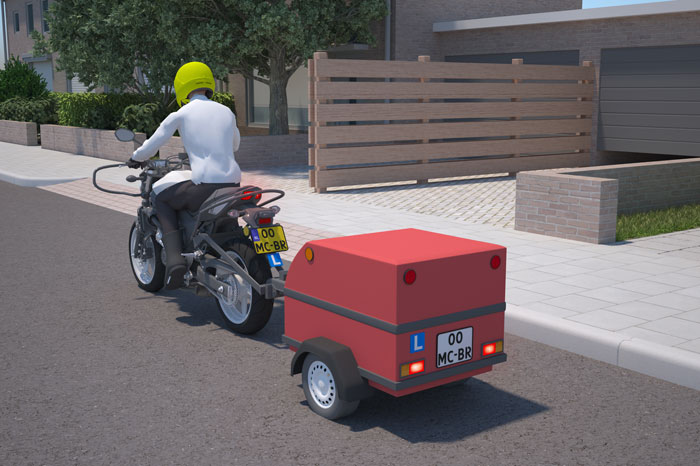

Use of lights during riding
Vehicles are provided with lights to be able to see better in the dark. But above all to be seen better by others. Sometimes lighting is required and sometimes it is not. Because visibility is very important to motorcyclists, it is best to run lights both during the day and night.
- Day
The period between sunrise and sunset.
- Night
The period between sunset and sunrise.
Dipped headlights

The dipped headlights are white or yellow light at the front of the vehicle and illuminates a quite a distance of the road surface in front of the vehicle. It does not shine straight ahead and is normally speaking not blinding. Running dipped headlights is always allowed.
The use of dipped headlights is required with poor visibility during the day and at night. This applies to drivers of motor vehicles, moped riders, snorfietsers and drivers of motorised disability vehicles. You also turn on the dipped headlights well before entering a tunnel. For motorcycles, it is wise to always run the dipped headlights due to their poor visibility. Even if it is not required.
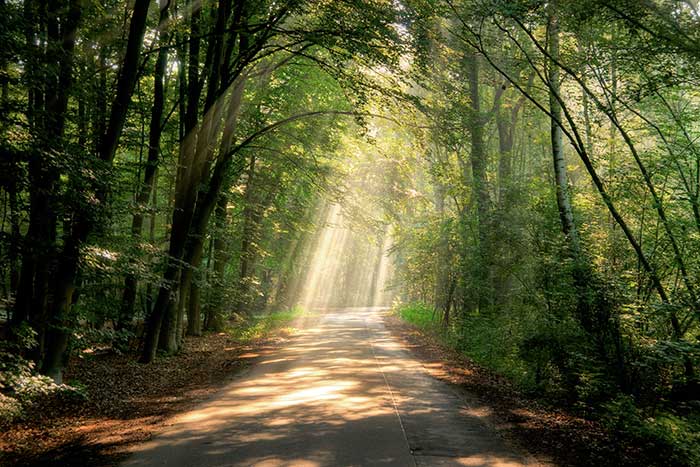
Even in sunny weather conditions dipped headlights could be required. For example, when the visibility is obstructed by the glare of the sun’s rays between the trees.
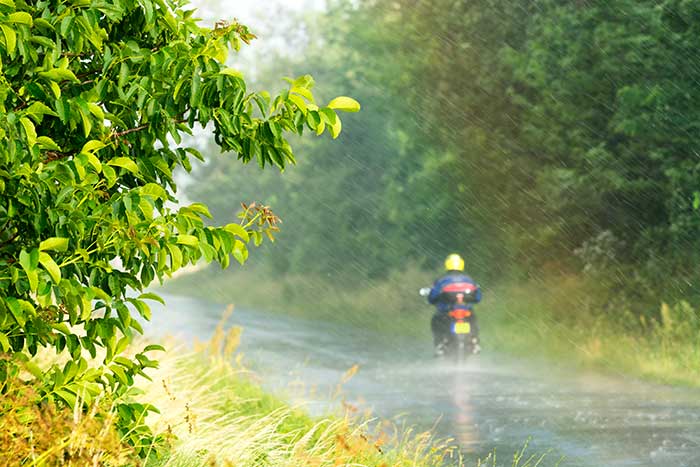
Using the dipped headlights is also required during poor weather conditions.
Daytime running lights
Daytime running lights are allowed to be present on motorcycles, but it is not required. In most cases, daytime running lights consist of LED lights in the vicinity of the headlight. Daytime running lights may only be used when the dipped headlights are not required and when no other lighting is turned on at the front of the vehicle.
Daytime running lights aims to ensure the motorcycle is clearly visible even if the dipped headlights are turned off. Do keep in mind that, in that case, the rear lights are sometimes turned off. This causes poorer visibility from behind. In normal circumstances, dipped headlights are always safter for motorcyclists.
Full-beam headlights

If there is insufficient visibility with just the dipped headlights, then you are allowed to run full-beam headlights instead of the dipped headlights. But this is only allowed:
- during the night;
- when there is no oncoming traffic;
- when there is no vehicle in front of you.
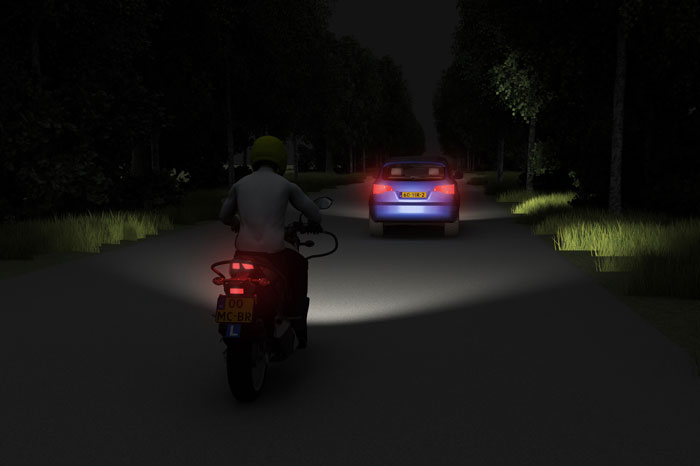
If you are riding behind another vehicle, then you are not allowed to run your full-beam headlights.
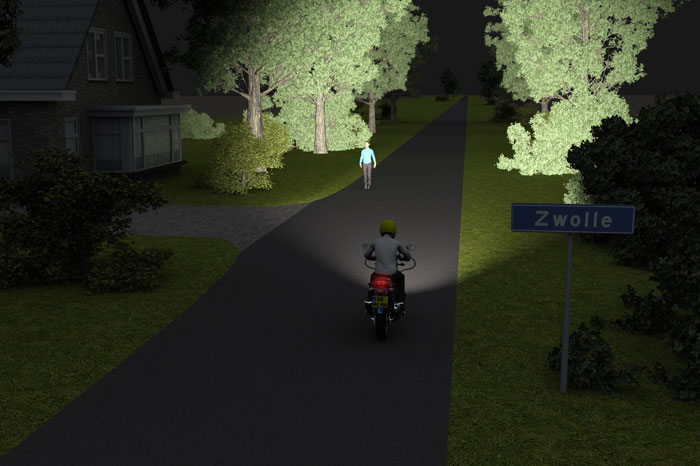
When there are oncoming road users, such as pedestrians, you are also not allowed to use the full-beam headlights.
In addition to that, the use of the full-beam headlights is not wise during poor weather conditions, such as heavy rainfall, snow or fog. In that case, there is a high chance that you are blinded by your own lights.
The full-beam headlight is a bright lamp that shines straight ahead. Which is why it quickly blinds oncoming traffic. If you are blinded by oncoming traffic yourself, flash your full-beam headlight to warn them.
If that is not effective, make sure not to look straight into the light, but try to look past it. If you see less due to the blinding light, then decrease your speed.
Chances of blinding are highest on straight roads. The full-beam headlights shine over a great distance, so you sometimes do not realise that you are blinding someone in the distance.
Fog light at the front side

This light is mainly meant to be used during foggy weather. The front fog light may also only be used when visibility is severely impaired due to fog, snowfall or rain. In addition to the fog light, dipped headlights or daytime running lights are also turned on. With very dense fog, even the dipped headlights can be blinding, which is why the dipped headlights are not required with fog lights.
Motorcycles are normally not equipped with a front fog light. It may be mounted on the motorcycle, as long as it is done properly. It is more downwards faced and is therefore not blinding. The downside is that the light only shines closely in front of the motorcycle.
Fog light at the rear side

Rear fog lights are also not standard on a motorcycle but may also be mounted to it.
The rear fog light consists of a bright red light on the back of the motorcycle. Because it is so bright, it is easily confused with the brake light. It may therefore only be used when visibility is less than 50 metres.
Reflector posts alongside the road are usually 50 metres apart. If you ride past a reflector post and you can only see the next post after that, then you may turn on the rear fog light. In that case, as a motorcyclist it is wiser to not go riding at all, due to even worse visibility.
Do note, the rear fog light may only be used during fog or snowfall. During rainfall it is not allowed to use the rear fog light because you can blind traffic behind you.
There must be a dashboard light that lights up when you turn on the rear fog light. This way, you are less likely to accidentally have the light turned on.
Side lights

Side lights emit very little light. They are white or yellow lights at the front of the vehicle. Side lights may be used in combination with the front fog light. Outside of that, the side lights are not really used. The lights of the side lights are usually the same as the lights of the parking lights.
Rear lights
This is the normal red light at the rear of the motorcycle. These must always be turned on when you run the full-beam headlight, dipped headlight, side lights, or fog light. The rear light is normally not blinding and is less bright than the brake light and the rear fog light.
Number plate lighting
This white light illuminates the number plate at the rear side. Just as the rear lights, the number plate lighting must be turned on when you run full-beam headlight, dipped headlights, side lights or fog light.
Brake light
The brake light consists of a bright red light that turns on the moment you use the brake pedal or brake lever. Because the brake light is that bright, you should avoid unnecessary braking as much as possible. Every time the brake light turns on, it could cause a startled reaction from following traffic. Make sure that you release the accelerator in time and maintain a sufficient following distance.
Lighting on a trailer
Just as the motorcycle, a trailer behind a motorcycle must run lighting in poor visibility during the day and at night. These are usually one or two rear lights, one or two brake lights, indicators and white number plate lighting. Red reflectors at the rear and amber yellow reflectors at the side are also required.