

Parking and placing
Are you stopping without necessity, but not loading or unloading or letting a passenger get on or off, then this falls under parking. Are you, for example, waiting for a passenger, then you are parking until the passenger is actually getting on the motorcycle. Are you on the side of the road to make a phone call, to ask for directions or to read a text, then all of this also falls under parking.
- Parking bay or parking lane
Paving next to the carriageway meant for stationary or parked vehicles.
- Parking
Stopping a vehicle for something else than immediately letting a passenger get on or off or immediately loading or unloading goods.
On all places where it is not allowed to stop, it is also not allowed to park. In addition to that, parking is also not allowed in the following places:
- within five metres of an intersection;
- in front of an entrance or exit construction, even if it is your own exit;
- outside the built-up area on the carriageway of a priority road; you are allowed to park in the verge;
- next to a broken yellow line, usually found on kerbs;
- next to another parked vehicle, which means you are double parking;
- within an erf outside the designated parking spaces.

Parking lots with indicated parking spaces are usually indicated by sign E-4. If this is the case, then you are only allowed to park inside these parking spaces. Parking outside these spaces is prohibited.
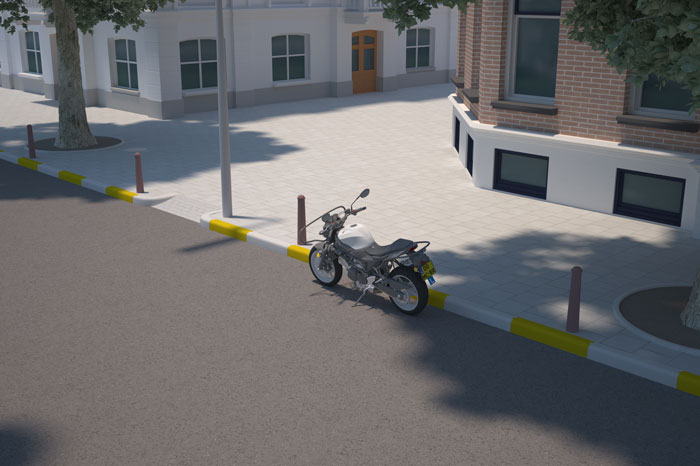
Parking next to a broken yellow line is prohibited. You are allowed to stop here.
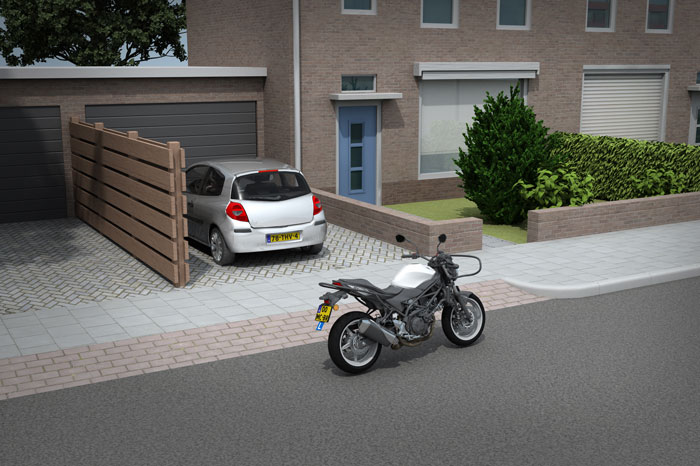
Parking in front of an exit is prohibited. You are allowed to stop here.
In addition, parking could also only be allowed under certain conditions. For example, a permit may be required, or you may only park with a certain vehicle or at a certain time.
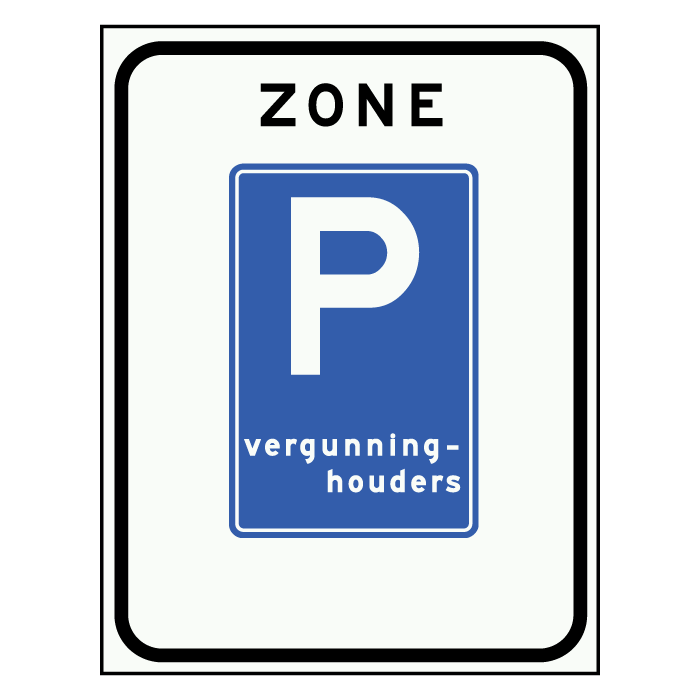
E-9 - Only drivers with a permit may park here.
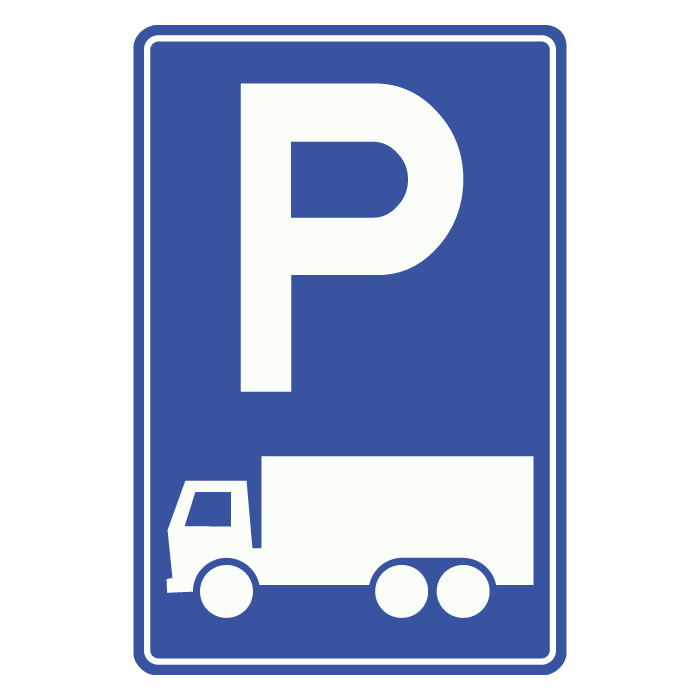
E-8 - Only drivers of lorries may park here.
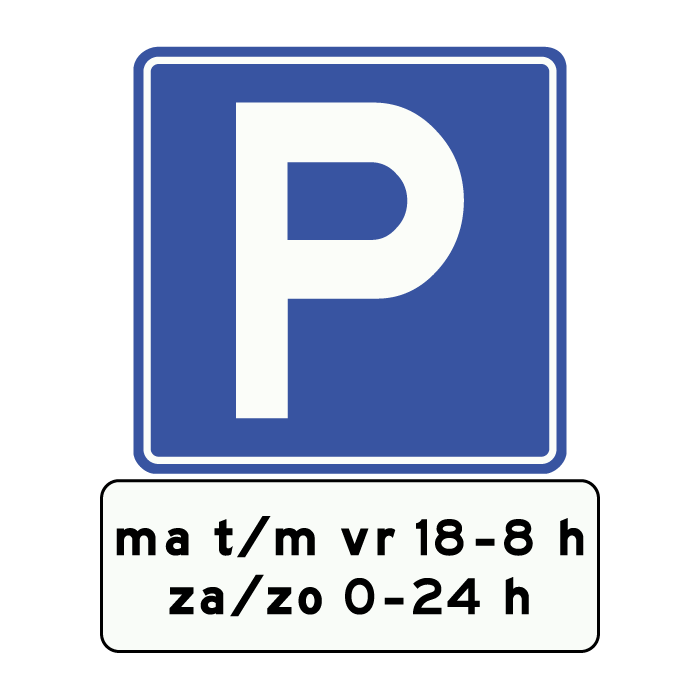
E-4 - Parking is only allowed during the indicated times.
Sign E-1 indicates that it is prohibited to park on the side of the carriageway the sign is placed at, or if the sign is executed as a zone sign, within the entirety zone on both sides of the carriageway. In that case, parking is allowed in places that are designed for parking, such as parking places, parking lanes, parking bays or the verge.

E-1 - Prohibited to park on the side of the carriageway the sign is placed.
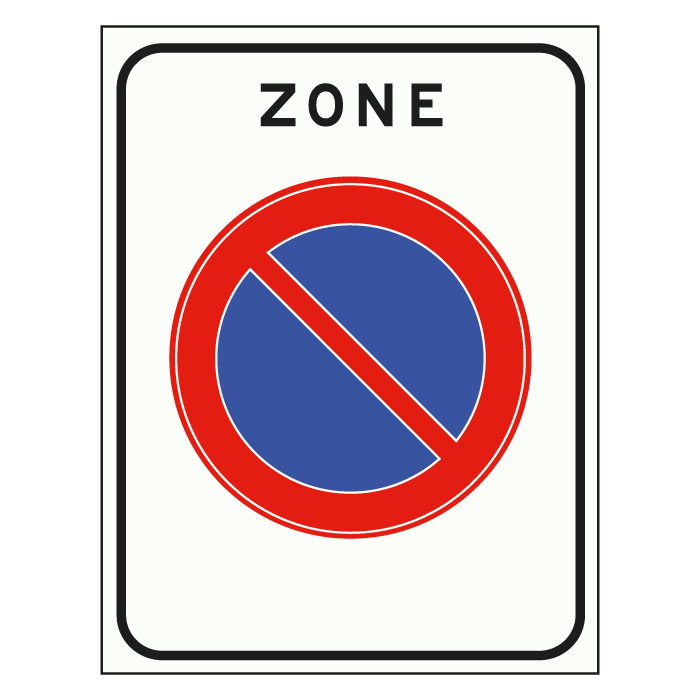
E-1 zonebord - Prohibited to park on both sides of the carriageway within the entire zone.
Do note!
Stopping or parking at places where it causes danger or unnecessary hindrance, is always prohibited.
Parking disc zone
Signs can also be used to indicate a parking disc zone. This is a zone in which you are only allowed to park on indicated parking places. You are also allowed to park in places provided with a blue line.
Are you parked next to a blue line with a vehicle on more than two wheels, then you are required to use a parking disc. It must be clearly visible.
On the parking disc, you indicate the time on which you started parking. You may round this time up to the next half or full hour. You are not allowed to adjust the time on the parking disc at a later time. If the indicated maximum parking time has expired, you are no longer allowed to park.
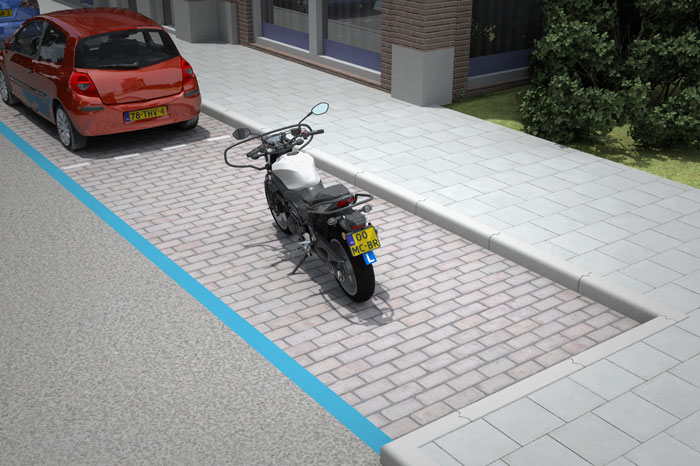
With a two-wheeled motorcycle, you are allowed to park here without a parking disc. A parking disc is required with a motorcycle with sidecar or a trike.
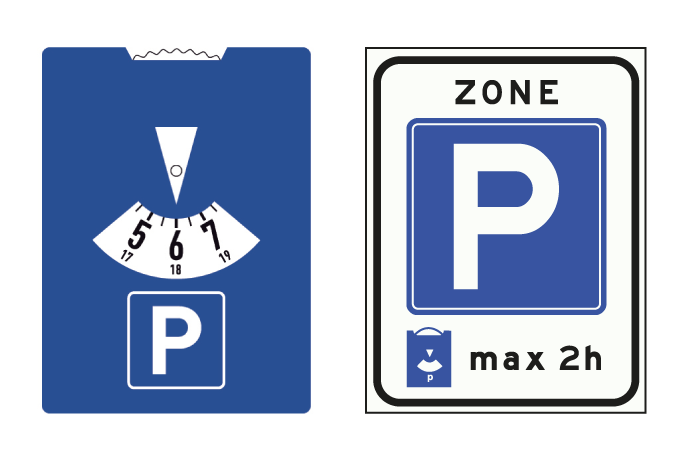
On the left is a parking disc; on the right is the sign indicating you are entering a parking disc zone. The parking limit here is 2 hours (2h).
Disability parking space
Disability parking spaces are meant to make sure that people with mobility problems can park close to certain locations. This is why parking is only allowed when it involves the transportation of a disabled person.
You can park on a disability parking space with the following vehicles:
- a disability vehicle;
- a motor vehicle on more than two wheels in which a valid disability parking card is visibly displayed;
- a vehicle for which the disability parking space is reserved. This is usually indicated by a supplementary sign with the vehicle registration number of the vehicle on it.
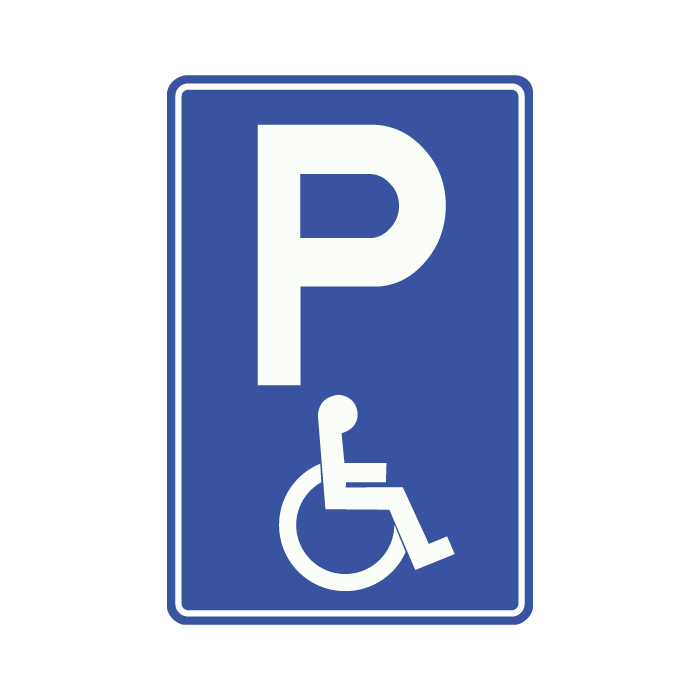
E-6 - Disability parking space.
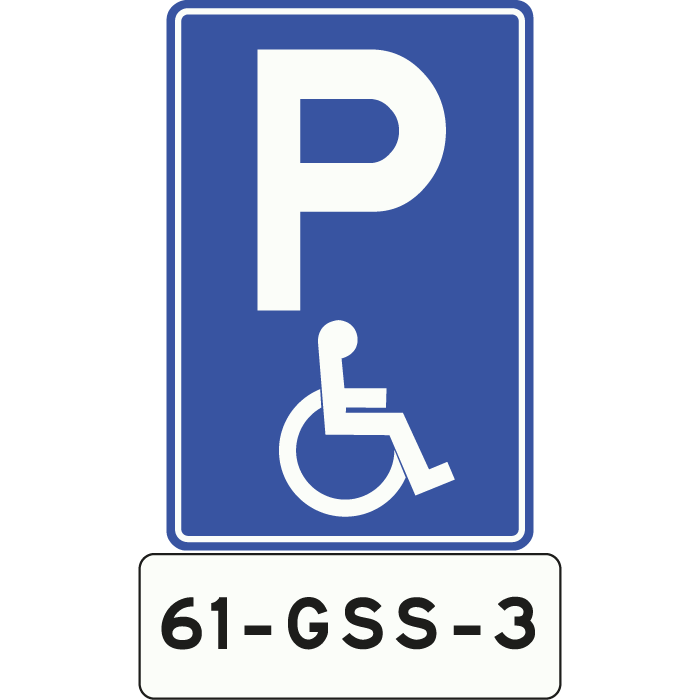
E-6 with a vehicle registration number on the supplementary sign - Disability parking space only for the mentioned vehicle.
A maximum parking duration can also be indicated on the sign or supplementary sign. A blue line does not have to be present. The use of a set parking disc is then required.
Drivers of disability vehicles, or with a valid disability parking card, may park in more places than other drivers.
- Within a parking disc zone, they are allowed to park anywhere, and they do not have to use a parking disc.
- Alongside a yellow broken line, within an erf outside the designated parking spaces and at sign E-1, they are allowed to park for a maximum of 3 hours. In these cases, a parking disc must be set and displayed.
Parking on the pavement
According to the national legislation it is not allowed to park your motorcycle on the pavement. However, in some municipalities this is tolerated, or even allowed in the General Municipal By-law (APV). In doing so, you are never allowed cause hinderance.
Do note: at the theory exam you are only asked about the national legislation.
Parking in the verge
Parking in the verge is allowed in most places, except alongside autowegen and motorways. The downside of parking in the verge is that it is easier for the motorcycle to topple over.
Do not put the motorcycle on the centre stand on a soft or less flat surface. This increases the chance to topple over. With the centre stand, the motorcycle rests on two closely spaced points, with slight sagging of one of those points or just not being straight quickly causing imbalance. With the side stand, the supporting points are more triangular, further apart from each other. Even if the side stand sags a little, usually the motorcycle stays upright.
Some motorcyclists have an attachment for the side stand in their equipment. This attachment makes sure that the side stand does not sag as quickly. A simple custom-made piece of wood could also be a solution to this.
Placing of bicycles, speed pedelecs, snorfietsen and mopeds
With this group, we do not talk about parking. If you put these vehicles somewhere, we talk about ‘placing’. The rules and signs that regulate parking do not say anything about placing.
When placing these vehicles, you may use the pavement, footpath or verge. In addition, you may also use spaces clearly indicated as places for bicycles, speed pedelecs, snorfietsen and mopeds.
Because brommobielen follow the traffic rules for motor vehicles, the rules for parking do apply to brommobielen.

E-3 - Prohibited to place bicycles, speed pedelecs, mopeds and snorfietsen on this side of the road.
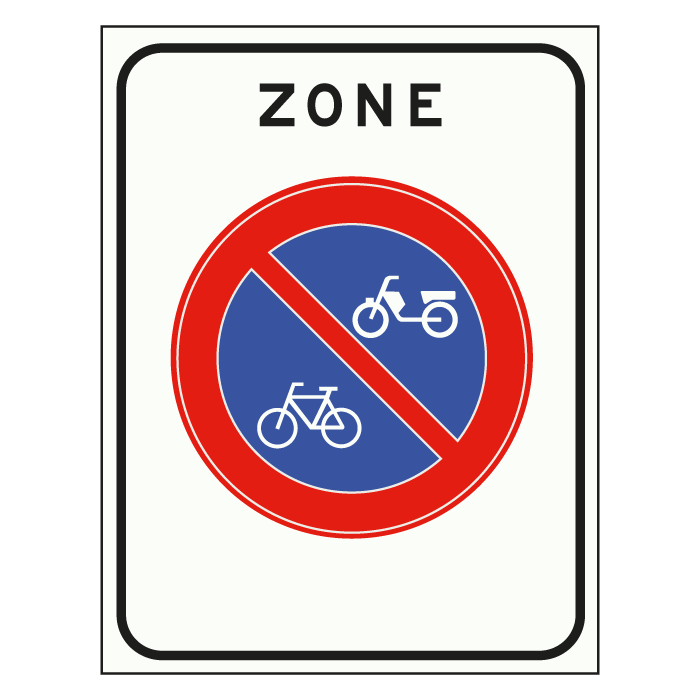
E-3 zone sign - Prohibited to place bicycles, speed pedelecs, mopeds and snorfietsen inside this zone.