

Road users
Important Dutch words
- Autoweg
Flow road with a speed limit of 100 km/h. Not the same as a motorway. Often recognisable by a green axis line.
- Erf
Residential area with a speed limit of 15 km/h. Pedestrians may use the road over the full width.
Road users are all persons that make use of the road. They are also called traffic participants or in short traffic. Because not all road users have the same rules, they are further divided. The first division is between pedestrians and drivers.
- Traffic
Traffic or traffic participants are the same as road users.
- Road users
Pedestrians, cyclists, moped riders, drivers of disability vehicles, motor vehicles or a tram, horse riders, handlers of horses and livestock, and drivers of a horsedrawn cart or handcart.
- Vehicles
Bicycles, mopeds, disability vehicles, motor vehicles, trams, and carts.
Extra information road users
Pedestrians
Pedestrians are primarily on foot. Persons on foot carrying a motorcycle, moped or bicycle by hand are also pedestrians. The same goes for persons moving around on objects not falling under vehicles, such as a kids’ scooter, skateboard, or skates.

Someone who moves around on skates falls under the category pedestrian.

Someone who walks around carrying a bicycle by hand.
- Drivers
All road users except pedestrians.
Drivers
Drivers are persons that are operating something. This could be a vehicle, but it could also, for example, be a drought or livestock animal such as a horse. This also includes someone walking with a horse on the reins, as well as livestock animals. Ultimately, all road users other than pedestrians are drivers.
All road users that do not fall under the category pedestrians, are drivers. Pedestrians + drivers = road users
Drivers of disability vehicles
Drivers of disability vehicles can fall under the rules of both pedestrians as well as drivers. This depends on where they are driving.
- Disability vehicle
Vehicle equipped for transporting a disabled person, not wider than 1.10 meters and not fitted with an engine, or fitted with an engine whose maximum construction speed does not exceed 45 km/h and is not a moped.
Does the driver of a disability vehicle follow the carriageway or cycle lane, the cycle path, or the cycle/moped path, then they follow the rules of drivers. If they are driving. But if they are driving over the pavement or footpath, or if they are in the process of crossing the road from one pavement or footpath to another, then they follow the rules of pedestrians.
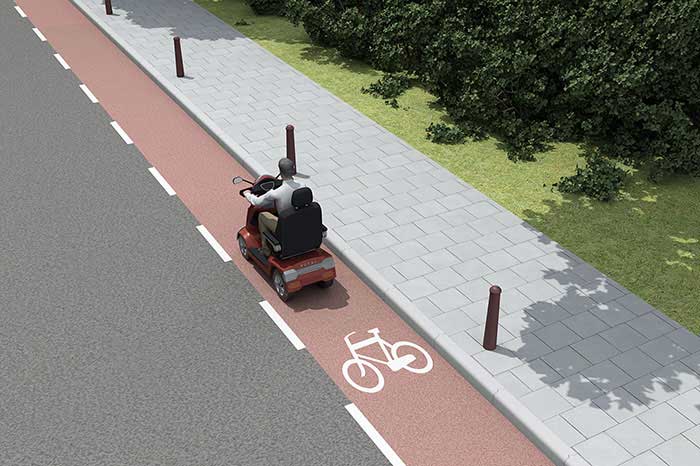
The driver of the disability vehicle must follow the rules of drivers here.

In this situation they fall under pedestrians because they are riding on the pavement.
- Moped
A motorised vehicle on two, three or four wheels that cannot and may not go faster than 45 km/h. The brommobiel, snorfiets and speed pedelec also fall under mopeds.
- Brommobiel
A moped on more than two wheels, fitted with coachwork. A brommobiel is not a disability vehicle and weighs a maximum of 350 kg.
- Snorfiets
A moped which, according to the vehicle registration register, is made for a speed limit not exceeding 25 km/h. Special mopeds, such as the segway or the BSO-bus also fall under this category. An electric bicycle (also called a bicycle with pedal assistance) does not fall under this category.
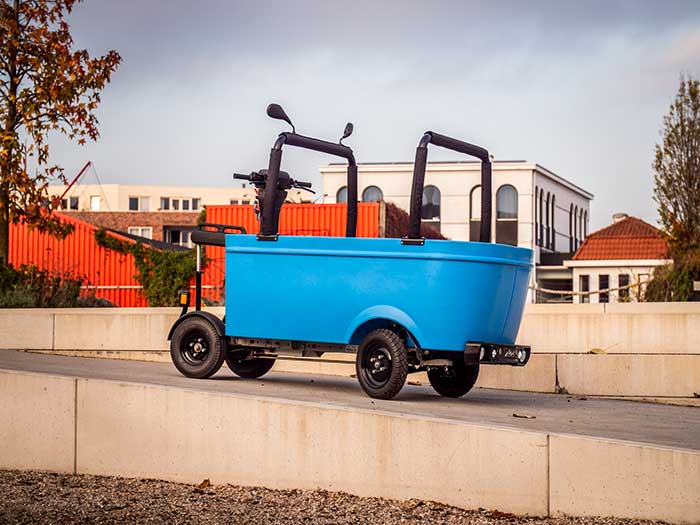
The BSO-bus does not look like a snorfiets but does follow the rules of snorfietsen.
- Speed pedelec
An electrical bicycle with pedal assistance of which the propulsion is maintained if the vehicle travels faster than 25 km/h. This is different than a normal electrical bicycle or a bicycle with pedal assistance. With these, the propulsion stops at 25 km/h. Because a speed pedelec falls under the category mopeds, the rider of it may ride a maximum of 45 km/h.
- Motor vehicles
All motorised vehicles except:
- mopeds (including brommobielen, snorfietsen and speed pedelecs);
- bicycles with pedal assistance;
- disability vehicles;
- trams;
- metros;
- trains.
- Motor carriages
All motor vehicles, including mopeds (including brommobielen, snorfietsen and speed pedelecs) and motorised disability vehicles. Like motor vehicles, this does not include trams, metros, and trains.
Drivers of motor vehicles
There are a few motorised vehicles that do not fall under the category motor vehicles. Such as mopeds. This also means that drivers of these vehicles do not follow the rules that apply to drivers of motor vehicles. However, there is one exception. A brommobiel falls under the category of mopeds and is therefore not a motor vehicle. But on the public roads, the driver of a brommobiel must behave as a driver of a motor vehicle and also follow those rules. Something that is prohibited for a driver of a motor vehicle, is therefore also prohibited for a driver of a brommobiel.
Drivers of bicycles, mopeds, snorfietsen and speed pedelecs
Not only the driver of a brommobiel follows different rules than drivers of ‘normal’ mopeds. A rider of a snorfiets instead follows the rules of bicycles. If there is a bicycle on a sign, it then also applies to the rider of a snorfiets, unless otherwise indicated.
Riders of speed pedelecs do follow the rules of mopeds.
| Falls under the category of: | Follows the rules of: | |
|---|---|---|
| Brommobiel | Mopeds | Motor vehicles |
| Snorfiets | Mopeds | Bicycles |
| Speed pedelecs | Mopeds | Mopeds |
Horseback riders and handlers of horses and livestock
This group falls under drivers. It does not matter whether the person is on a horse or livestock animal or beside it. If you are riding on a horse, you are a driver. But if you walk with a horse (or cow) on a lead, or if you are guiding it, then you are also a driver. This applies to all draft animals and livestock.
Because regular pets are not draft animals or livestock, then you are just a pedestrian when you are walking the dog.
Drivers of carts
These are drivers of horse drawn or hand drawn carts. Horse drawn carts are carts with one or more horses in front of it. Hand drawn carts are carts pulled by people. In addition to these two vehicles, pedestrians who form a parade or convoy also fall under the category carts. Think of a funeral procession consisting of pedestrians or a (carnival) parade.