

Road types
Roads come in all shapes and sizes. They are designed with a specific purpose. There is a distinction between three different types:
- access roads
- distributor roads
- flow roads
Access roads
These areas are primarily residential. Here, speeds are low, roads are narrower and there are more speed bumps and obstacles. You will come into contact with weaker road users such as cyclists and pedestrians. You must adjust your speed to this. On these roads, cyclists often do not have their own cycle path, but cycle on the road. Most intersections are equivalent.
Example of access roads are an erf and a 30km zone. However, 60km zones also fall under access roads, because they aim to ensure that farms and entrances to meadows and fields can be easily reached. You also encounter a lot of slow traffic on these roads, such as agricultural vehicles.
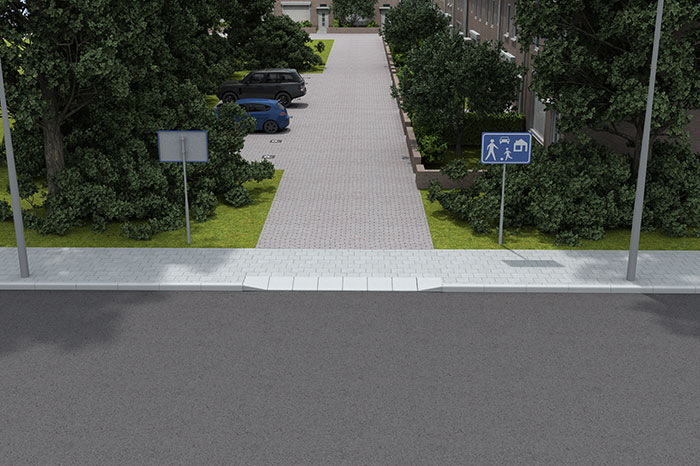
Erf
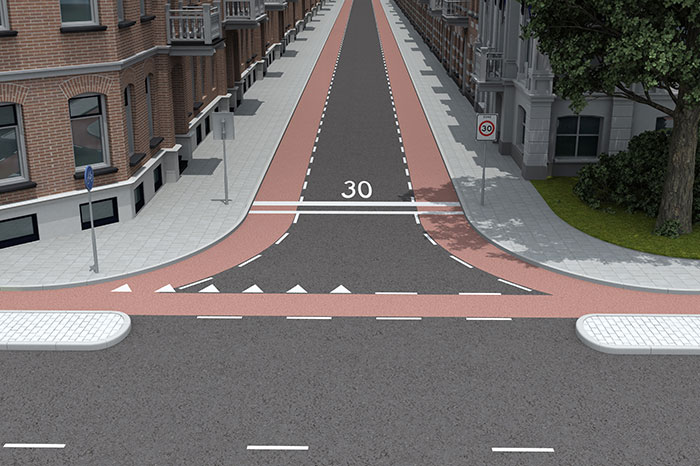
30km zone

60km zone
Distributor roads
These roads connect residential areas (with access roads) and flow roads. Distributor roads are wider, and the speed limits are a little higher. Think of roads within the built-up area where you can ride 50 km/h and sometimes even 70 km/h and where houses are not directly located. These roads form the connection between different neighbourhoods within a city.
80 km/h roads outside the built-up area also fall under the distributor roads. They connect different villages and small towns.
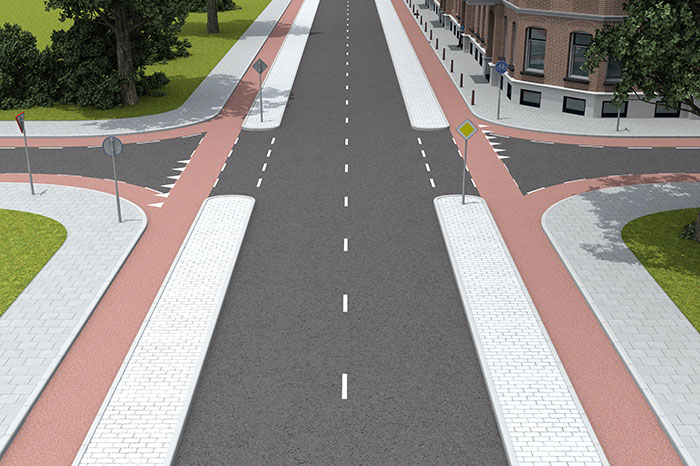
50km road
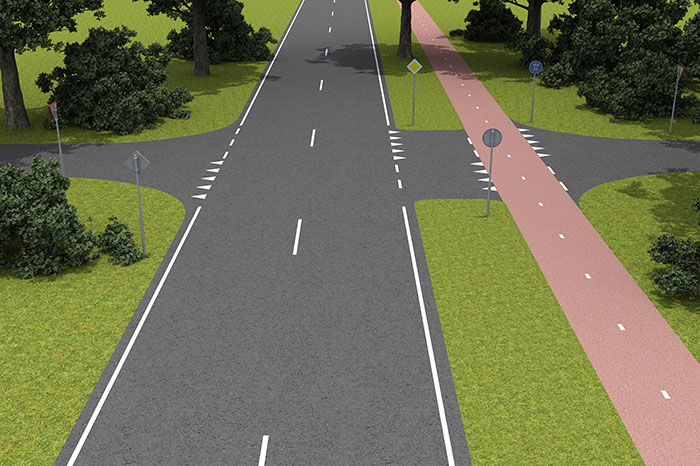
80km road
Most distributor roads have separate cycle paths and cycle/moped paths. You also encounter less agricultural traffic. Most intersections are on one level but not equivalent. Priority is regulated by means of signs and markings or traffic lights.
Most fatal accidents happen on distributor roads, with the most occurring on the municipal 50km roads. This is mainly due to accidents between motor vehicles and cyclists, moped riders and pedestrians. But many fatal accidents also occur on 80km roads including head-on collisions during overtaking manoeuvres.
Flow roads
The aim of these roads is the smooth transportation of traffic over larger distances. They connect bigger cities. Think of autowegen and motorways. The speed limit is high and all motorways and wider autowegen have a separation (crash barrier or central reservation) between the two directions.
The two-lane autowegen that do not have a separation in the form of a crash barrier or central reservation, are far more dangerous than those with a separation. In order to overtake you must cross to the side of oncoming traffic. On these roads, head-on collisions regularly occur. Often with fatal consequences.
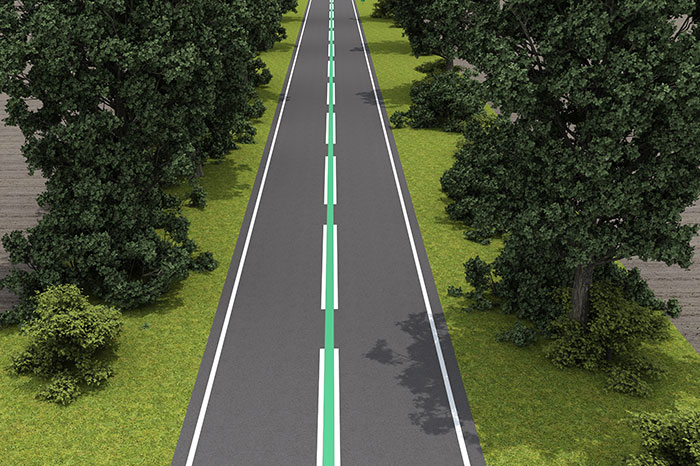
Autoweg
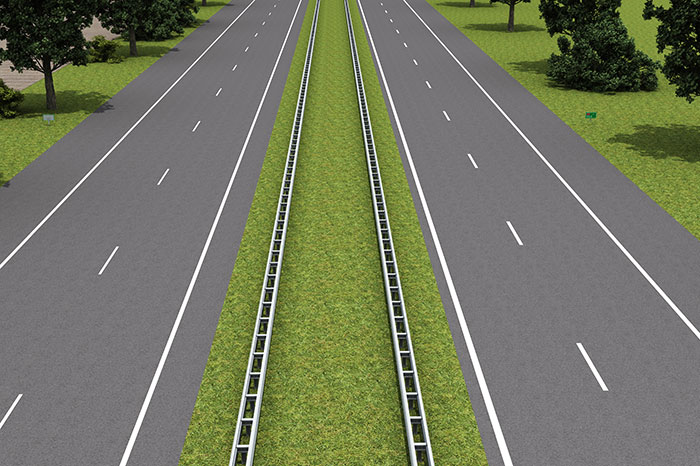
Motorway
Some autowegen have equal level intersections or crossings, but most flow roads have unequal level junctions (flyovers) on which traffic is led from one (flow) road to another via ramps and exits.
You will not encounter cyclists or other slow traffic on flow roads. Vehicles must be able to and allowed to drive at a minimum speed before they are allowed on flow roads. However, it can occur that slow traffic must cross an autoweg on a equal level intersection. This can lead to dangerous situations if the crossing driver does not consider the high speed on the autoweg.
But the most common accidents on flow roads are rear-end collisions because too little distance is kept, and unexpected braking happens. These roads are also known for their traffic jams.
An extra rule for lorries and vehicles with a trailer where the combination is longer than seven metres is that on motorways, they are only allowed to use the two rightmost lanes. This does not apply to motorcycles with a trailer, as they are always shorter than seven metres.

Equal level crossing on an autoweg.

Unequal level junction on an autoweg.