

Maintaining distance
The more free space around your vehicle, the smaller the chance you will come in contact with other vehicles. Therefore, always maintain sufficient distance to the left and right of your vehicle, but also in front of your vehicle: the following distance. If the following distance is too short, then we call it ‘tailgating’. In that case, the rear vehicle does not have enough time to react if the front vehicle starts braking. Maintaining insufficient distance is one of the most important accident causes on the motorway.
- Driving vision
the distance over which you can oversee the road. This could be impaired due to road or weather conditions, but also due to, for example, your following distance. The less driving vision you have, the lower your speed should be.
Stopping distance
In traffic, you regularly encounter situations where you must, expectedly or unexpectedly, brake. It is important that you stay aware of the distance you need to be able to stop. We call this the stopping distance. The stopping distance is not just the braking distance, but also the time you need before you actually start braking: the thinking distance.
stopping distance = thinking distance + braking distance
Thinking distance
If something unexpected happens in front of you, you have to react to it first. This follows a set pattern.
- Perceiving
You see something happen to which you may need to react. - Predicting
You will predict what this means and which possibilities you have. - Evaluating
You compare the possibilities. - Deciding
You choose the best possibility. - Acting
Act according to your decision.
How fast you are in the cycle of perceiving, predicting, evaluating, deciding and acting determines your thinking time. When you are healthy, alert and experienced, the thinking time is about one second. It then takes one second from the moment you perceive something you must brake for, to actually squeezing or pressing the brake.
During this second you will continue riding at the same speed. This distance is the thinking distance. You can calculate this by dividing the ridden speed by four and then adding 10%. This number is the thinking distance in metres.
(ridden speed : 4) + 10% = thinking distance in metres
Example: (60 km/h : 4) + 10% = 15 + 1,5 = 16,5 metres
Braking distance
As soon as you touch the brake, you do not come to a standstill immediately. This mainly depends on how well you handle braking and the speed you are riding. The distance you travel during that time is called the braking distance.
This distance increases quadratically as you increase the speed. This means that the braking distance becomes four times longer if the speed is twice as high. The state of the road surface and the weather conditions also influence the braking distance.
To calculate the approximate braking distance, you can divide the ridden speed (in km/h) by 10. Multiply this number by itself and then divide it by two. This number is the braking distance in metres.
Do keep in mind that, for motorcyclists, the braking distance is more dependent on experience and practise, than for motorists. Braking well takes a lot of practise and is not as easy as you would think. However, nowadays, some of this difficulty is addressed by tools such as ABS and combined braking systems.
(ridden speed : 10) x (ridden speed : 10) : 2 = braking distance in metres
Example: (60 km/h : 10) x (60 km/h : 10) : 2 = 6 x 6 : 2 = 18 metres

Following distance
The distance between the front of your vehicle and the rear of the vehicle in front of you is the following distance. Not maintaining a sufficient following distance is punishable and beside that extremely dangerous. You can decide a safe following distance by applying the ‘two-second rule’. This means that if the vehicle in front of you passes a post, it must take you two seconds before you reach that post.

You can also calculate the approximate following distance in metres. You do this by dividing the speed in km/h by two. Then you add 10% of this result.
(ridden speed : 2) + 10% = following distance in metres
Example: (60 km/h : 2) + 10% = 30 + 3 = 33 metres
Use of the brake
While riding a motorcycle, the use of the brake is a lot more precise than while driving a car. It is by no means possible to brake in all situations. That is why, in the vehicle control exam, more brake tests are included. Two-wheeled motorcycles can skid easily and the chances to fall while braking during emergency braking are real.
Build up the braking pressure, do not squeeze the brake too abruptly and divide the brake force well over the front and rear brake. The distribution between them is usually about 70-80% front brake and 20-30% rear brake.
In addition to that, never brake in bends, at most use the rear brake while manoeuvring in a tight bend (like you will learn in the half turn and the imaginary figure eight). If you, in a bend, brake with your front brake, then the motorcycle will righten itself more (slant less). As a result, the bend can become too wide, and you can even fly out of the bend. You also run the risk of a skidding front wheel, which almost always causes a fall.
If you can choose a motorcycle with an anti-lock braking system (ABS), then this always has the preference. ABS does not immediately ensure a shorter braking distance. But because the wheels not locking up while braking, there is less risk of falling while braking and the motorcycle remains more controllable. But also try to steer as little as possible during braking, even with ABS.
Good suspension is also important during braking. The suspension makes sure that the tyre has good contact with the road surface, even if it is a little bumpier. But the suspension also catches the weight shift that arises when braking. Poorer suspension therefore causes an imbalance while braking which results in a longer braking distance or even a fall.
Poorer circumstances
The following distance according to the ‘two-second rule’ is a minimum following distance. It is based on good road and weather conditions, an alert driver and a good road holding.
If your motorcycle is in poor condition, or if you are not as experienced with braking, then the braking distance increases. The same applies if you encounter poor road or weather conditions. The road could have less grip and be more slippery due to that. In that case you must maintain a larger following distance.
If the visibility is reduced due to snow- or rainfall, or if you are less alert, then you can perceive less well and react less quickly. This therefore also increases your thinking distance. You also solve this by maintaining a larger following distance. Estimating the minimum following distance in these kinds of situations requires insight and experience. But as a guideline you can keep to a following distance of three or four seconds.
To know whether you are dealing with a poorer road surface, and with that a poorer road holding, you can look at:
- Road surface type and the state of it
A wet road surface has less grip, just as a road surface with holes or loose gravel or sand. In addition to that, for example, a cobblestone road has less grip than an asphalt road. - Road banking
In bends the roads are often a little slanted, where the inner bend is a little lower than the outer bend (positive road banking). This ensures more grip in bends. If, due to circumstances, the outer bend is lower than the inner bend (negative road banking), then you have less grip in the bend.
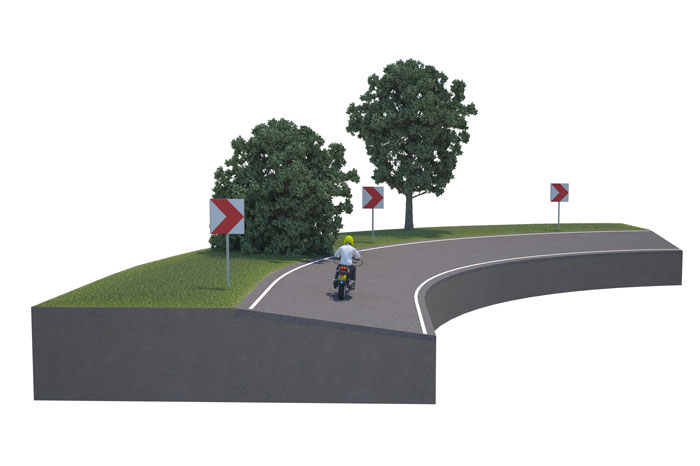
Positive road banking. The inner bend lies lower.
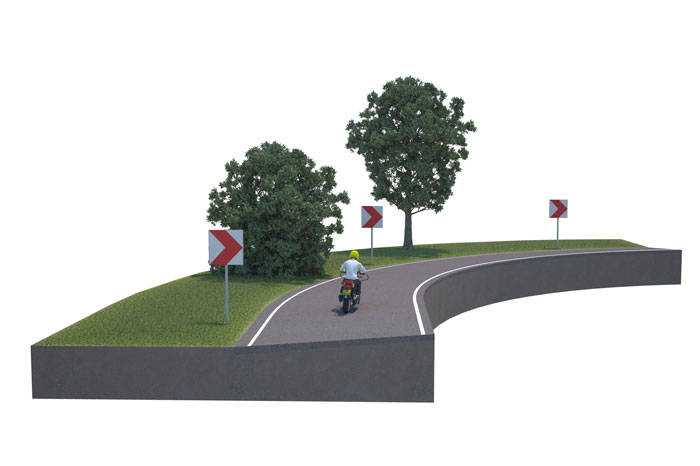
Negative road banking. The inner bend lies higher.
- New road surface
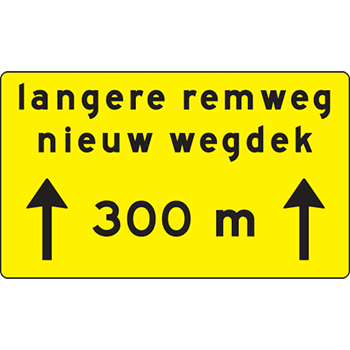
You would expect that the grip would immediately be good with a new road surface. However, this is not the case. A road must first be ‘ridden-in’ before it is rigid enough. A new road surface is therefore more slippery in the beginning.
Centrifugal force
The centrifugal force is the force that pushes you and the motorcycle to the outside when riding in a bend. The heavier, bigger and higher a vehicle is, the bigger the centrifugal force. Adjusting the speed has a direct effect on this force. When the speed is doubled in a bend, the centrifugal force is four times as big. The bigger the centrifugal force, the bigger the chance that you skid and fly out of the bend, especially when you also brake in the bend. Therefore, adjust your speed well before the bend and make sure that you do not have to brake in the bend. By tilting the motorcycle in the bend, you partially catch the centrifugal force. A part of this force is also caught by positive road banking, if present.
Braking in poorer circumstances
Braking well under normal circumstances already takes some practice. But it becomes a little more difficult if the circumstances are not ideal, such as during slipperiness due to bad weather, or with a poor road surface due to loose chippings or sand. In that case, it is important that you brake less, or not at all, with the front brake depending on this situation, unless it is really necessary. As soon as the front wheel starts skidding, it will almost always cause a fall because it is difficult to correct. In these kinds of circumstances, brake mostly with your rear brake. If your rear wheel skids, then it is generally easier to correct. But try to dose the brake in such a way that the rear wheel does not skid.
In these situations, preventing to brake is always the best. Maintain a larger following distance and look far ahead. Avoid poor and slippery sections on the road surface, such as white markings, black tar snakes on the asphalt, manhole covers and dirt. Also keep in mind the presence of tram rails. Prevent having to ride over them in the longitudinal direction.