

Code of conduct special situations
Some situations require a different approach from motorcyclists than from motorists. For example, while riding in traffic jams or in the mountains, or when encountering unexpected situations.
Code of conduct motorcyclists in a traffic jam
One big advantage for a motorcyclist is that, in the Netherlands, you are allowed to pass the traffic jam on the motorway. Note, this is often not allowed in other countries! You do have to adhere to a few codes of conduct if you want to overtake a traffic jam.
These compiled codes of conduct do not only apply to motorcyclists, but motorists are also expected to keep them in mind. However, this is not a free-for-all for motorcyclists, overtaking must be safe. You must generally keep in mind that, as a motorcyclist, you are less visible to motorists and that motorists can often poorly estimate the speed of a motorcyclist.
Approaching a traffic jam
When you approach a traffic jam, keep an eye out via the mirrors for following traffic that does not reduce speed in time. Gradually reduce your speed and, for your own safety, warn following traffic with your hazard lights and/or brake light. If you are the last one in the traffic jam, keep using the hazard lights or brake light to clearly indicate that you are stationary. Sometimes motorists do see the traffic jam, but do not see the motorcyclist at the back of the traffic jam. Keep enough distance relative to person in front of you and try to ride between the waiting cars when possible. It is safer there.
Riding between the lanes
To prevent confusion among motorists, you do not use indicators or hazard lights as soon as you ride in between the traffic jam. On motorways with more than two lanes, you are only allowed to ride between the two leftmost lanes (lanes 1 and 2).
Appropriate speed
If you ride in between the traffic jam, then do this calmly and at an appropriate speed. An appropriate speed means that the speed difference between you and the car you are passing may not exceed 10 km/h. High speed differences are the most important source of annoyance and irritation in motorists and could result in dangerous startle reactions.
Multiple motorcyclists
If you want to pass the traffic jam with multiple motorcyclists, stay responsible yourself and ride calmly in a row past the traffic jam. Maintain a mutual following distance of about two cars and all choose the same passage. Also keep in mind how motorists react to the motorcyclists in front of you.
End traffic jam
As soon as the traffic jam starts moving again, get in lane in between the cars again. Timely use – so before getting in lane – the indicator.
Where are you not allowed to ride?
Passing a traffic jam is in principle permitted. When overtaking you must keep in mind that you do not use:
- The hard shoulder
The lane to the right of the carriageway, intended for emergency services. - The redressing lane
The asphalt strip between the left lane and the left crash barrier. - The target lane
Road sections meant for buses, freight traffic or trams. - The hatched road markings
Area with diagonal stripes (at the transition to fewer lanes). - The dividing point
White road marking (also called pie tip). - The (pre-sort) lanes for other directions
You are required to follow the direction indicated on that lane. You are not allowed to pass a traffic jam going straight via a lane that turns left or right.
Preventing a (ghost) traffic jam
A ghost jam arises because too little distance is being kept. If one driver releases the accelerator, then the driver right behind them often has to brake already. Every other following driver must brake harder, leaving drivers at the back even at a complete standstill.
You prevent a ghost jam by maintaining a sufficient distance so that you can keep riding at a constant speed. You then do not have to go along with releasing the accelerator and accelerating of the vehicles in front of you. The less you need to let off the throttle, the less the vehicles behind you need to brake.
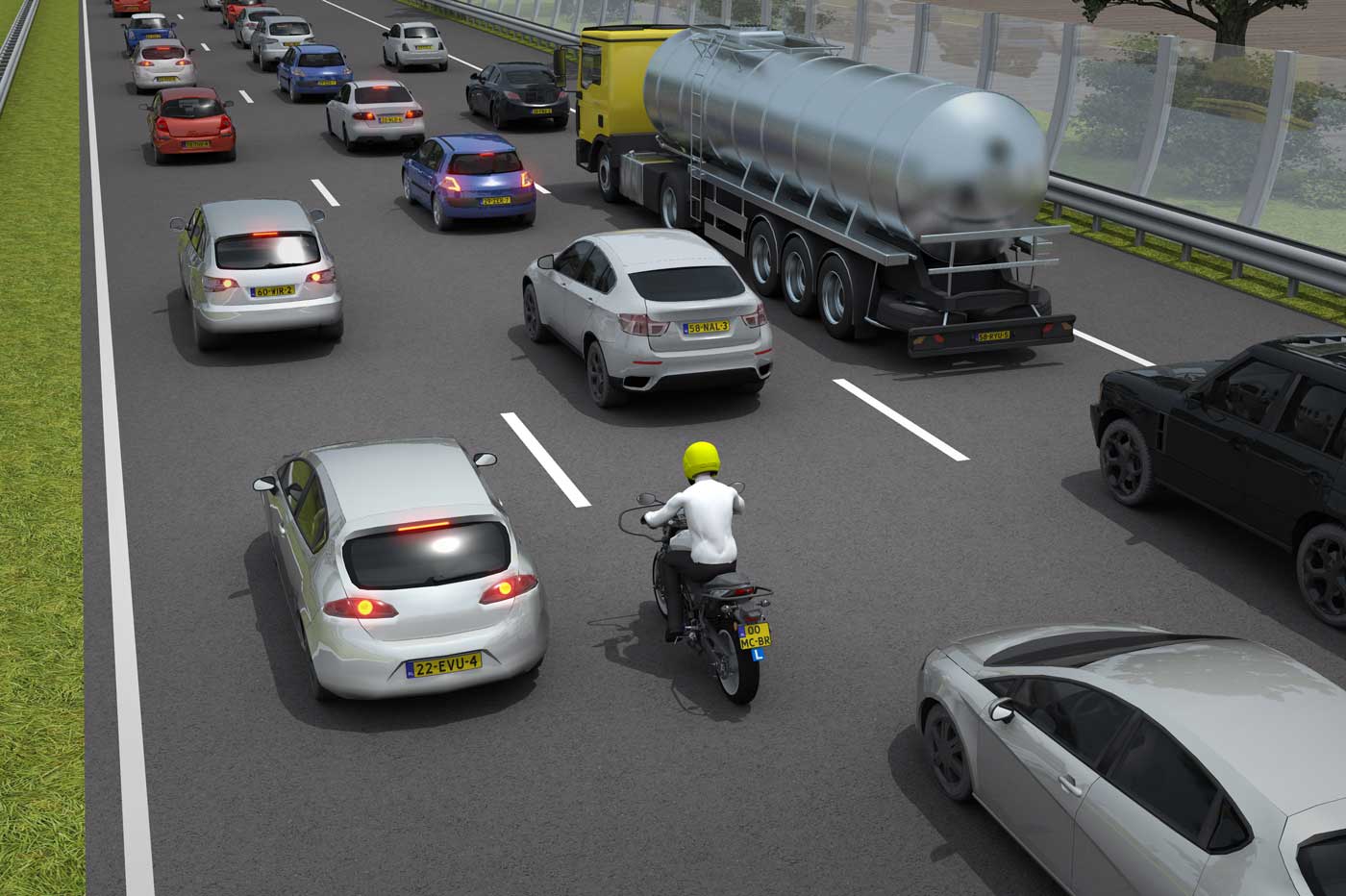
Only use the passage between lane 1 and 2. In addition, do not use hazard lights and ride a maximum of 10 km/h faster than the other traffic. Keep in mind that drivers do not expect you.
Riding in the mountains
A lot of motorcyclists love to tour in mountainous areas. The often winding roads make the motorcycle stand out even more here. But riding in the mountains does require a slightly different riding style than riding on the Dutch roads or motorways.
Always make sure that your motorcycle is top condition before going on longer tours, especially when you are going to ride in the mountains. This requires a little more from your motorcycle than riding on flat surfaces. Double-check your brakes and replace the brake pads if they are worn too much.
Do not brake more than necessary. You do this by choosing a lower gear than you would normally expect while descending. As a rule of thumb, you can assume that you choose the same gear as when riding up this same stretch. This ensures that the motorcycle brakes more on the engine and you therefore have to brake less. Long descents where you must continually brake, could cause overheating. Due to this, the motorcycle brakes less effectively and the brake pads wear a lot more.
In addition, pay extra attention to other traffic. Especially in sharper bends, it is sometimes unexpected how much space you and other traffic needs to negotiate that bend. In addition, in the mountains, the rule applies that if you cannot ride through a situation at the same time, ascending traffic may go before descending traffic. This prevents that drivers come to an unexpected standstill on an uphill slope. Standing still and riding off again on a descent is a lot easier than on an uphill slope. Therefore, always look through the bends well and check if there is enough space to ride through the entire bend. Maintain enough distance and prevent that you must stop in the bend itself. Stopping in bends increases the risk of falling over.
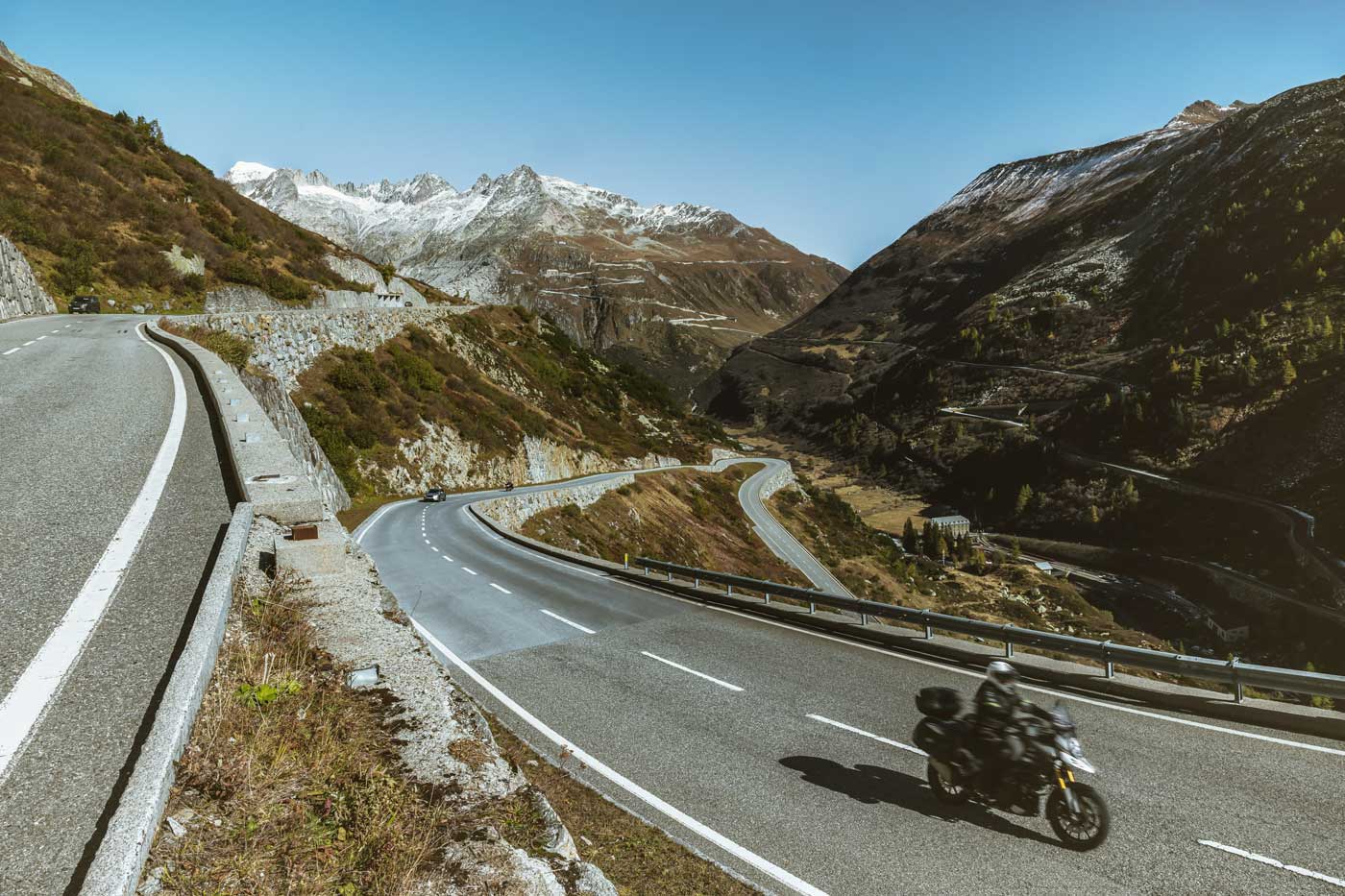
A lot of motorcyclists love to ride in the mountains. Do make sure you know what to look out for.
Reacting to unexpected situations
That you are more vulnerable as a motorcyclist is well known by now. but how do you handle unexpected situations as a motorcyclist? To learn this, there is a separate exam for vehicle control (AVB-exam) for motorcyclists. A good control over the motorcycle is namely the first step. But getting on the motorcycle with the correct attitude is just as important. In short, safe riding comes down to this:
- Maintain your motorcycle properly and get on well rested.
- Be aware of the risks and do not seek out these risks unnecessarily.
- Learn to predict what others will do, but do keep some space when things turn out differently. Do not be surprised.
- Ride visibly and predictable, avoid riding in blind spots.
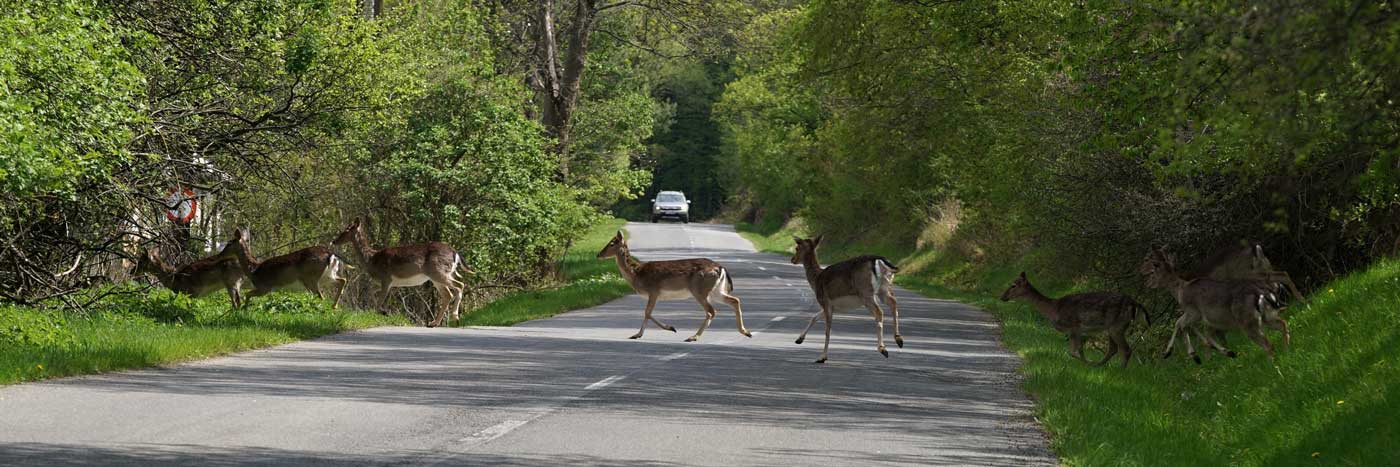
Swerving
Even if you properly follow these points, unexpected situations can arise. Always react defensively to this, getting even is less important than getting home in one piece. If you must swerve, try to do this with the lowest speed possible. Thus, if you have space to brake first, then do so. If braking prevents you from having to swerve at all, this is preferable but making an emergency stop is not without danger. In addition, always make sure you have released the brake as soon as you swerve.
How you react to unexpected situations is reflected in a number of exercises of the AVB section, namely the braking exercises, the deceleration exercises and the swerve exercise.