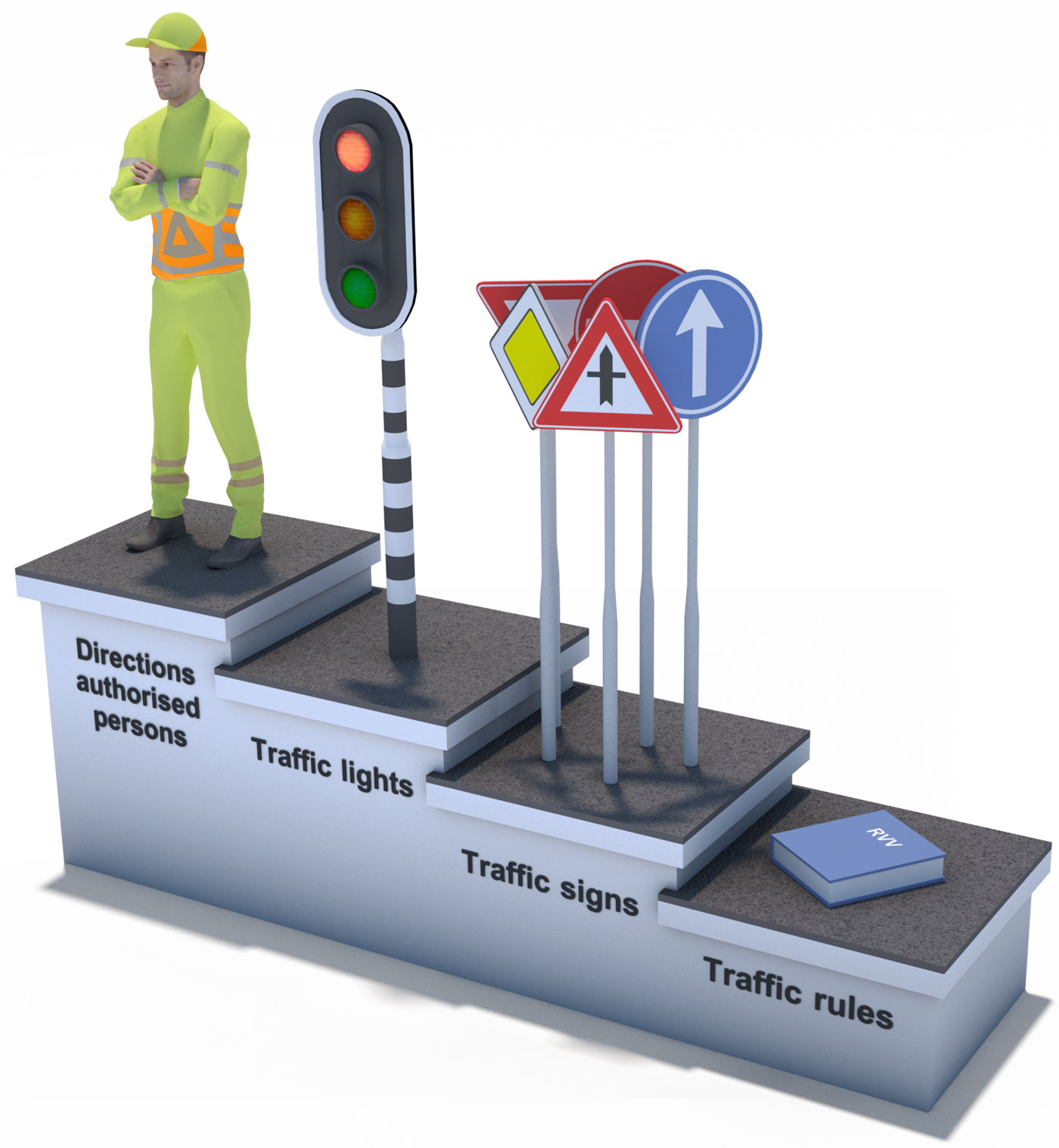

Traffic signage
Traffic signs include:
- road signs;
- road markings on the road surface (such as lines and priority triangles);
- traffic lights.
All road users must adhere to the traffic signs that contain an obligation (obligatory action) or a prohibition (prohibited action).
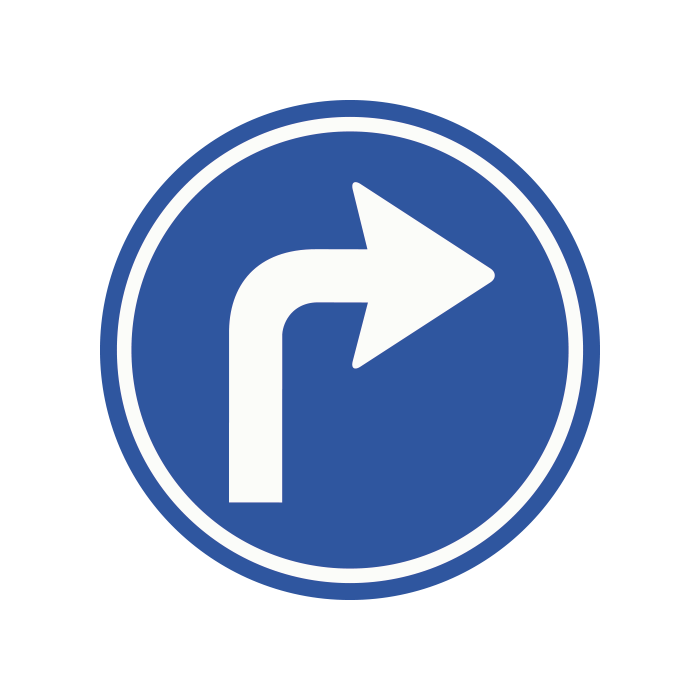
Obligation signs are mostly blue (you must turn right here)
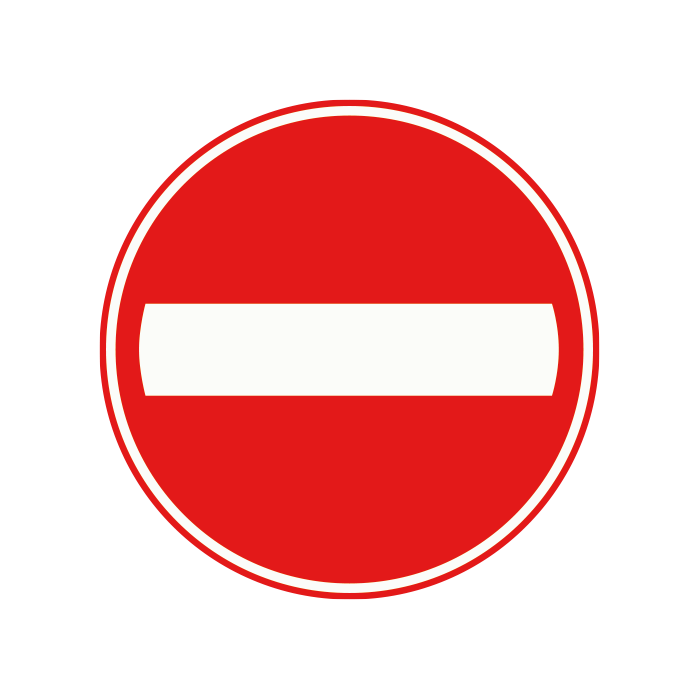
Prohibition signs are mostly red or have a red edge (you are not allowed to enter here)
Traffic signs supersede traffic rules, as far as these signs and rules refer to the same situation.
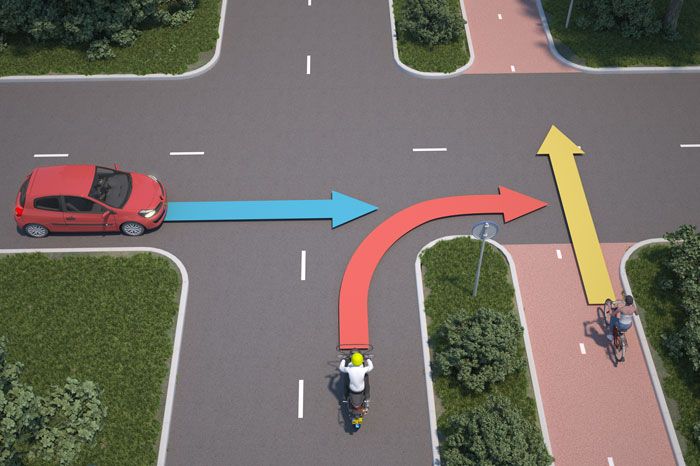
Situation 1, no traffic signs. The cyclist may go first, then the motorcyclist and lastly the driver of the red car.
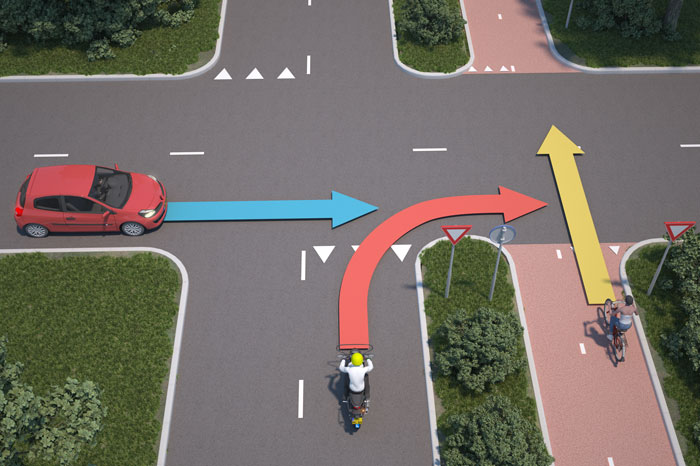
Situation 2, with traffic signs. The driver of the red car may go first, then the cyclist and lastly the motorcyclist.
Are you the motorcyclist, then you are dealing with two traffic rules in situation 1:
- Drivers give way to drivers coming from the right.
The driver of the red car gives way to you and the cyclist. - Through traffic on the same road goes before traffic turning off.
You give way to the cyclist that is continuing straight on.
In situation 2 you encounter sign B-6 and priority triangles, that indicate that you must give way to drivers on the intersecting road.
- The rule ‘drivers give way to drivers coming from the right’ expires.
The driver of the red car does not have to give way to you and the cyclist. - Through traffic on the same road still goes before traffic turning off.
You must still give way to the cyclist that is continuing straight on.
Temporary signs
Sometimes temporary signs or road markings are placed. For example, during roadworks. There, you can encounter both white (normal) markings as well as yellow (temporary) markings. Yellow road signs can also be placed. In that case, the yellow traffic signs apply instead of the normal ones.
During roadworks where yellow lines are applied on the road surface, lanes could be narrower and therefore the speed limit is often lowered. If there are multiple lanes, then the left lane is often narrower than the right lane.
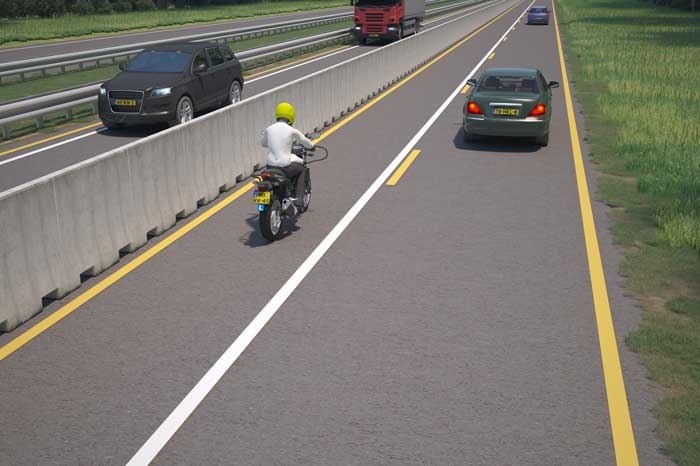
The yellow lines indicate that the lanes have been moved. The speed limit is often lowered, and the lanes (especially the left lane) may be narrower.
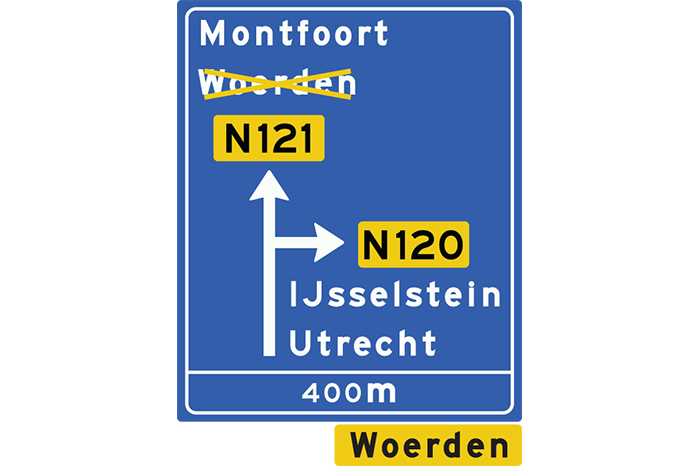
The road straight ahead to Woerden is closed. To go to Woerden you now have to (temporarily) turn right.
Electronic matrix signs
The electronic matrix signs also fall under traffic signs that may contain an obligation or a prohibition. They could indicate a speed limit, or, for example, a prohibition to use the lane, or they could indicate that the rush hour lane is open.
If a different speed is indicated on the electronic matrix signs than on the traffic signs along the road, then the lowest indicated speed applies. Usually this is the speed indicated on the electronic matrix signs. What is displayed on an electronic matrix sign above a lane, only applies to that lane.
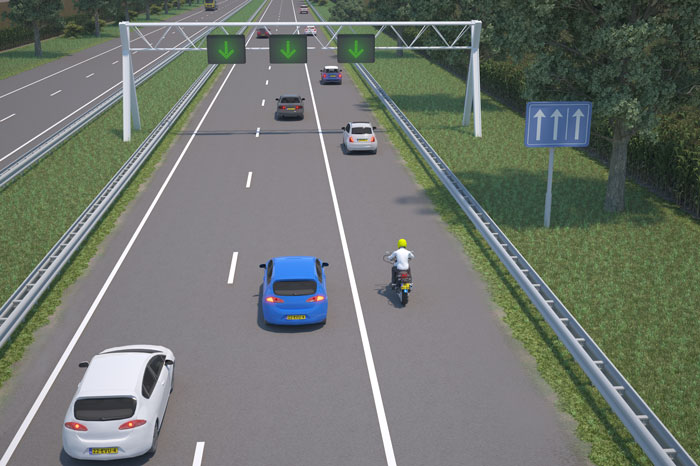
All lanes are opened. This can be seen by the green arrows above the lanes and the sign next to the road.
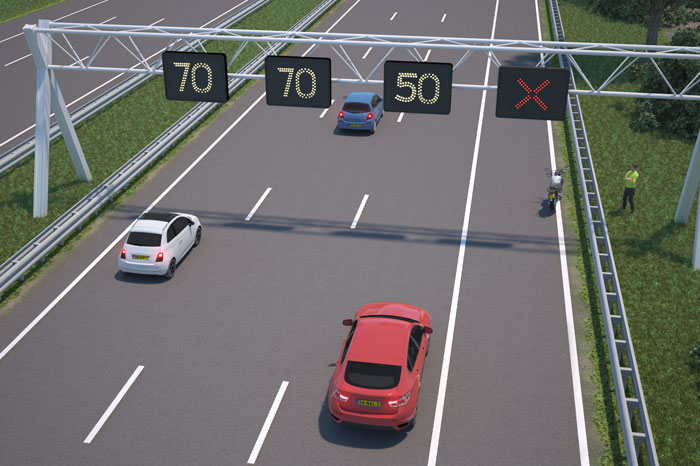
In this case, the hard shoulder is closed because a vehicle has broken down and is stationary on it. For safety reasons, the lane next to the hard shoulder has a lower speed limit than the two other lanes.
Traffic lights and priority signs
If there are working traffic lights present, then these traffic lights supersede other traffic signs. Priority signs and markings no longer apply. Only when the traffic lights are out of order, do the traffic signs and road markings apply again.
Do note! There are some traffic rules that still apply, even at traffic lights:
- Through traffic on the same road goes before traffic turning off.
- The short bend goes before the long bend.
If two drivers are approaching each other and want to turn into the same road, then the driver turning right goes before the driver turning left.
If you want to turn off at a traffic light with a round lamp instead of an arrow, you may have to deal with traffic coming towards you or next to you that have a green light at the same time you do. These could be through drivers or drivers turning off, but also pedestrians continuing straight on. In that case, you must give way to traffic continuing straight on.
If you turn left, then you must also give way to oncoming drivers that want to turn right, or that want to continue straight on.
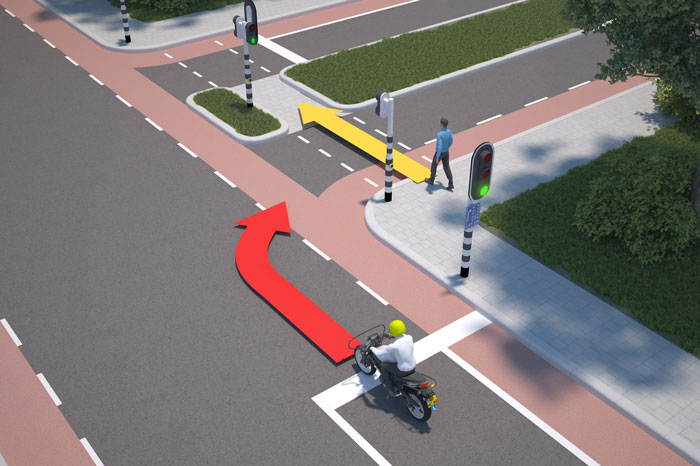
The motorcyclist and the pedestrian have a green light at the same time. In this case, the motorcyclist must give way to the pedestrian.
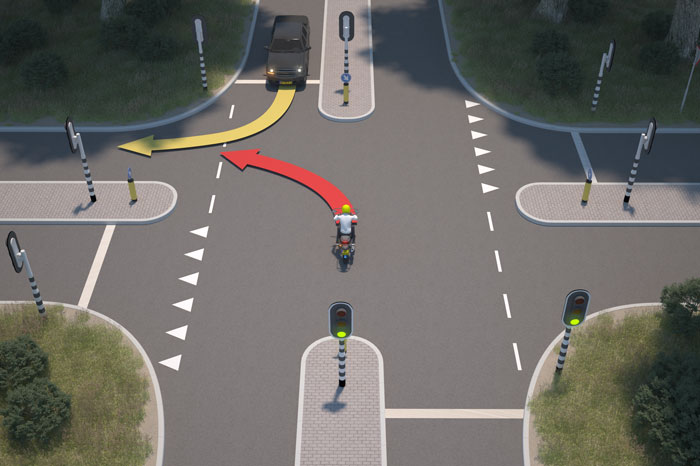
The motorcyclist is turning left at a round traffic light and must wait for the oncoming driver turning right.
Hierarchy directives, signage and rules
Sometimes you will see that rules, signs or directions contradict each other. In those cases, there is a certain hierarchy that you should keep to. The rules are the basis. As soon as traffic signs contradict these, they supersede the rules. As soon as there are traffic lights, the priority signs present no longer apply. And as soon as there is an authorised person giving directions, they supersede all traffic rules, signs and lights.