

Acting in case of breakdowns and accidents
If you are on the public road, then you could encounter a breakdown or accident. It is important to know how to act in these cases.
Equipment
Motorcycles themselves generally have little storage space. If your motorcycle is fitted with side cases and/or top cases, or do you go out on a motorcycle with sidecar or a trike, then it is wise to always carry a few items with you:
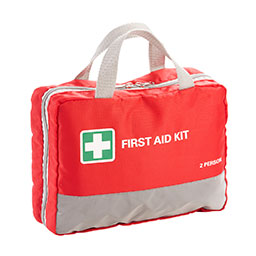
A first aid kit
Not required in the Netherlands, but in some surrounding countries it is. In case of larger injuries, it could be lifesaving if you can at least apply a pressure bandage. If you do not know how to use a first aid kit, then maybe a bystander might be able to do it. A first aid course is always advisable. In addition, regularly check the first aid kit for expiry dates and used things.
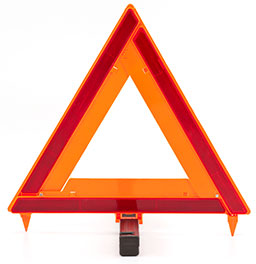
A warning triangle
Sometimes, you come to a stop with your motorcycle in a place where you form an obstacle. In the case that your hazard lights are not working, you are required to place a warning triangle when you are riding a motorcycle on more than two-wheels. This also applies when, even with the hazard lights are on, the vehicle cannot be seen in time. Carrying a warning triangle with you is not required but is advisable if you are going out on a motorcycle with sidecar or a trike.
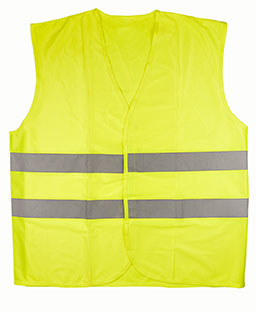
A fluorescent safety vest
With such a vest you stand out more when you are waiting alongside the road. In some countries, wearing such a vest in case of a breakdown or accident is even required for all occupants.
A European damage claim form
In case of an accident, both parties involved fill in their details and an account of the damage so that it can be settled by the insurance company. Fill in the front side together, immediately after the accident. Do not forget the signatures. Divide the two sheets (the original and the carbon copy) between the two parties. You fill in the backside at home, after which you send the form to your insurance company.
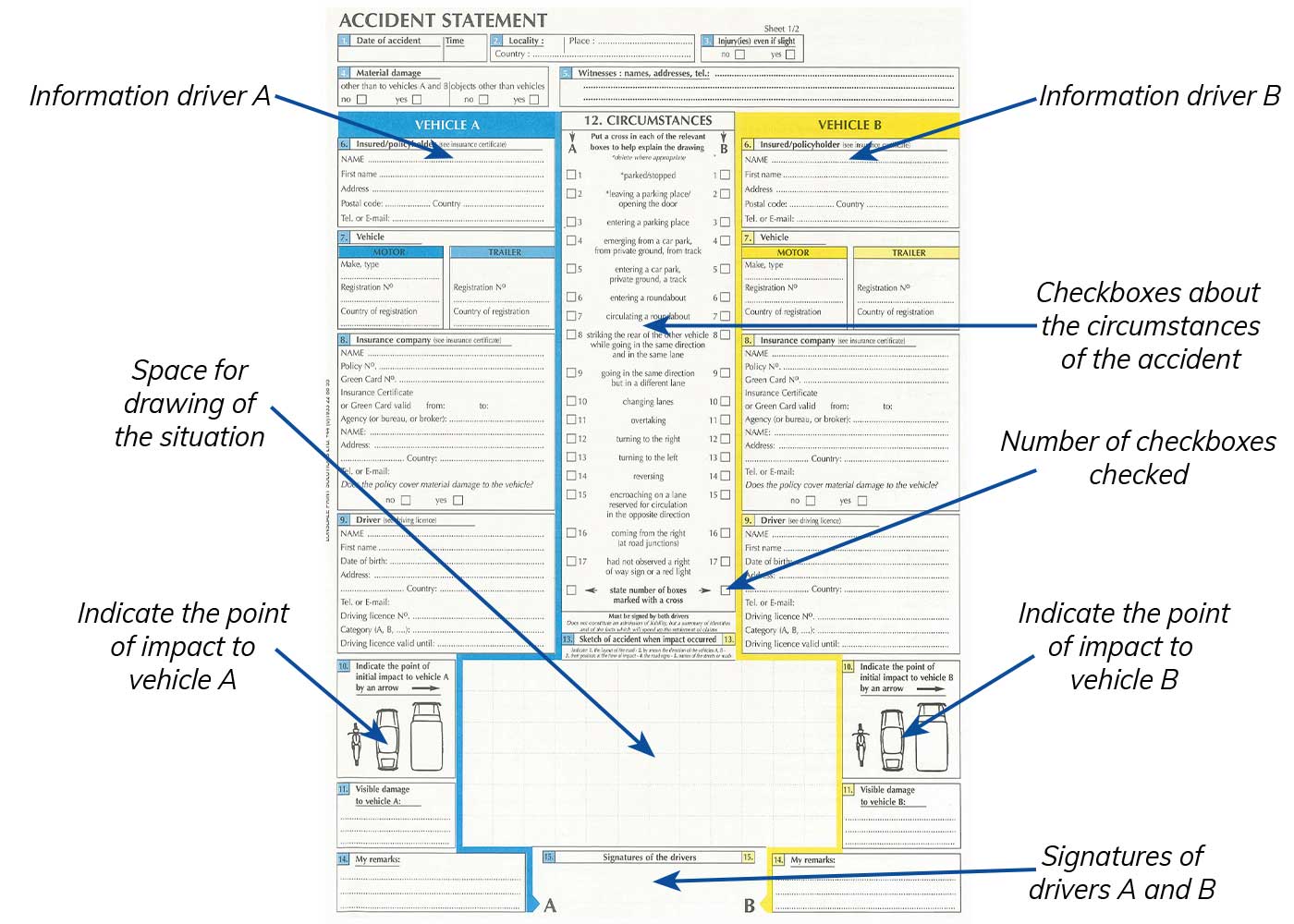
Nowadays, more and more insurers also accept it when you enter the damages in a special damage report app. Even then, it is wise to carry a paper version with you. Not everyone can deal with this digital version, and you will have to fill in the paper version together with the opposing party.
Use of the hard shoulder
The hard shoulder is meant to be used in case of a breakdown or in emergency situations. But the hard shoulder is not a safe place to stay (long). If it is possible, it is wiser to continue riding. If necessary, do this on the hard shoulder, to the next exit, parking lot or petrol station.
If it is not possible and you must stand on the hard shoulder, then stand as far away from the through carriageway as possible. Never stay with the vehicle but look for a safe place, preferably behind the crash barrier. On most motorways, Rijkswaterstaat can close a lane. You can then repair, or have a repair done, more safely, or the vehicle can be towed. Contact emergency services to do this.
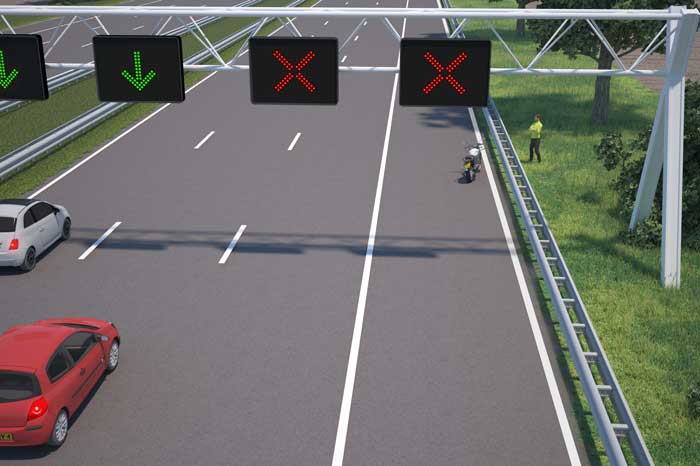
Due to the breakdown case, the lane immediately next to the hard shoulder is also closed.
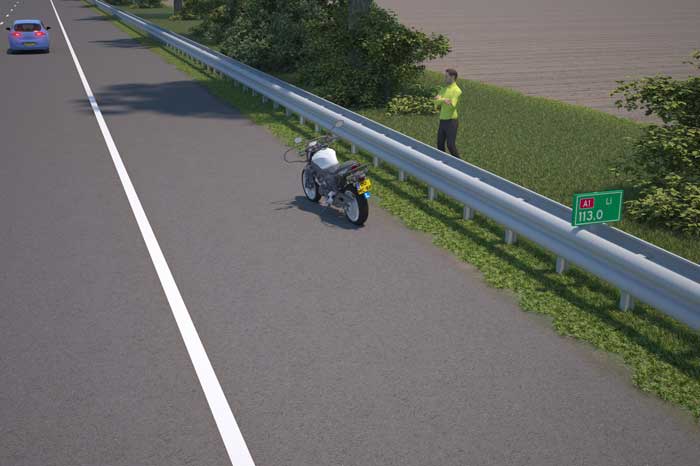
Do not stay on or close to the vehicle if you are stuck on the hard shoulder due to a breakdown. Find a place behind the crash barrier.
Accident or breakdown on the motorway
In case of a breakdown or accident on the motorway, the first thing you need to pay attention to is your own safety. Never cross the carriageway of the motorway, not even when you ended up in the central verge after an accident. Wait in the central verge for emergency services, as far removed from the carriageway as possible. Also never retrieve lost parts from the carriageway but let the police or employees of Rijkswaterstaat do this. Were you involved in an accident, but can you continue riding? Ride to a safe space, such as a parking lot, to deal with the damages.
Rules during breakdown
- Park the vehicle as safe as possible on a parking lot, lay-by or hard shoulder, or in the verge if these are all missing.
- Think of your own safety and of the safety of a possible passenger, preferably wear a safety vest. Together with your passenger, find a safe place to wait, as far from the carriageway as possible.
- If necessary, place a warning triangle and turn on your warning lights. When it is dark or during poor visibility, also turn on your side lights and rear lights (or parking lights).
- Try and fix the problem if you can safely do so or contact emergency or breakdown services. Fixing a vehicle on the hard shoulder is allowed, but not advisable.
- While waiting, do not stand near the vehicle, but wait at a safe distance. For example, behind the crash barrier.
Rules during an accident
In case of an accident, it is important to act in a set order.
- Personal safety: always think of your own safety first. If you get injured, you cannot offer any aid.
- Someone else’s safety: check how the victims are doing and make sure that others do not take any risks.
- Marking the accident site: make sure that it is clear to other traffic that something happened, that way they can adjust their speed and no other accidents happen.
- Notifying emergency services: inform the correct emergency services of the accident and indicate what help is needed.
- Providing necessary aid: if necessary, provide first aid, always let the most qualified person provide first aid.
Extra things to keep in mind are:
- That you are required to help when this is necessary, even if you are not immediately involved in the accident but were a bystander.
- Try to avoid an overload of ‘helpers’ by keeping spectators at bay and keep your distance if there is enough help on site.
- Listen to emergency services, follow their directions and do not get in their way!
Emergency services
In case of (possible) injured people always call the emergency services via the emergency number 112. When calling, tell them where you are and which emergency services you need. In addition, always mention the name of the street, the hectometre sign alongside the autoweg or motorway or a different location indicator of where you are. Perform any actions you are asked to do. Stay on the phone as long as the operator indicates.

If you need to report on which lane of the motorway an accident has happened, keep in mind that you count lanes starting from the central verge. The left lane is the first lane. On a road with three lanes, the right lane is the third lane. It does not matter if the lane is in use or not.
If there is no life-threatening situation, but the police do need to come, or you have a question for the police, then you can call the national police number 0900-8844.
Important phone numbers:
- for emergencies: 112;
- no emergency, but do need police: 0900-8844;
- animal police: 144.
Offering first aid
If there are injured people, never move them without urgent necessity. Urgent necessity means that not moving the victim brings more risk than moving the victim. For example, when the victim lies on train tracks or sits in a car where there is a risk of fire. When the victim is wearing a helmet, the same thing applies. It may not be removed unless leaving the helmet is more dangerous. For example, because the victim is vomiting and cannot breathe due to that.
Make contact with the victim and calm them down. Let the victim move as little as possible and have someone hold their head if there is a risk of neck injuries. If the victim is unconscious, then it is important to check whether they are still breathing. If this is not the case, then let the person with the most medical knowledge administer CPR. Also pass this on to the emergency services. If the victim is breathing but is at risk of vomiting or a different threat to the airways, then put them in the stable side position.
To be able to properly help someone, it is best to follow a first aid course.
One-sided accident
In any accident where no other party is directly involved, but damage is caused to someone else’s property or municipal property, you are obligated to report it. You can do this immediately if you can find the owner, or by calling the police. Driving on without leaving your information is punishable.
In case of a collision involving animals, such as a cat, dog, or a wild animal such as a deer, you are obligated to inform the police. In the latter case, there is a special phone number available for the animal police: 144. This is a separate department within the normal police.
Hazardous materials
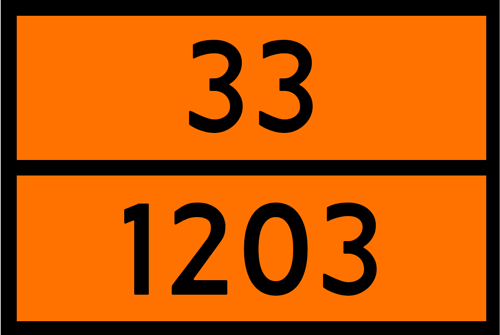
Always pass on the numbers on a plate such as this one to emergency services.
If you are involved in an accident with a vehicle that transports hazardous materials, it is mainly important for emergency services to know which hazardous materials were transported and what the danger of these materials is. Therefore, always pass on the numbers indicated on the orange plate on the lorry.
Towing vehicles
If a vehicle is broken, then you can tow this vehicle with another vehicle. Because towing a vehicle involves additional dangers, there are some rules you need to follow:
- With a motor vehicle, you are only allowed to tow only one other motor vehicle.
- You are not allowed to tow a two-wheeled motor vehicle, and you are not allowed to be towed by a two-wheeled motor vehicle.
- You are not allowed to tow if the distance between the two motor vehicles is more than 5 metres.
- There are not allowed to be persons in the towed vehicle, except for the driver and the passengers that do not fit in the towing vehicle.
- The towed vehicle must be operated by someone who has a driving licence for that vehicle. This towed vehicle both falls under trailers as well as motor vehicles.
As a motorcyclist, you will have little to do with towing, unless you ride a motorcycle with sidecar or a three-wheeled motor vehicle.
Roadworks
In addition to breakdowns or accidents, you could also encounter roadworks. How to ride in that case can be indicated by yellow signs or yellow road markings and stripes on the road surface. In that case, the yellow traffic signs supersede the normal traffic signs. The speed limit is often lowered, not only for the safety of traffic but also of the roadworkers.
Lanes indicated by yellow lines can be narrower, during roadworks on the motorway this is often the left lane. The hard shoulder could also be missing. In that case, temporary lay-bys are constructed. Adhere to the lowered speed, even if the rest of traffic does not.