

Helmet obligation
Drivers and passengers of a moped, motorcycle or three a wheeled motor vehicle must wear a well fitting helmet. It must be properly secured to the head by means of a clasp and it must be provided with an approval mark. The helmet, the strap and the visor may not be damaged. The strap must always be used. Otherwise, to the law this is equivalent to not wearing the helmet. You can get fined for this.
Not all mopeds and motorcycles are subject to a helmet obligation. You do not have to wear a helmet on a cargo moped, when in a brommobiel with a roof or on a three-wheeled motorcycle that is fitted with seatbelts. Think of a trike. On a trike or in a brommobiel, wearing the seatbelts is then required.
Wearing a helmet on a snorfiets is required since January 2023. It is also obligated for a side passenger to wear a helmet, regardless of whether there are seatbelts present in the sidecar. If there are seatbelts present, it is wise to wear them. But it is not mandatory.
It is required for drivers and passengers to wear a helmet when riding. This must be done correctly, so with the chin strap fastened.
Children younger than 12 years: the driver is responsible for the helmet obligation.
Children from 12 years and up: they are responsible for the helmet obligation themselves.
Helmet choice
There are a lot of different helmets to choose from, all with their own advantages and disadvantages.
Full face helmet
The full face helmet is the most covering helmet and with that the helmet that offers the most safety. Important features are the fixed chin piece and the flip-up visor. The more luxurious versions also have a sun visor behind the normal visor, that you can push down during sunny weather.
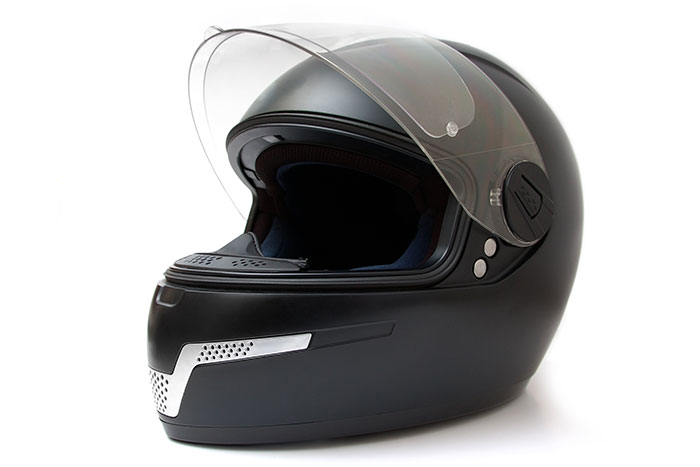
The disadvantages of the full face helmet are the reduced contact with your surroundings because you can hear less, and you can also be heard less well due to the chin piece. In addition to that, the visor fogs up quicker. This helmet is also more troublesome for people who wear glasses.
Modular helmet
The modular helmet is similar to the full face helmet. The only difference is that the chin piece, including the visor, can be flipped up. There is little difference in safety compared to the full face helmet. The most important advantages relative to the full face helmet are the ease at which you can communicate as soon as you flip up the chin piece and the greater comfort for people wearing glasses.
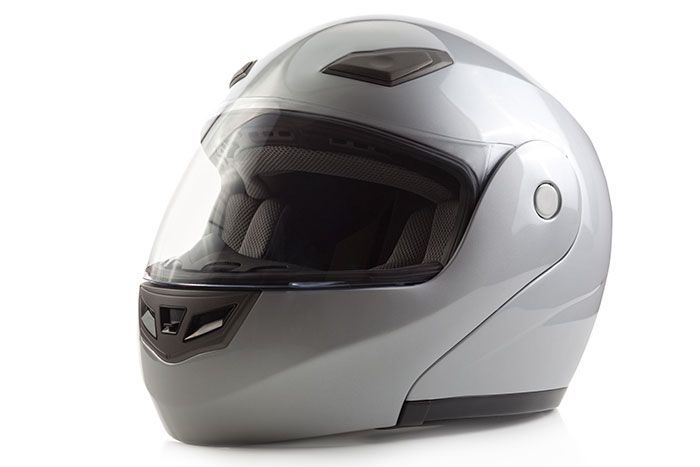
Riding with an opened modular helmet is, depending on the approval mark, often not allowed. A good number of modular helmets are only approved when they are closed. That means that when they are flipped up, they do not have approval and riding like that is then also prohibited.
A few modular helmets are approved both with a closed as well as a flipped up chin piece. Riding with a flipped up chin piece is then allowed with these helmets. You can recognise whether this is allowed by the approval mark.
It may contain, for example, the letter P (Protective). This indicates that the chin piece takes on part of the protection during a fall. If you have the chin piece flipped up, the helmet has less protection which may cause it not to comply with the approval mark.
It could also contain NP (Non-Protective). In that case, the helmet with chin piece does not protect better than the helmet without chin piece. This is of course a less protecting helmet. Lastly, it could also contain the letter J, this stands for ‘Jethelm’ (open face helmet).
If there is a combination of J/P in a modular helmet, then the helmet is both approved with and without the chin piece and you are then also allowed to ride with the chin piece flipped up. Of course, riding with a closed chin piece will be safer.
Open face helmet
An open face helmet is a helmet without a chin piece. Most open face helmets do have a visor, but with old-fashioned (pot)helmets, it may also be missing. Wearing eye protection by means of protective (motorcycle) goggles is then wise. The open face helmet is a reasonably open helmet which also immediately means that in the event of a fall, it protects less of the lower half of the face in particular.
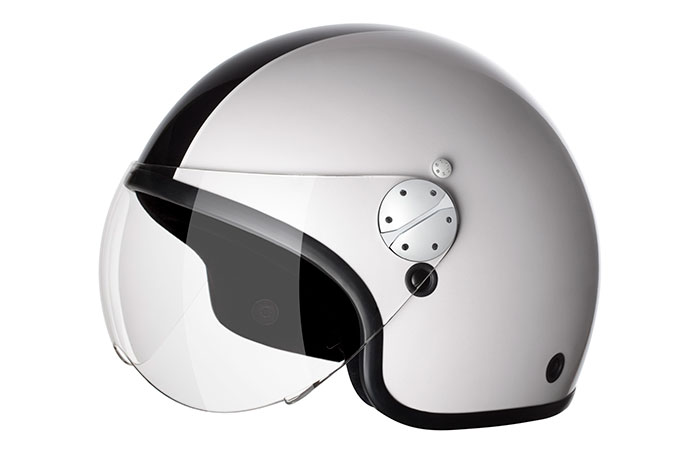
The biggest advantages of an open face helmet are that you feel less closed in and that wearing glasses in the helmet is usually not a problem. Communications is also easier, because the chin piece is missing.
Motorcycle helmet or moped helmet?
Legally speaking, there are no differences between a moped helmet and a motorcycle helmet. Both must comply to the same ECE standard (ECE 22). Yet, most helmets that are sold as moped helmets, are cheaper than helmets that are sold as motorcycle helmets. This has everything to do with the quality of the helmet. The approval mark does not say everything, this is a certain minimum requirement the helmet must meet.
You could say: the more expensive the helmet, the higher the quality. You can see the difference in safety (for example, the amount of protection at higher speeds), but also in the practical usage (a sun visor, a visor that fogs up less quickly and protection against wind noise).
Because the speeds on a moped are lower than on a motorcycle, a moped rider is more likely to choose a cheaper helmet than a motorcyclist.
Most important requirements upon purchase
If you have made up your mind on which helmet you are looking for, then there are a few other things you can and should consider in your decision.
- Choose a well fitting helmet. This means that the helmet is just tight enough to be comfortable but cannot be rotated on the head. Be properly informed in the shop.
- Make sure that the helmet is properly on your head when fitting. The edge above the face should be resting just above the eyebrows and not halfway up your forehead.
- The helmet is not allowed to touch the back of your neck or back when looking up.
- After clasping the chinstrap, there may be a maximum of 2 centimetres of slack between the chinstrap and the chin.
- Always pay attention to the approval mark applied in the helmet. E4 means that the helmet is approved in the Netherlands, every country has its own number. A helmet must at least be approved according to the ECE 22 standard. There is another number behind this, currently this is ECE 22.05 or, the newest one, ECE 22.06. The higher this number is, the newer (and usually stricter) the requirements the helmet meets.
- Keep in mind that a brightly coloured, light helmet is always more visible in traffic than a darkly coloured helmet and therefore contributes to your safety.
Helmet maintenance
Just as the motorcycle itself, you must also maintain the helmet properly. Both the lining (inner shell) as well as the hard outer surface (outer shell) of the helmet take care of the distribution and absorption during a collision. Applying stickers or painting the helmet is not advisable, because it can damage the outer shell of the helmet.
You can also not endlessly use a helmet. Eventually the inner shell will age and harden or become porous and absorb less forces during a collision. In addition to that, the helmet loosens around the head over time. It is advised to replace a helmet every 5-7 years. This period starts from the production date of the helmet.
Damaged helmet
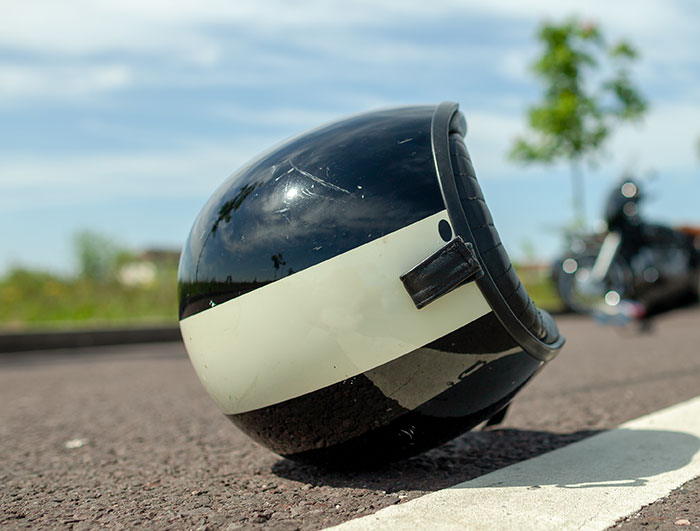
If you have fallen and the helmet hit the ground or another object, it is wise to replace the helmet. Damage to the helmet is sometimes invisible because it could also be on the inside of the helmet. The padding (the inner shell) inside the helmet that is supposed to protect your head in an accident only works well once.
Because protection is no longer guaranteed after an accident, you can no longer use the helmet. This is also why you should be very careful when buying a second-hand helmet. Always handle your helmet properly and prevent dropping it.
Cleaning the helmet
The visor of the helmet must be regularly cleaned to be able to maintain a good view. The best way to clean the visor is with a soft wet cloth. If necessary, leave it on the visor for a while to soak off the dirt. Drying off is also done with a soft cloth. Avoid using paper towels and strong or abrasive cleaning supplies, because it can damage the visor. Possibly use a cleaning agent that is meant for visors. Also regularly clean the outer shell the same way.