

Special manoeuvres
During riding, you sometimes have to perform a special manoeuvre. When performing a special manoeuvre, you must give way to all other traffic. Special manoeuvres include:
- Riding off
By this we mean riding off after having parked or, for example, having stopped on the side of the road. Riding off from a parking space is also included here. - Moving backwards
Moving the motorcycle backwards. - Entering or exiting an entrance or exit construction
An entrance or exit construction is recognisable through a continuing pavement with lowered kerbs or driveway blocks. In a way, you must cross the pavement. The driver that exits a construction preferably goes before the driver entering the construction. - Turning around
Turning the motorcycle around to ride in the opposite direction. - Getting in lane
Entering the through carriageway from the acceleration lane. - Exiting
Entering the deceleration lane from the through carriageway. - Changing lanes
A lateral movement where you move from one lane to the lane next to it.
- Through carriageway
The main carriageway excluding the acceleration lane, deceleration lane and hard shoulder.
Getting on or off
While getting on or off the motorcycle, you are also not allowed to hinder other traffic. Therefore, walk against the flow of traffic before getting on and after getting off the motorcycle.
This way, you can clearly see approaching traffic. Wait to get on or off the motorcycle until it is safe to do so. Make sure that possible passengers do so too.
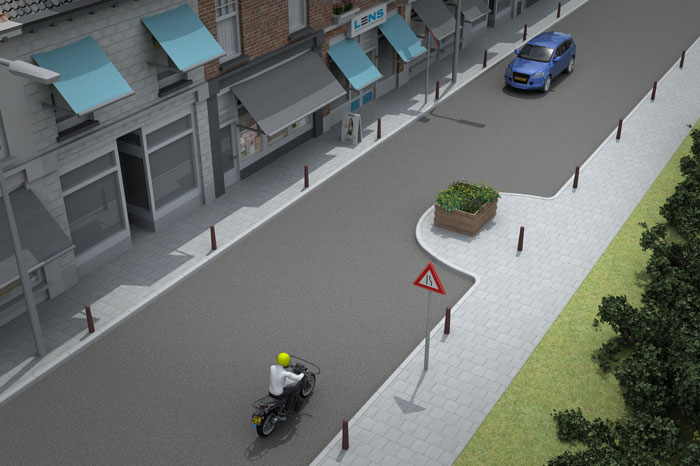
If you must diverge from your riding line, then the oncoming driver may go first.
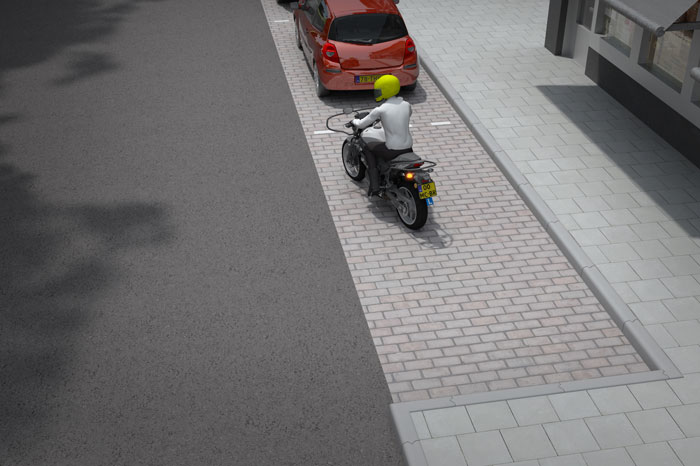
When riding off you must give way to all other traffic.
Lateral movement and swerving
Sometimes you must diverge from your riding line (important lateral movement). For example, because you have to go around something or because you have to pass between a road narrowing. In that case you must give way to oncoming traffic. If you both have to diverge from the riding line, then you arrange among yourselves who gets to go first. In many of these cases there are signs that regulate who may go first.
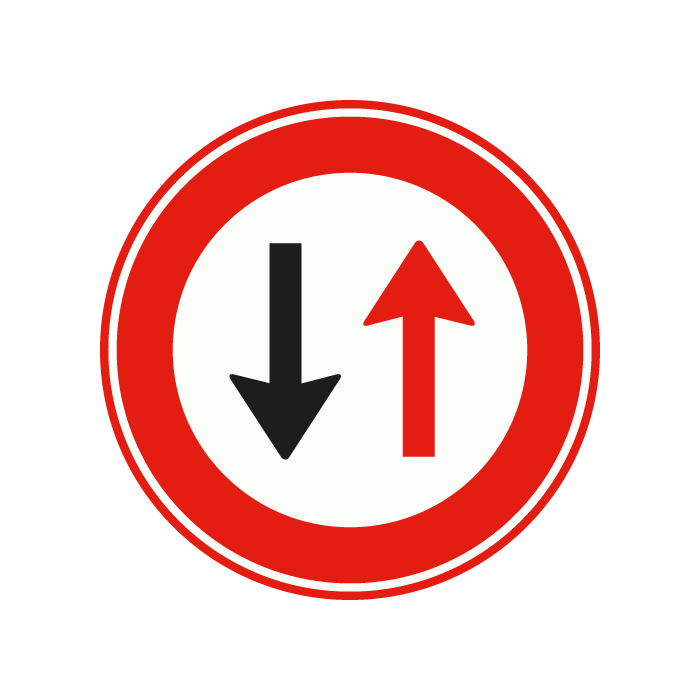
F-5 - If you see this sign, then oncoming traffic may go first. This sign only applies to drivers!
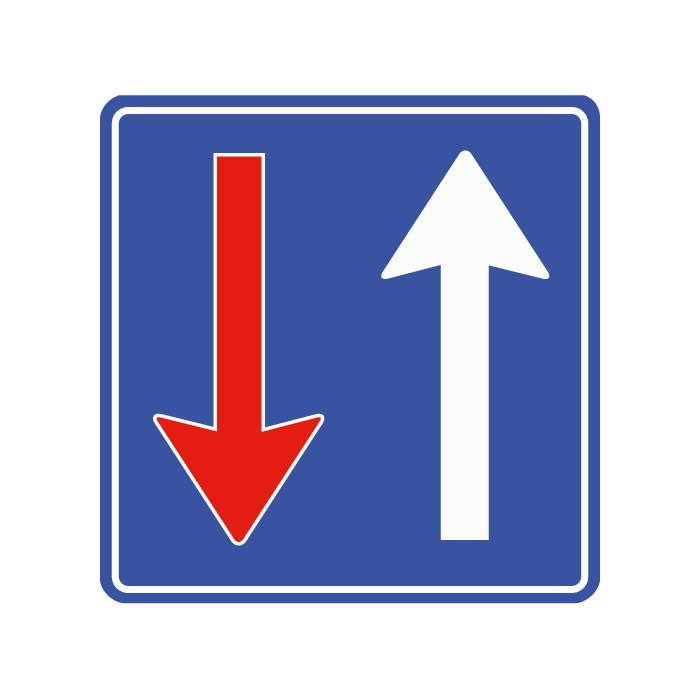
F-6 - If you see this sign, oncoming drivers must give way to you, even if you are a pedestrian.
If you must pass each other on a narrow road, it can happen that someone must enter the verge. Consider that heavier vehicles, such as lorries and passenger cars with trailers, cannot enter the verge. They then are at too much risk of the vehicles sinking or even toppling over. In that case you must make extra space to be able for the both of you to pass each other. As a motorcyclist, it is preferred not to enter the verge while riding! If it gets that far, briefly stop and let the other pass.
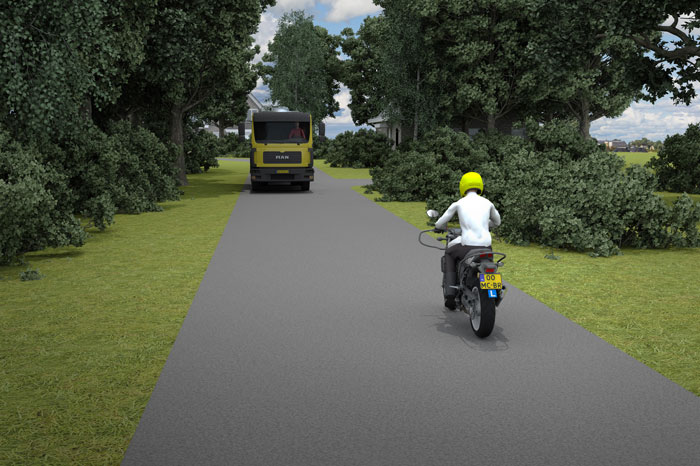
The lorry cannot enter the verge to swerve. You must swerve here. If you must enter the verge, then briefly stop.

If you both want to switch lanes, then it is preferred that the exiting driver goes first. They usually have a higher speed. As a motorcyclist, try and not get in these kinds of situations. Here, you are riding in the blind spot.
Getting in lane and exiting
At combined acceleration and deceleration lanes (weaving lanes) it is preferred that the exiting driver goes before the driver getting in lane. They often travel at a higher speed.
As a motorcyclist, always keep in mind that you are poorly seen, and the exiting driver usually does not take into account a fast motorcyclist coming to overtake them on the right. Try and avoid these situations as much as possible by adjusting your speed in time to make sure that you emerge well ahead or behind a vehicle at the height of the blocked markings.
Indicating direction
To make sure that other traffic knows what you are about to do, it is required to indicate direction when:
- riding off;
- overtaking other motor vehicles;
- getting in lane;
- exiting;
- changing lanes;
- performing important lateral movements.
- Important lateral movements
This is that you must move so far left or right, that it is important for the safety of other traffic that they know this in advance.
Indicating directions when overtaking a cyclist or moped rider is not required, because these are not motor vehicles. But if you must perform an important lateral movement to do so, you do have to indicate direction.
Indicating direction is meant to make clear what you are about to do. Do not use it to force others to let you in or let you go first.
Important focus points
When performing a special manoeuvre there are a few things are important:
- The manoeuvre should be as short in duration as possible.
- The manoeuvre should cause as little hindrance to other traffic as possible.
- The traffic safety may not be threatened.
- At the place where you perform the special manoeuvre, it should be allowed to do so.
Performing special manoeuvres is only allowed at places where this is allowed. You are not allowed to turn around, stop or reverse on the motorway or autoweg. Reversing and turning around on a one-way street is also not allowed.
Sometimes you must stop before or during the special manoeuvre. Only do this in places where you are allowed to stop.
In addition to that, turning around could also be prohibited through a sign (F-7, turning ban).
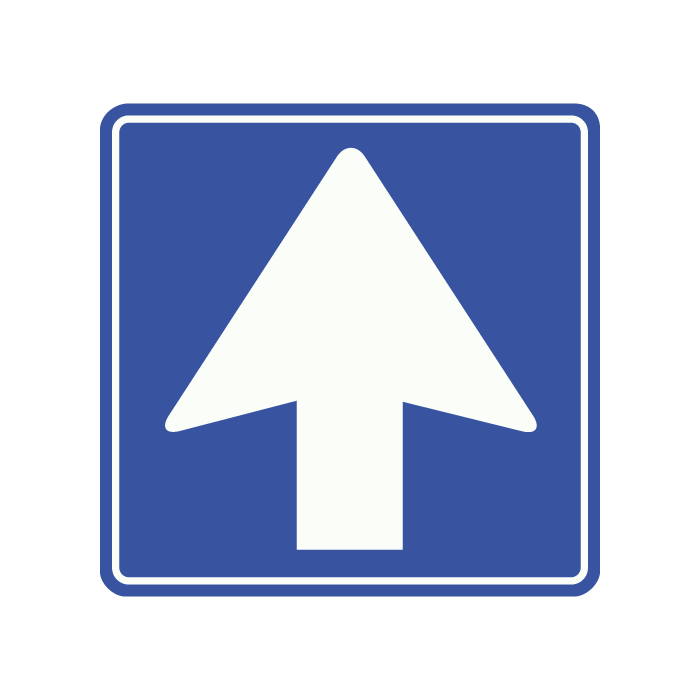
C-3 - One-way street, you are not allowed to turn around or reverse here.
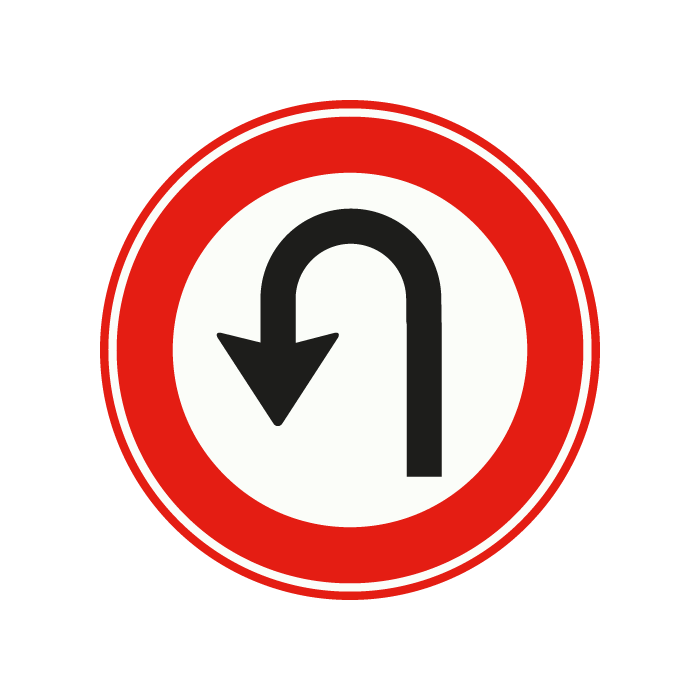
F-7 - Turning ban.
A bus driving off
Normally speaking, drivers must give way to all other traffic. There is one exception to this rule: you must give way to the driver of a bus, when they indicate direction to leave a bus stop within the built-up area.
This only applies when this bus driver indicates this with their indicator. It does not matter whether it is a touring car or public bus, it applies to all buses. Outside built-up areas, this rule does not apply, and the bus driver must simply wait.

The motorcyclist must give way to the bus driver because they indicate to leave the bus stop within the built-up area.

The motorcyclist does not have to give way to the bus because it is indicating to leave a bus stop outside the built-up area.
Embarking and disembarking passengers
There are tram or bus stops where passengers must embark or disembark in the middle of the road. Then, do keep in mind whether there is a refuge or central verge where passengers can wait. If this is not the case, then you must give way to passengers that cross the carriageway. If there is a refuge or central verge, then you do not have to give way to them.
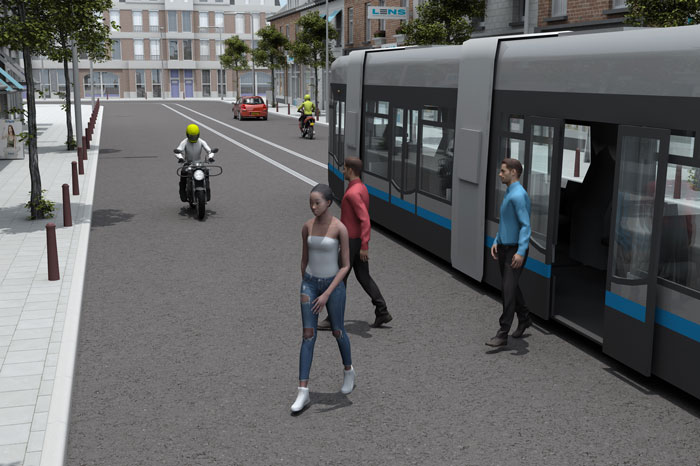
The tram passengers do not have the possibility to wait on a refuge. The motorcyclist must therefore give way to them.
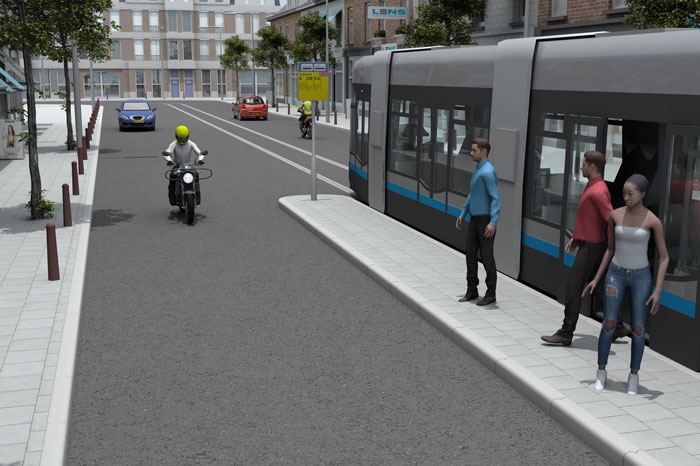
In this situation there is a refuge present where passengers can wait. The motorcyclist may therefore continue riding.