

Behaviour when turning off
If you do not want to continue straight on at an intersection, but want to turn left or right, then you have to deal with several more traffic rules. You must then give way to more road users than when you continue to go straight on. Also keep in mind the road users in the blind spot.
- Blind spot
The area next to and behind the vehicle that cannot observed via the mirrors. This area is only (and sometimes just partially) observable by turning your head and look well beside and behind you. With bigger vehicles the blind spots are bigger, and the number of blind spots increase, for example, right behind and in front of the vehicle.
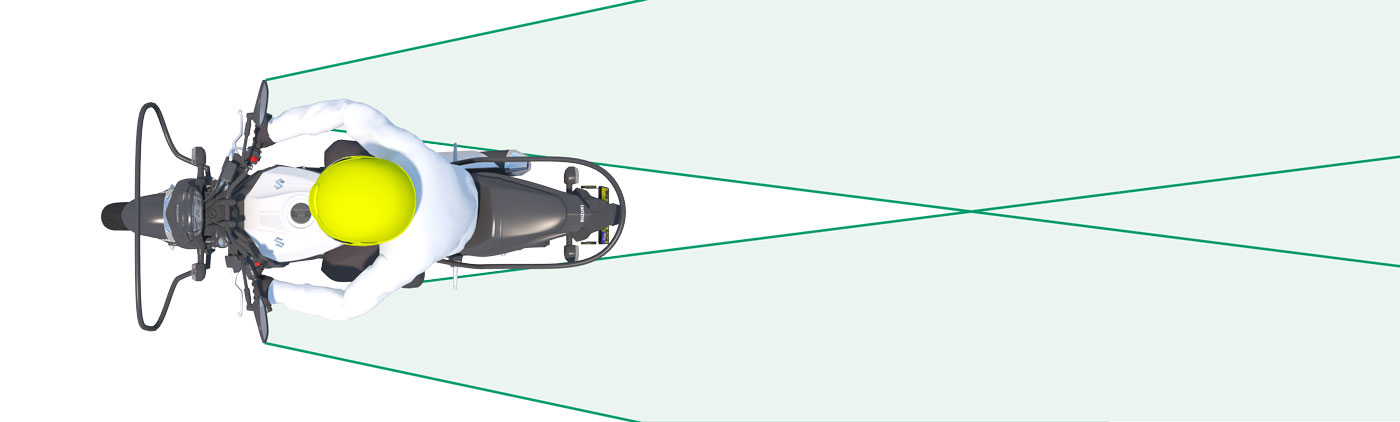
The coloured section is observable through the mirrors. Outside the coloured section is not observable through the mirrors, you should turn your head to be able to see here.
Giving way
Once at the intersection, the following rules apply:
- You must give way to through traffic approaching you on the same road. Including pedestrians!
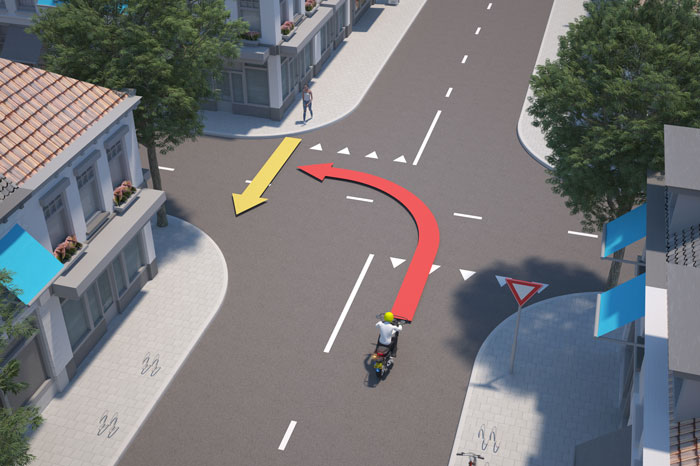
The motorcyclist must give way to the pedestrian. After all, the pavement also belongs to the road.
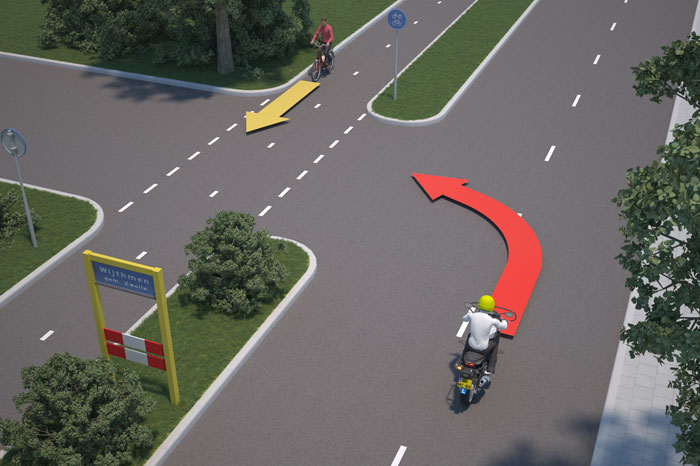
The motorcyclist must give way to the cyclist. They are on the same road as the motorcyclist, even though the cycle path is separated.
- You must give way to through traffic that is besides, or slightly behind, you. Including pedestrians!
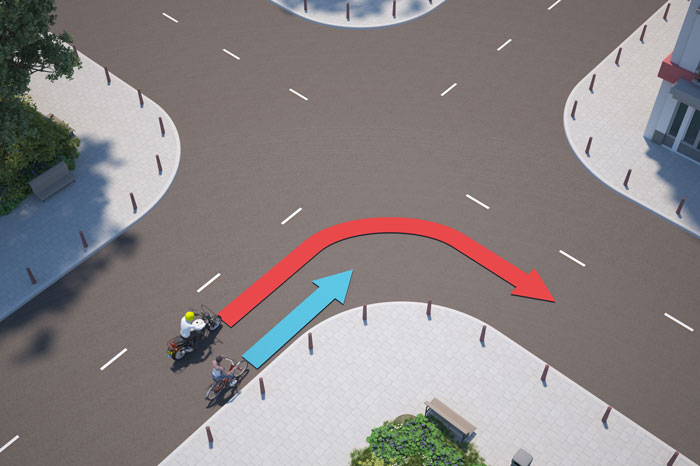
The cyclist next to the motorcyclist is continuing straight on and may go before the motorcyclist. Try to avoid these kinds of situations by adjusting your speed in time.
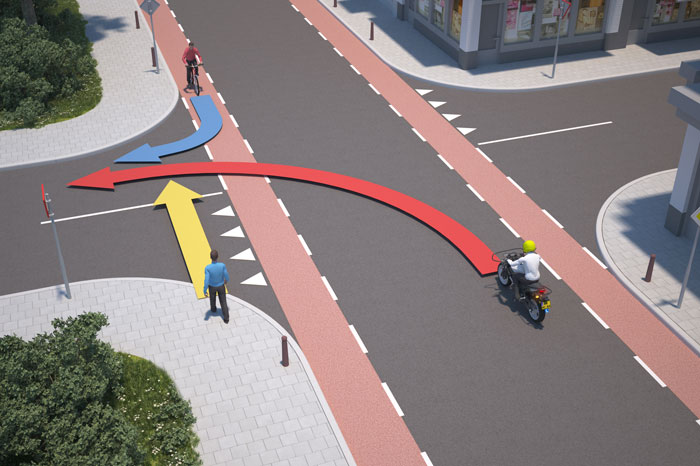
The pedestrian is continuing straight on the same road as the motorcyclist and the cyclist. The pedestrian may therefore go before both drivers.
- If oncoming drivers want to enter the same road as you, then the driver that is turning right goes before the driver turning left. This is also referred to as ‘the short bend goes before the long bend’.
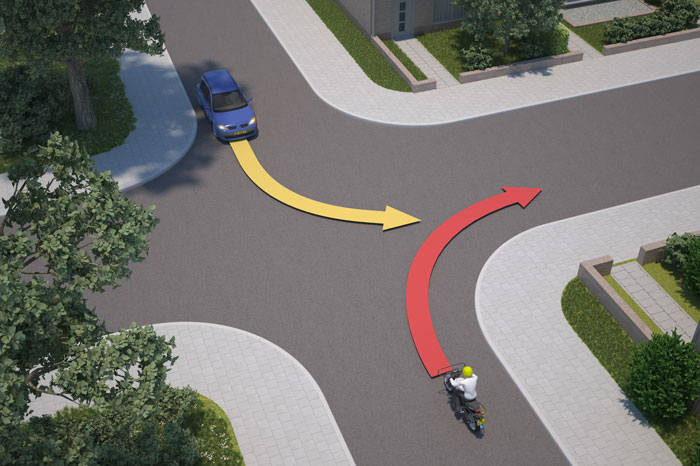
The motorcyclist has the short bend. The driver of the blue car must give way to the motorcyclist.
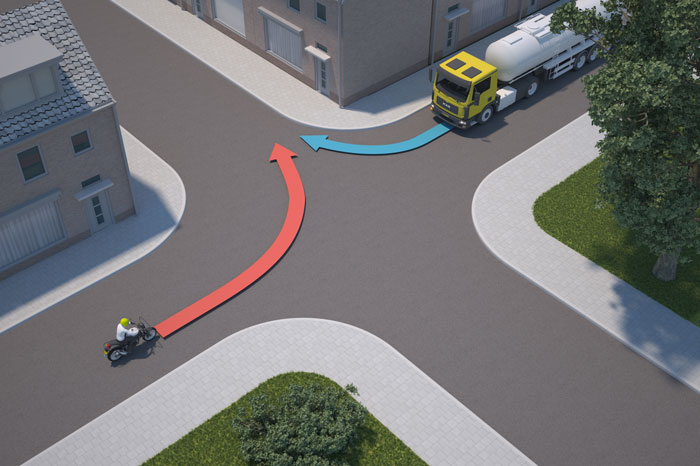
The driver of the lorry may go before the motorcyclist. The lorry has the short bend.
- A tram turning off may go before all other traffic that approaches it from the front or back.
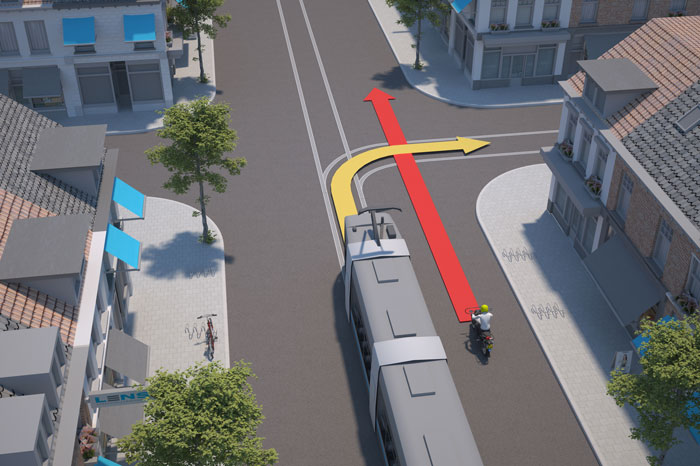
A tram turning off may always go first. The motorcyclist must wait in this situation.
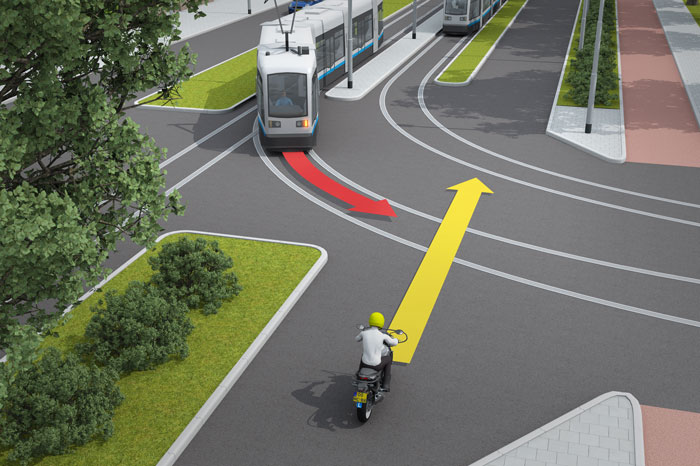
It does not matter whether the tram approaches from the front or back. Here, the tram may also go first.
Diverging priority road
Some priority roads do not run straight but diverge. These diverging priority roads must be seen as the through road. If you leave this road, then we speak of turning off. Only then the rules ‘through traffic on the same road goes before traffic turning off’ and ‘short bend goes before the long bend’ apply.
This can be confusing, because there is a bend in the road. Try to imagine that the priority road is straight, with on or more side roads. Drivers on the diverging priority road are, relative to the side road, intersecting drivers. They therefore have priority over the drivers coming from the side road.
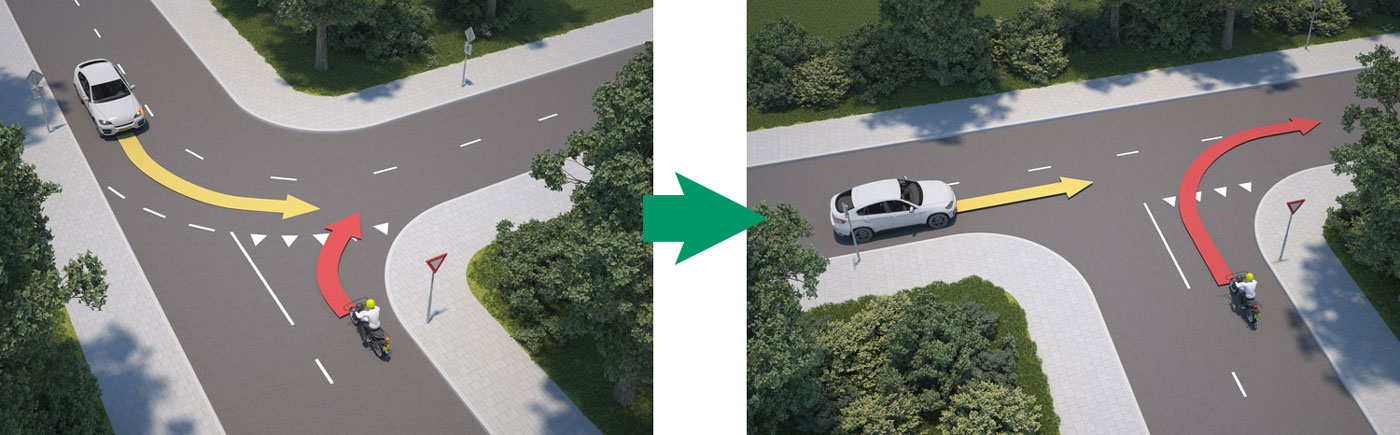
If you encounter a diverging priority road, try to ‘straighten’ it in your head before applying the priority rules. Diverging priority road should be seen as the through road. In these two situations the priority is the same, the motorcyclist must wait for the car because the car is driving on the priority road.
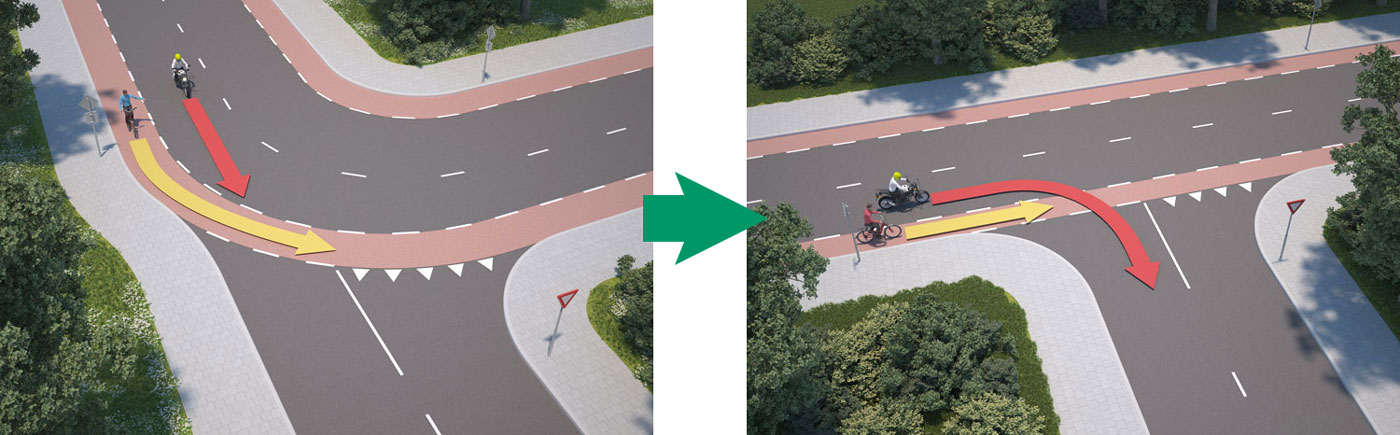
In these two situations the rules for giving way are also the same. The cyclist may go first in both situations. The cyclist is ‘through traffic’ even though it looks like they are turning off in the first situation. But the cyclist keeps following the priority road, just as in the second situation. The motorcyclist is turning off in both situations.
Within the priority rules, continuing to follow a diverging priority road does not count as turning off. However, it is expected of you that you indicate direction when you keep following the road. It is then clear to other road users that you keep riding on this road.
Diverging priority roads are usually indicated with supplementary signs under the sign ‘priority road’ or ‘priority intersection’. On these signs, the thick line indicates the priority road, and the thin line or lines indicate the side roads that must give way.
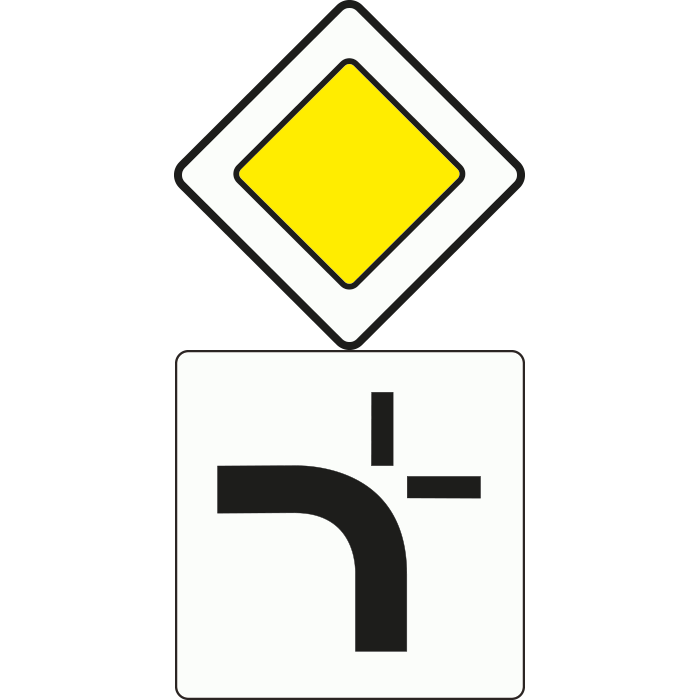
B-1 with supplementary sign - Diverging priority road to the left with two side roads.
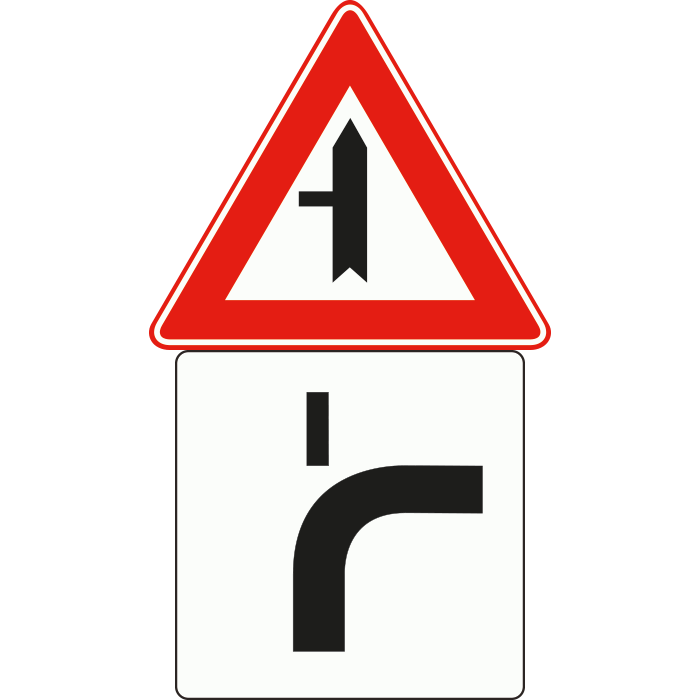
B-4 with supplementary sign - Diverging priority road to the right with just one side road.