

Behaviour on intersections
Various rules have been established for when you encounter other traffic on intersections. For this, you must understand the difference between road users (all traffic, including pedestrians) and drivers (all traffic, except pedestrians). Besides that, it is important that you understand the difference between traffic on the intersecting road and traffic on the same road.
- Intersection
Gathering of roads. On an intersection it is possible to change direction. Meaning that you can turn left or right. Intersections can be shaped in many ways.
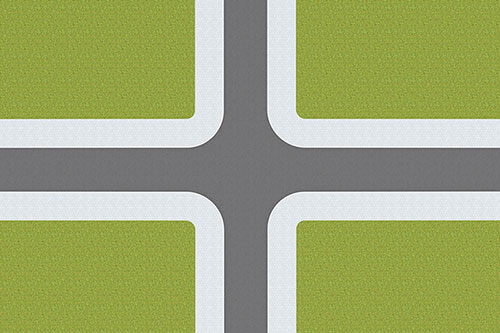
Normal intersection
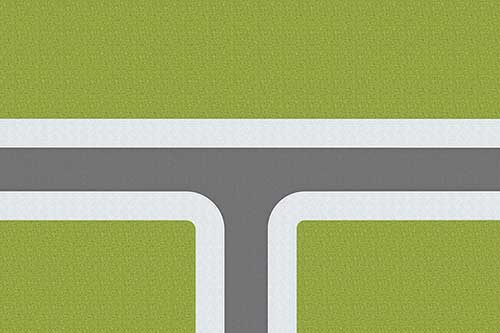
T-junction
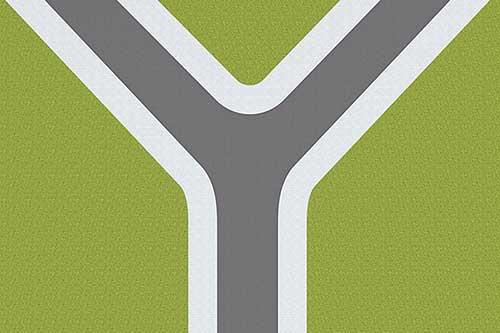
Y-junction
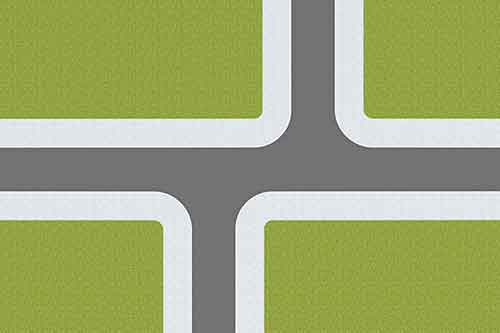
Bayonet intersection
- Intersecting road
This is the road that intersects your road. It does not necessarily have to be on a 90-degree angle. It could also be a road that connects at an angle to the road you are on, such as at a Y-junction.
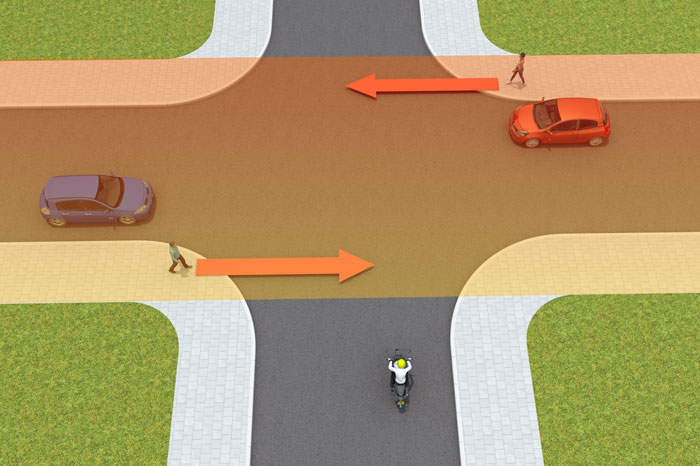
Relative to the motorcyclist, the coloured section is the intersecting road.
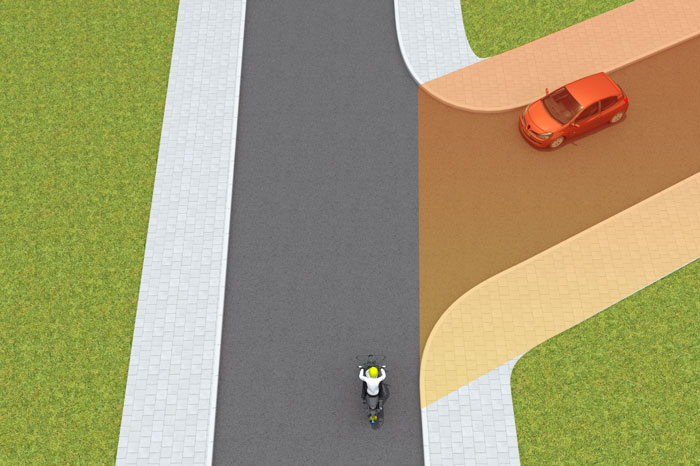
Relative to the motorcyclist, the coloured section of the Y-junction is the intersecting road.
- The same road
This is the road you are on. Traffic that is on the same road as you, approaches you from the back or front. It does not matter whether they are pedestrians on the pavement or in the verge, or drivers of motor vehicles on the carriageway. If you are riding on a roundabout then all traffic that follows this roundabout, is traffic on the same road.
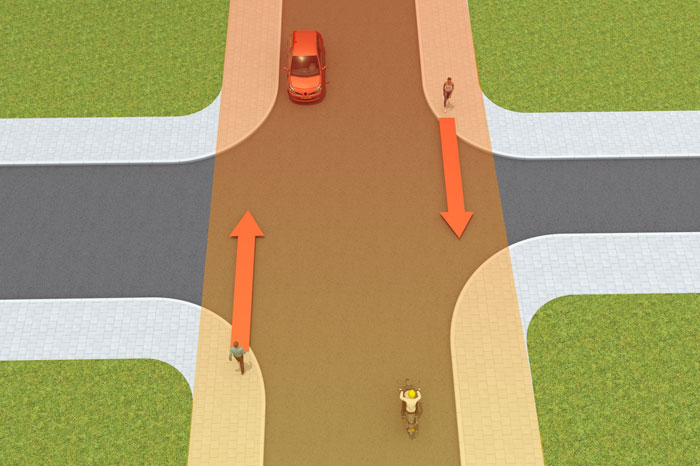
All these road users are on the same road (coloured section).
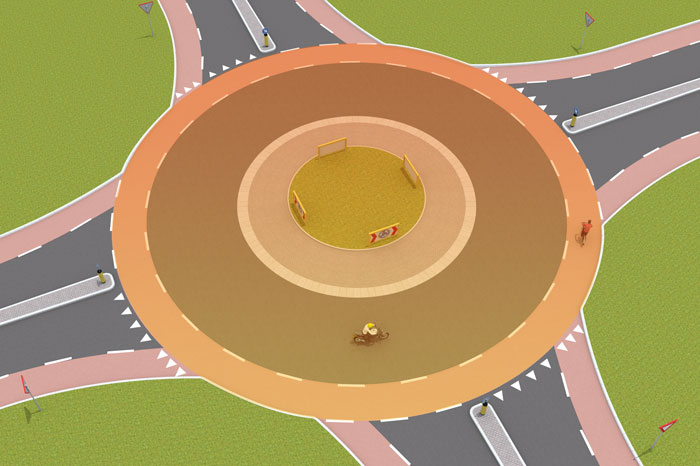
On a roundabout, the entire circular section of road is ‘the same road’. The motorcyclist and the cyclist are therefore on the same road.
- Giving way
Enabling the drivers concerned to continue driving unhindered. This means that the driver that has the right of way, should also feel like they have the right of way. This driver should be able to continue driving unhindered.
Giving way
If the priority on an intersection is not regulated by signs, road markings or traffic lights, then we speak of equivalent roads. On equivalent roads drivers give way to drivers coming from the right.
You therefore do not have to give way to a pedestrian, because pedestrians are not drivers.
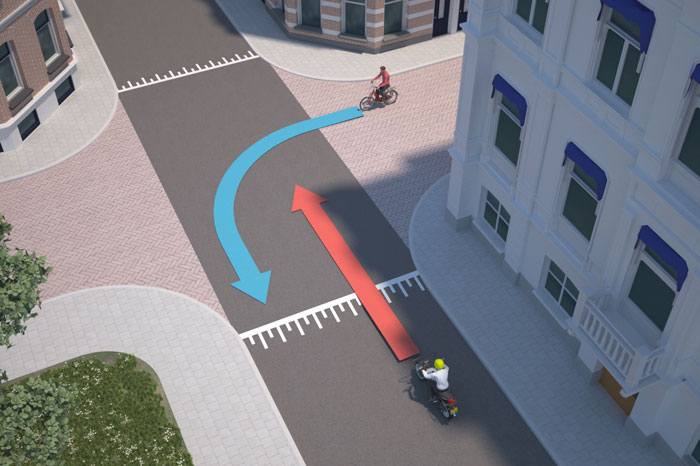
The cyclist approaching from the right has priority over the motorcyclist.

The pedestrian approaching from the right is not a driver and must therefore give way to the motorcyclist.
There are two exceptions to this rule:
- Drivers give way to drivers of a tram.
- Drivers on an unpaved road give way to drivers approaching from the left and right on a paved road.
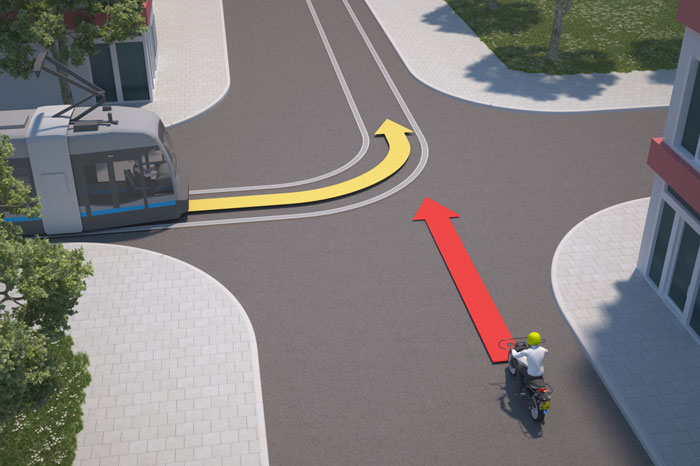
The motorcyclist must give way to the tram, even though it is approaching from the left.
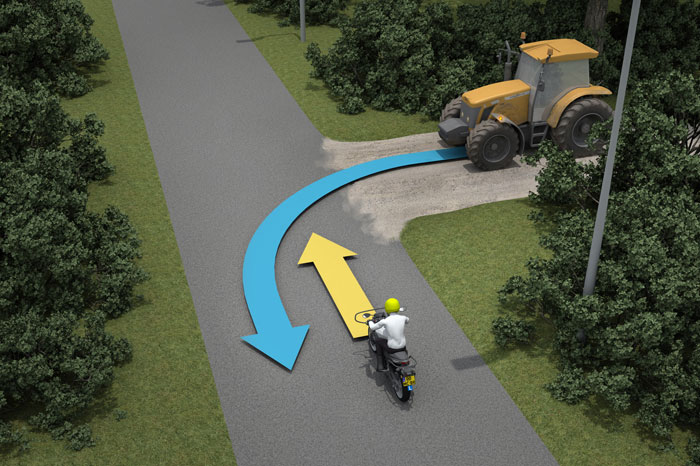
The tractor is coming from an unpaved road and must give way to the motorcyclist on the paved road.
- Priority triangles
-
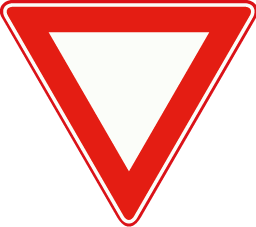
B-6
Priority triangles on the road surface. These are usually, but sometimes without, used in combination with sign B-6. In both cases, the priority triangles mean that you must give way to drivers on the intersecting road.
Priority regulated by signs or markings
If the priority on an intersection is regulated by signs or road markings, then the priority rule ‘drivers from the right have right of way’ is no longer valid. There are different signs that regulate priority.
- Receiving priority – priority road
-
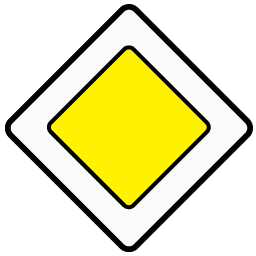
B-1
Sign B-1 indicates that you are riding on a priority road. You must be given way by drivers on the intersecting roads. Inside the built-up area this sign is repeated before every intersection. Outside the built-up area this sign is repeated after every intersection. This way you can see whether you are riding inside or outside the built-up area.
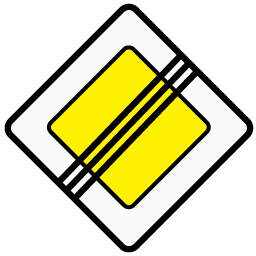
B-2
Sign B-2 indicates the end of a priority road. After this sign, the normal priority rules apply again.
- Receiving priority - priority intersection
-
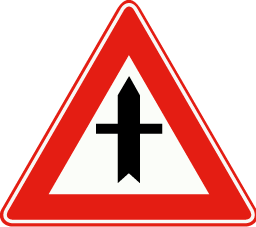
B-3
Sign B-3 indicates a priority intersection where you must be given way by intersecting drivers. The thick arrow indicates the road you are on. The two thin lines indicate the side roads. These signs only apply to the next intersection.
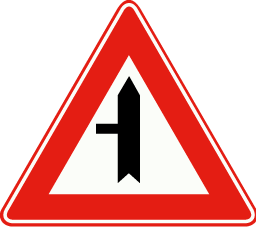
B-4
Sign B-4 indicates a priority intersection with just one side road. This side road is on the left and drivers coming from this side road must give way to you.
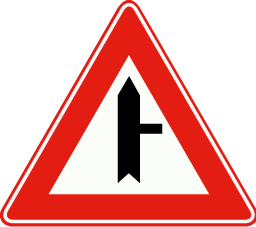
B-5
Sign B-5 indicates a priority intersection with just one side road. This side road is on the right and drivers coming from this side road must give way to you.
- Giving way
-
B-6
Sign B-6 indicates that you are approaching a priority road or a priority intersection from a side road. You must give way to all drivers on the intersecting road. At this sign, stopping is not required if you can see that you can enter the intersection safely in time.
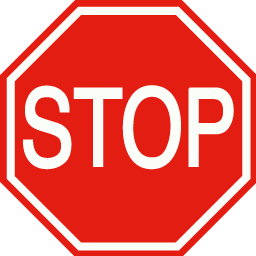
B-7
Sign B-7 also indicates that you are approaching a priority road or a priority intersection from a side road. You must give way to all drivers on the intersecting road. At this sign you must always stop first, even if you can see that no other traffic is approaching. These signs are often placed at places with poor visibility, or where accidents often happen because drivers look poorly.
The difference between the last two signs is therefore that you must always stop at the ‘STOP’-sign.
In addition to that, sign B-6 is always combined with priority triangles and sign B-7 with a stop line.
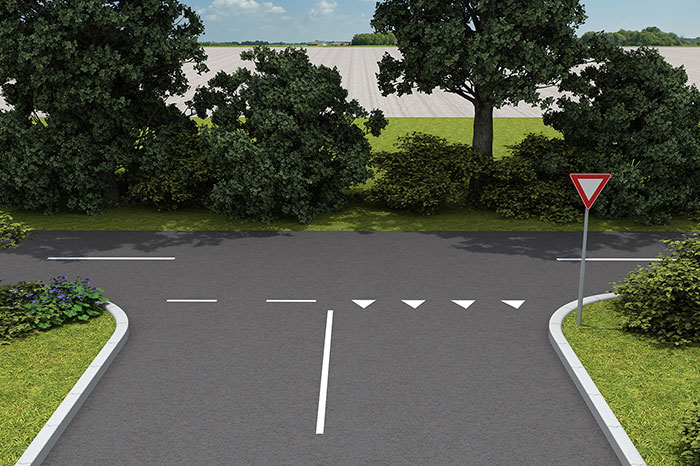
Sign B-6 is combined with priority triangles.
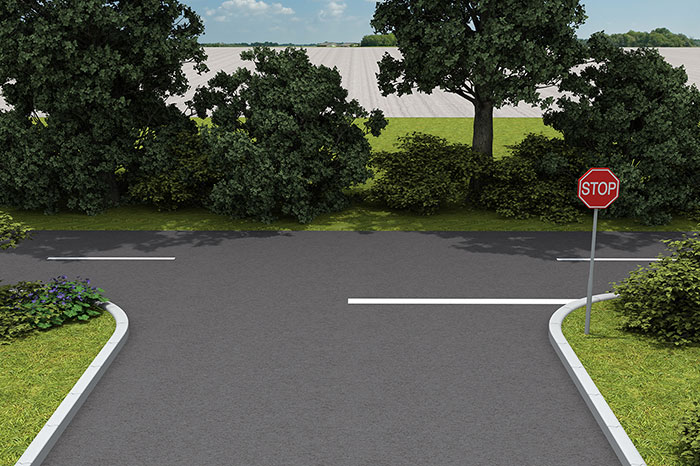
Sign B-7 is combined with a stop line.
These signs are also only meant for drivers. A pedestrian does not participate in in these priority rules.
Examples

When approaching sign B-6 and priority triangles, you must give way to drivers on the intersecting road. In this case, a horsedrawn carriage is approaching from the left on the intersecting road. The motorcyclist must give way to this driver.
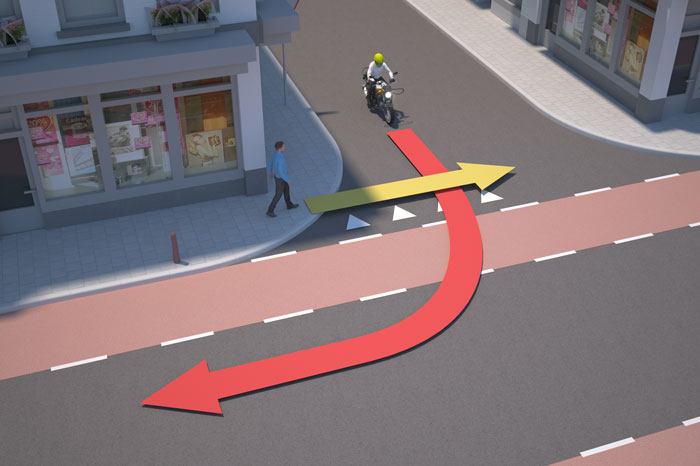
In this case, the motorcyclist is also approaching priority triangles. The pedestrian on the intersecting road must wait for the motorcyclist. At priority triangles, the motorcyclist only has to give way to drivers, not pedestrians.
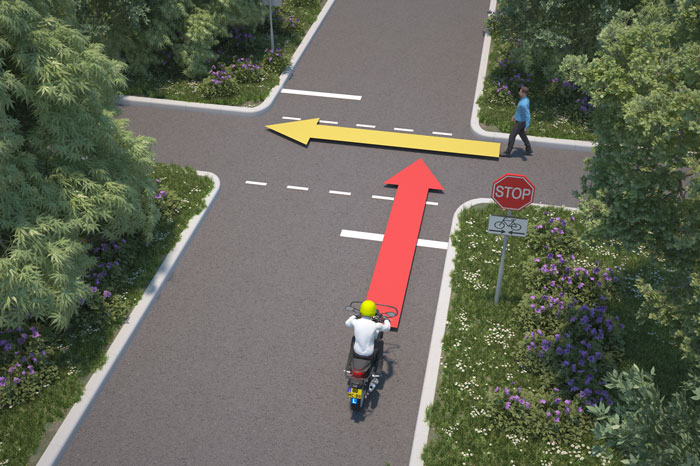
Here, the pedestrian must also wait for the motorcyclist. They are approaching a stop sign in combination with a stop line. Due to the stop sign, the motorcyclist must stop here, but can immediately ride off again when there are no drivers approaching from the left or right. A pedestrian is not a driver.
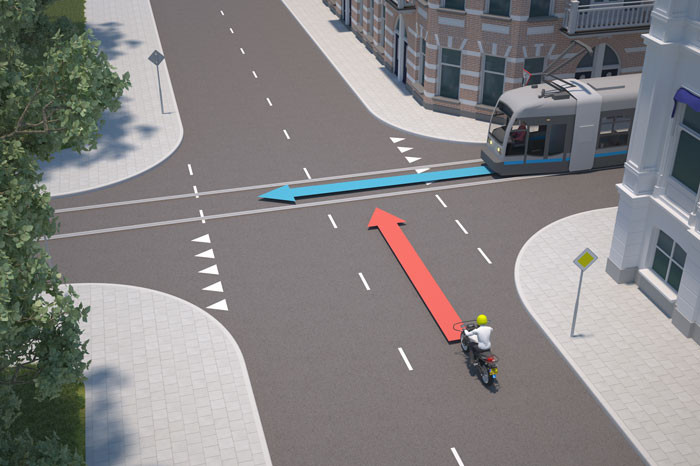
A tram driver always has the right of way at equivalent intersections. As soon as signs or markings regulate the priority, the tram driver must follow these regulations. In this case, the dram driver must wait for the motorcyclist.