

Pre-sorting and indicating direction when turning off
If you do not want to continue straight on an intersection, but want to turn left or right, then it is important to indicate what you want to do. You do this by timely indicating direction and pre-sort correctly. Other traffic can then adjust accordingly.
Indicating direction
It is important that you indicate direction in a timely manner. This depends on the speed you are travelling at and the situation you are in. As a guideline you can keep to the following distances:
- within the built-up area: 100 metres before an exit;
- outside the built-up area: 200 metres before an exit;
- on motorways: 300 metres before an exit.
On a motorcycle, you normally indicate direction with the indicator. However, on some vehicles there is no indicator, such as on a bicycle and some snorfietsen and mopeds. In that case, drivers must indicate direction with their arm.
Indicating direction on roundabouts
Not (timely) indicating direction on roundabouts is a great annoyance for a lot of drivers. Prevent this annoyance by:
- Indicating direction to the right before entering the roundabout
if you want to exit the roundabout at the first exit (turning right). - Indicating direction to the left before entering the roundabout
if you want to exit the roundabout after the second exit (turning left). - Always indicating direction to the right
drive past the last exit before the exit you want to take.
So, around a quarter of the roundabout before the exit.
Indicating direction on weaving lanes
On a combined acceleration and deceleration lane (weaving lanes) it is important to indicate direction in time whether you want to leave the lane or not. If you want to get in lane, then you indicate direction to the left as soon as there is space to get in lane.
If you do not want to get in lane and want to keep following the weaving lane, then you indicate that you want to keep right before the start of the weaving lane. You do this by indicating direction to the right. Drivers on the through carriageway then know that you will not get in lane.

If you do not want to get in lane at the weaving lane, then indicate direction to the right before the block marking start.
Pre-sorting
Before you turn off, you should pre-sort if possible. You do this as follows:
- Turning right
When turning right it is legally allowed to pre-sort on the right side of the carriageway. Even if you need to cross a cycle lane with a broken line. A cycle lane with a solid line may never be used to pre-sort. But for motorcyclists, the position is crucial for one’s own vision, being visible and to be able to cut the bend properly. That is why, due to safety reasons, pre-sorting to the right is often not preferable for motorcyclists.
The risk of being driven past narrowly by following motor vehicles becomes greater as you pre-sort further to the right. Therefore, decide per situation whether pre-sorting on the right side is a wise thing to do. During the practical course, plenty of attention is paid to this.
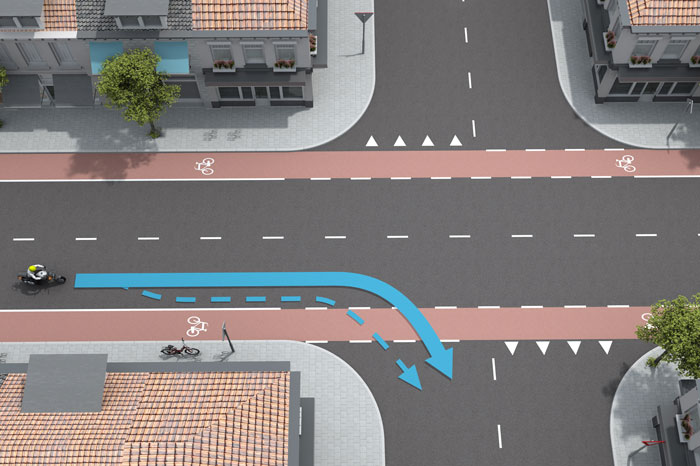
It is not allowed to pre-sort on a cycle lane that is separated from the carriageway with a solid line.
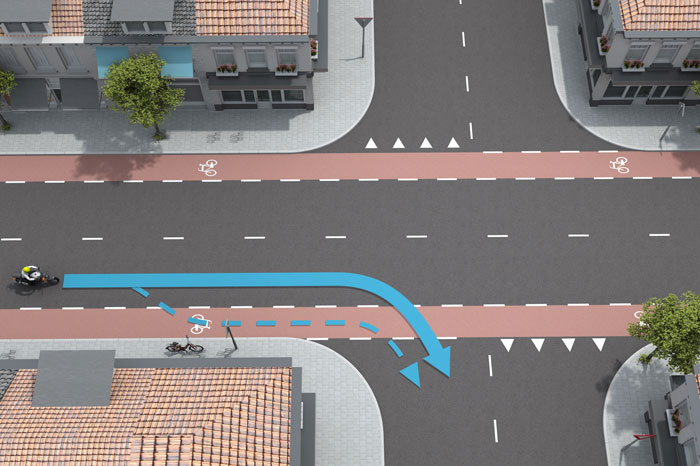
Pre-sorting on the cycle lane is allowed here. However, it is not always the best thing to do.
- Turning left
When turning left, you pre-sort against the road axis. Do maintain enough free space so that oncoming traffic does not narrowly pass you.
If you ride on a one-way street, then you normally pre-sort to the left of the carriageway.
However, if it is a partial one-way street and are cyclists and/or moped riders exempt from this? Then you still pre-sort against the road axis to leave space for these drivers.
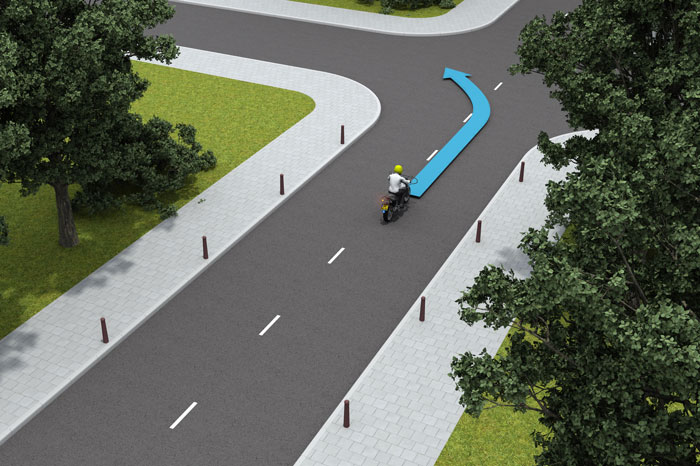
When turning left you pre-sort against the road axis.
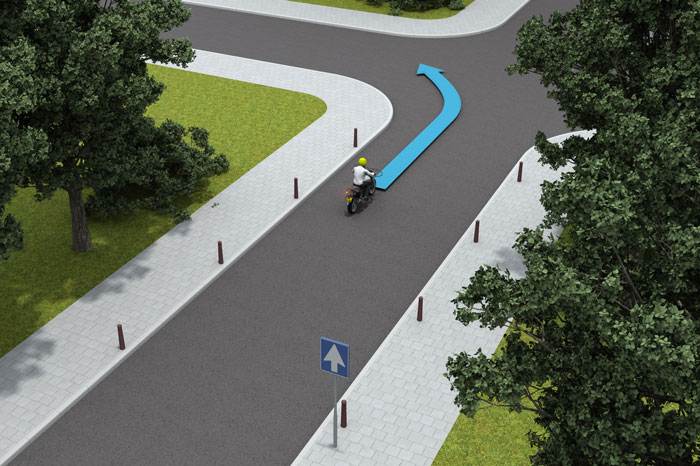
When pre-sorting on a full one-way street, you pre-sort to the left of the carriageway.
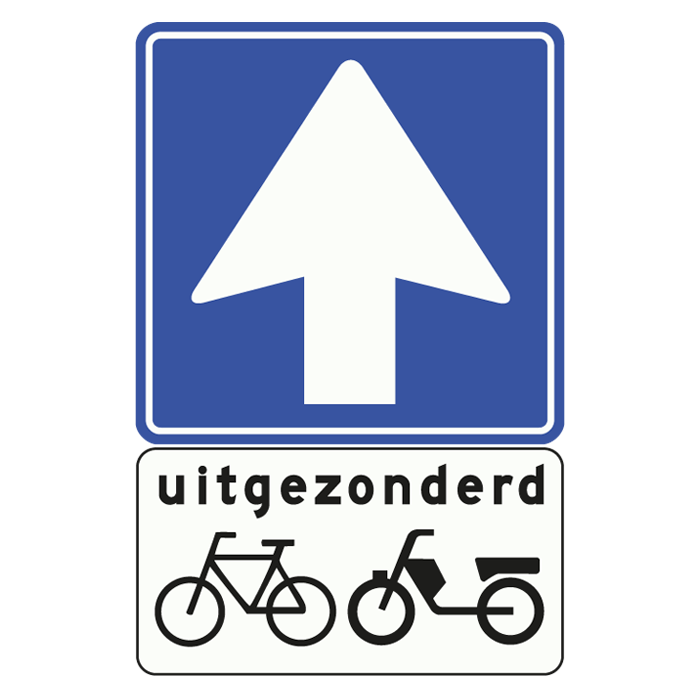
C-3 with supplementary sign - Not a full one-way street. Do not pre-sort all the way to the left.

C-3 with supplementary sign - Not a full one-way street. Do not pre-sort all the way to the left.

C-3 - Full one-way street. Pre-sort all the way to the left.
- Turning on an intersection with multiple lanes in the same direction
Choose the correct lane in time.
Normally speaking, this is the rightmost lane of that direction. Sometimes it is better for traffic flow, or the situation after the intersection, to choose the left-hand lane. For example, because you want to turn left after the intersection, or because you want to overtake slow moving traffic.
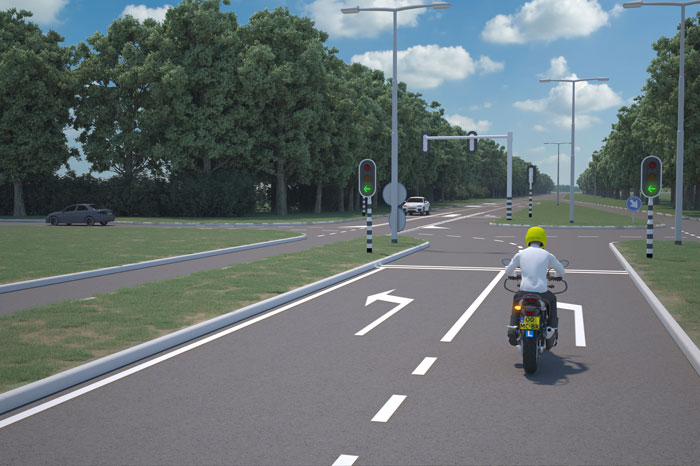
If you have no reason to pre-sort on the left lane, then you always take the right lane.

Here you have a good reason (overtaking the lorry) to use the left lane.