

Use requirements
If you are going to ride a motorcycle (with or without trailer or sidecar), you must also keep to the usage requirements. These are rules that indicate how you may use the vehicle. The most important rules are:
- You are only allowed tow one trailer at a time with a motor vehicle.
- You are only allowed to tow a trailer with a motorcycle with sidecar if the wheel of the sidecar is braked.
- You are not allowed to tow another motor vehicle or moped with a two-wheeled motorcycle. You may also not be towed.
- During riding, you may not be hindered by passengers or load. For example, a tank bag may not hinder you while steering.
- You must always have sufficient view to the front and sides. Also, in a normal sitting position, you must have sufficient view on the road sections beside and behind you via the mirrors. For example, if you ride with loose fitting billowing clothes, it could impair your view in the mirror.
- Load must always be properly secured so that it will not move during acceleration, braking and steering. It may also not decrease the stability of the vehicle.
- A trailer behind a motorcycle must always be fitted with a number plate with the same vehicle registration number as the towing vehicle.
- Even with a loaded trailer, the service brake (the front brake possibly in combination with the rear brake) of a motorcycle must have a deceleration rate of at least 4.0 m/s2.
Motorcycle with sidecar
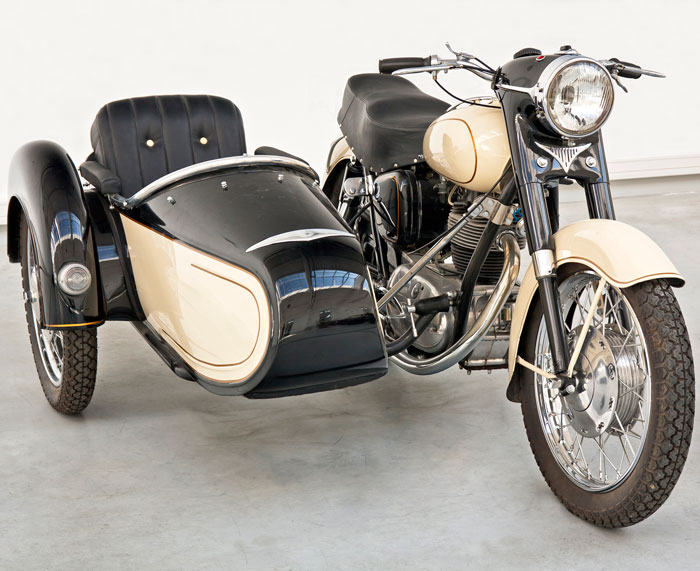
A sidecar is a to the motorcycle mounted wagon, usually equipped with a seat. Sometimes the sidecar also serves as a luggage compartment.
A sidecar can be detachable, which means that you can remove the sidecar from the motorcycle relatively easily. Other sidecars form a whole with the motorcycle. A motorcycle with sidecar is sometimes called a sidecar combination.
Mounting of the sidecar
Not every motorcycle can be fitted with a sidecar. The frame of a normal motorcycle is not designed to withstand the forces of a sidecar. To be able to ride a motorcycle with sidecar, the existing frame must be reenforced or even renewed. Therefore, always leave this to someone with experience and expertise. A badly mounted sidecar can pose major risks.
Riding with a sidecar
Because a sidecar adds weight and makes the whole less aerodynamic, the performance of the motorcycle will decrease. Not only does the motorcycle become less manoeuvrable, but also less fast. Therefore, the transmission or the wheel size is often changed. The ‘third wheel’ (the wheel of the sidecar) can both be braked or unbraked. Sidecars with a powered wheel can also occur.
Riding with a sidecar is totally different than riding with a normal motorcycle. It is advisable to take separate lessons for this. You control a sidecar with the handlebar, unlike a motorcycle where you mainly steer by shifting your body weight. In addition, an unpowered sidecar also pulls on the motorcycle, both when accelerating, as well as during deceleration and decoupling. With an unbraked sidecar on the right side, the combination will pull to the left during braking. When accelerating, this motorcycle with sidecar will generally pull to the right. Of course, this will be less with a powered sidecar wheel.
Also, the relatively low weight combined with the wider tyres of the sidecar can make aquaplaning more likely.
Legislation sidecar
When you are riding on a motorcycle with sidecar, you are only allowed to tow a trailer unless the wheel of the sidecar is braked.
A motorcycle with sidecar mostly falls under the same rule as a motorcycle without sidecar. So, the maximum width, hight and length is the same, as well as the speed limit. Because even though you may only ride 90 km/h on the motorway with a motorcycle with trailer, you may ride the normal speed limit that applies to motorcycles without sidecar with a motorcycle with sidecar.
Just as the driver of the motorcycle, the passenger also has a helmet requirement. Even if there are seat belts present in the sidecar. Using these seat belts is not mandatory but is advisable.
Do note that with a motorcycle with sidecar, you also fall under the rules of a motor vehicle on more than two wheels.