

Maintaining distance
The more space you keep free around your vehicle, the smaller the chance you hit something. Therefore, always maintain enough distance to the left and right of your vehicle, and also to the front of your vehicle: the following distance. If the following distance is too short, we call it ‘tailgating’. When the driver in front of you suddenly brakes, it usually leads to an accident where the fault is yours.
- Driving vision
The distance over which you can oversee the road. This could be impaired due to road or weather conditions, but also due to, for example, your following distance. The less driving vision you have, the lower your speed should be.
Stopping distance
In traffic, you regularly encounter situations where you must, expectedly or unexpectedly, brake. It is important to know how much distance you need to be able to stop. We call this the stopping distance. The stopping distance is not only the braking distance, but also the distance you need to think before you actually start braking: the response distance.
Stopping distance = Response distance + Braking distance
Response distance
If something unexpected happens in front of you, you have to react to this first. This follows a set pattern.
- Observing
You see something happen to which you may need to react. - Predicting
You predict what this means for you and which options you have. - Evaluating
Compare these options. - Deciding
You choose the best option. - Acting
Act according to your decision.
How quick you are with the cycle observing, predicting, evaluating, deciding and acting determines your response time.
Are you healthy and experienced, and you pay close attention, the response time is about 1 second. So, it then takes about 1 second from the moment you observe something you need to brake for, to actually squeezing or pressing the brake.
During this second, you keep driving at the same speed. This distance is the response distance. You can roughly calculate this by dividing the driven speed (in km/h) by four and then adding 10% to this. This number is the response distance in metres.
At 40 km/h, a response time of 1 second means that you travel about 11 metres. At that point, you have only had time to think and still need to brake.
Braking distance
As soon as you touch the brake, you do not come to a stop immediately. This mainly depends how well you handle the brake and the driven speed. The distance you travel during that time is called the braking distance.
This distance increases by a factor of four as your speed doubles. This means that the braking distance is four times as long if the driven speed is twice as high. The state of the road surface and the weather conditions also influence the braking distance.
To roughly calculate the the braking distance, you divide the driven speed (in km/h) by ten. You then multiply the answer by itself and then divide the result by two. This number is the braking distance in metres. Do note, for two-wheeled vehicles, the braking distance mainly depends on experience and practise, compared to four-wheeled vehicles. So, being able to brake well takes practise.
At a speed of 40 km/h, you need about 8 metres to brake. You already needed 11 metres to think. So in total it takes about 19 metres to stop!
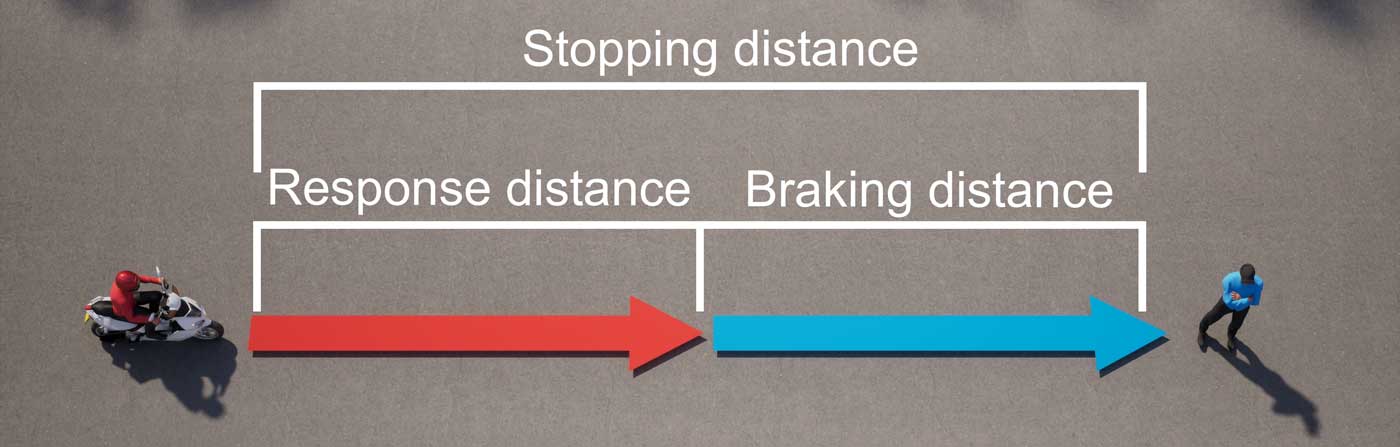
The stopping distance is the response distance and the braking distance combined. If the moped rider is riding 45 km/h, then they need 22 metres to come to a stop.
Following distance
The distance between your vehicle and the vehicle in front of you is the following distance. Not maintaining a sufficient following distance is punishable and besides that extremely dangerous. You must be able to stop your vehicle within the distance that is free and overseeable. This means that when the vehicle in front of you suddenly comes to a complete stop, you must be able to stop before hitting the rear of their vehicle. You can determine a safe following distance with the ‘two-second rule’.
This means that when the vehicle in front of you passes a pollar, it must at least take two seconds before you pass that same pollar. Do keep in mind that you do not count too fast!
You can also roughly calculate the following distance in metres. You do this by dividing the speed in km/h by two. Then add 10% to the result.
At a speed of 40 km/h, there must therefore be at least 22 metres between you and the vehicle in front of you.
Making an emergency stop
Making an emergency stop is not easy on a snorfiets, moped or speed pedelec. Braking as hard as possible just like that can cause the wheels to lock up and skid. This usually result in a fall. Use the brake with care by first squeezing the brake lightly and then brake harder. If you feel that the wheels might lock up, let go of the brake a little so the wheels start spinning again and then start braking again. This is not easy and needs practise.
Usually, the front brake (right brake lever) and rear brake (left brake lever) work separately. The braking distribution between the front and rear brake is best when you brake 70 to 80% with the front brake and only 20 to 30% with the rear brake.
Due to the weight movement while braking, there is more weight on the front wheel and less weight on the rear wheel. Because of this, the rear wheel will lock up faster if you brake too hard with the rear brake.
The suspension also influences the braking behaviour. If the suspension is not correctly adjusted, or is even broken, your vehicle will brake less effectively. Then, the wheels bounce more and have less grip.
Riding in the verge
When riding a two-wheeled vehicle, you should avoid riding in the verge as much as possible. Verges are often muddy and slippery. In addition, the edge of the asphalt could cause you to start swerving when you try to re-enter the carriageway. If you have to swerve for oncoming traffic, try and stay on the carriageway. If you have to enter the verge, lower your speed or come to a complete stop. If you accidentaly end up in the verge, slowly release the accelerator and wait until you ride slower before carefully steering back to the carriageway.
Swerving
If you must swerve, make sure that you brake as much as possible if there is space for this. Stop braking as soon as you start steering. Braking and steering do not go well together. This can cause you to fall.
Poorer conditions
The following distance according to the ‘two-second rule’ is a minimum following distance. It applies on a good road, with good weather conditions, an alert driver and good road holding.
Is your vehicle in a poor condition, or are you (still) inexperienced with braking, then the braking distance increases. This also applies when you deal with poorer road or weather conditions. The road can be more slippery due to that. You should therefore keep a greater following distance.
If the visibility is poor due to fog, snow or rain, or if you are less alert, you are less able to observe and therefore slower to react. The response distance therefore increases. Then too, you should keep a greater following distance.
You need insight and experience to be able to estimate the minimum following distance in these kinds of situations. Assume a following distance of 3 or 4 seconds in poorer conditions. To know whether you are dealing with a poorer road surface and thus a poorer road holding, you can look at a few things:
- Road surface type and the state of it
A wet road surface has less grip, just as a road surface with holes or loose gravel or sand. In addition to that, for example, a cobblestone road has less grip than an asphalt road. - Road banking
In bends the roads are often a little slanted, where the inner bend is a little lower than the outer bend (positive road banking). This ensures more grip in bends. If the outer bend is lower than the inner bend (negative road banking), then you have less grip in bends. This is often the case on roundabouts.
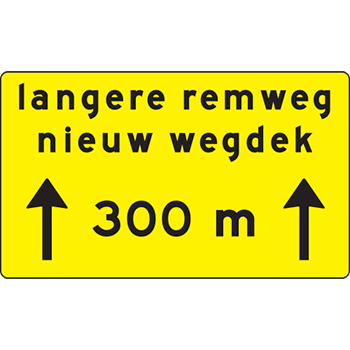
- New road surface
You would expect that the grip would immediately be good with a new road surface. However, this is not the case. A road must first be ‘driven-in’ before it is rigid enough. A new road surface is therefore more slippery in the beginning.
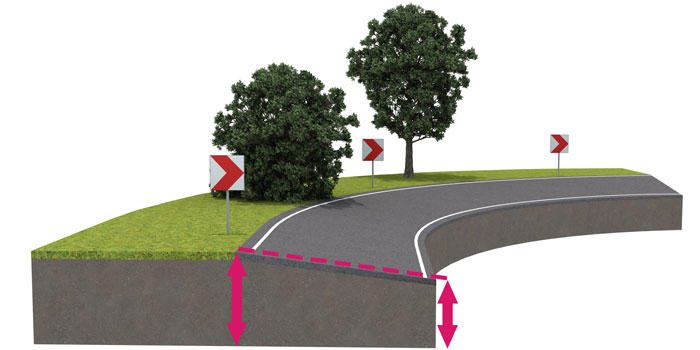
Positive road banking. The inner bend lies lower.
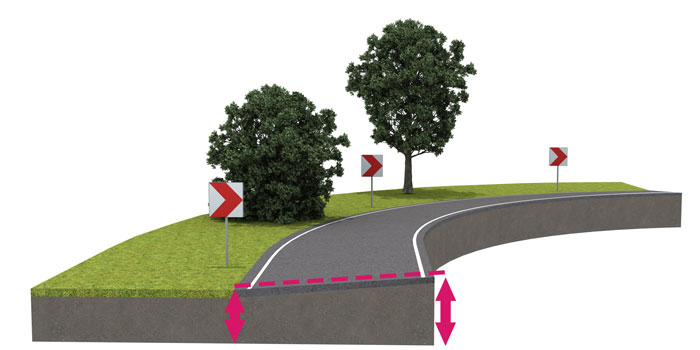
Negative road banking. The inner bend lies higher.
Centrifugal force
The centrifugal force is the force that pushes you and your vehicle to the outside when driving in a bend. The heavier, bigger and taller the vehicle is, the bigger the centrifugal force is. Adjusting your speed has a direct effect on this force. When the speed is doubled in a bend, the centrifugal force is four times as big. The bigger the centrifugal force, the bigger the chance that you skid and fly out of the bend, especially when you also start braking in the bend. Therefore, adjust your speed well before the bend and make sure you do not have to brake in the bend. By tilting the moped, snorfiets or speed pedelec in the bend, you partially catch the centrifugal force.
Braking in poorer conditions
Braking well under normal conditions already takes some practise. But it becomes even more difficult if the conditions are not ideal. Think, for example, of slippery conditions due to bad weather or poor road surfaces due to loose gravel or sand. In that case, it is important that you brake less with the front brake of your snorfiets, moped or speed pedelec. In extremely slippery situations it is even best not to brake with the front brake at all. As soon as the front wheel starts skidding, you will almost always fall, as it is difficult to correct this. Therefore, in these conditions, it is best to mainly brake with the rear brake. If your rear wheel skids, it is often easier to correct. But try to dose the brake in such a way that the rear wheel does not skid.
In these situations, preventing to brake is always best. Maintain a larger following distance and look far ahead. Avoid poor and slippery sections on the road surface, such as white markings, black tar snakes on the asphalt, manhole covers and dirt. Also keep in mind the presence of tram rails. Prevent having to ride over them in the longitudinal direction.