

Special vehicles – emergency vehicles
Some vehicles have more rights than other vehicles. These are, for example, emergency vehicles. In addition, trams, military convoys and funeral processions consiting of motor vehicles have special rights. There are also vehicles that do not immediately have extra rights, but which you have to take extra into account, think of larger transports.
- Emergency vehicle
Motor vehicle that runs optical (flashing light) and sound signals (sirens). These include blue flashing lights and a two-tone horn. You should always give way to these vehicles.
- Ambulance
Motor vehicle equipped and intended to be used for the transport of sick or injured people to and from the hospital.
- Emergency medical services
Motor vehicle intended for the provision of emergency medical care. This does not have to be for the transport of a patient, such as with an ambulance. It could, for example, be a company car from a GP (general practitioner). This is mainly intended to get the GP to the patient urgently.
- Animal ambulance
Motor vehicle, equipped and intended to be used for the transport of sick or injured animals. These vehicles are never emergency vehicles. They do often have yellow flashing lights to make sure they are clearly visible. They are not allowed to run sirens, so they are not equipped with them.
Emergency vehicles
Emergency vehicles are motor vehicles that have an urgent task to complete. They show that they are in a hurry by means of blue optical signals (flashing lights) and sound signals in the form of a two-tone horn (siren). Without these signals, or with just one of these signals, they are not emergency vehicles.
Emergency vehicles include ambulances, police vehicles and fire engines among others. But other vehicles can also be authorised to use these signals. In this case, they also fall under emergency vehicles. Think of vehicles of Rijkswaterstaat, or vehicles for the transport of blood or organs.
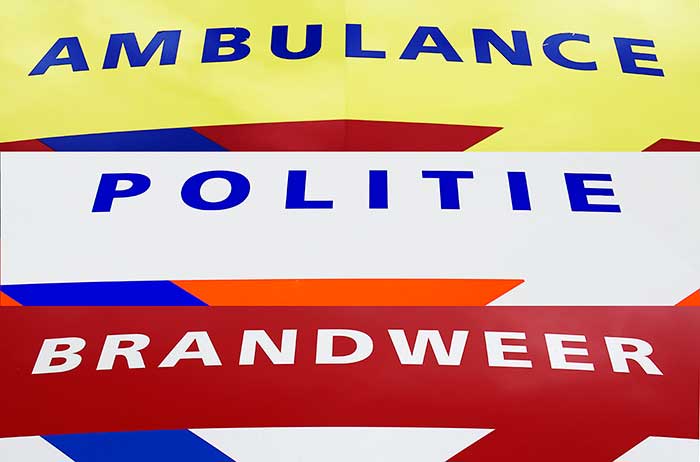
Not only vehicles of these services are emergency vehicles.
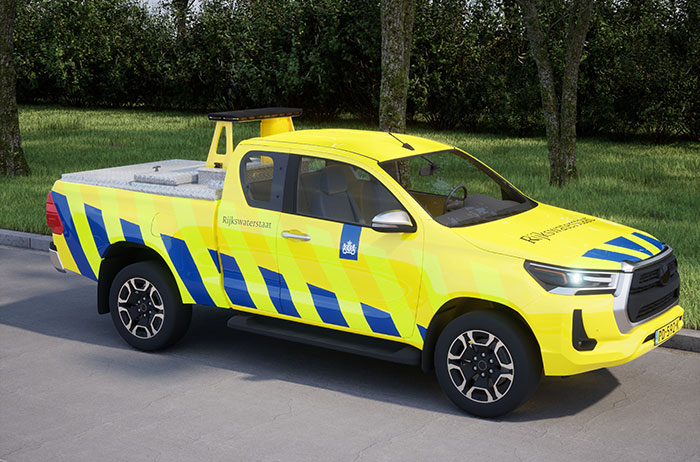
Vehicles of Rijkswaterstaat and other services can also be emergency vehicles.
Giving way to emergency vehicles
All road users must give way to drivers of emergency vehicles. Without exceptions. It is important that you do so safely. You are not allowed to cause hinder or danger or break any rules in order to give way to an emergency vehicle.
If an emergency vehicle is approaching, remain calm. A driver of an emergency vehicle will find their own way and keeps to the normal rules as much as possible. The more predictable your driving is, the easier that is for them. Some tips:
- Only make space when it is safe to do so. In the meantime, keep driving the speed limit.
- If there is a free lane, leave it free for the emergency vehicle.
- If you are driving on a roundabout, or if you are approaching one, with an emergency vehicle behind you, continue to drive on the roundabout until the emergency vehicle has exited the roundabout.
- Are you waiting at a red traffic light, then only make space if the emergency vehicle cannot pass you otherwise. Also, only make space if it is safe to do so. Never just drive onto the intersection through a red light. In that case, it is safer to wait.
- If an emergency vehicle wants to pass you, then stay on the carriageway and keep to the right as much as possible. Never suddenly enter the verge or pavement at high speeds.
- Always watch out for more emergency vehicles that follow.

In this situation, just drive an extra lap until the police car is off the roundabout.
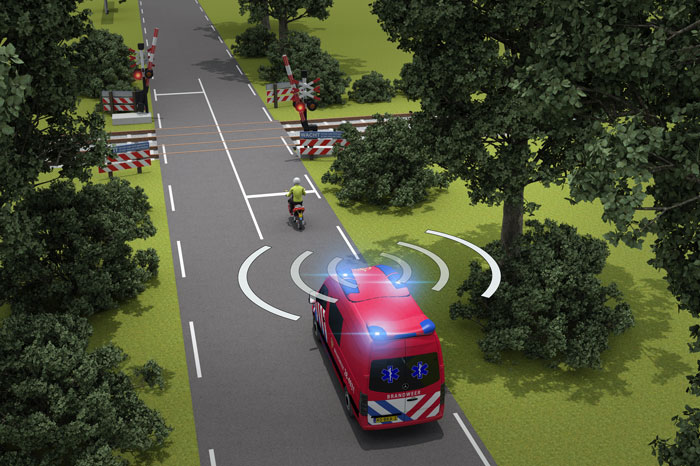
Never just enter a level crossing to let the fire engine pass when the red lights are on.
If you do not see an emergency vehicle or see it too late, you cannot respond properly. Make sure you check your mirror(s) regularly. If you listen to music while driving, do not turn it up too much so that you can still hear environmental sounds (and possible sirens). In addition, always maintain sufficient distance between the person in front of you, even when waiting at a traffic light. Then you still have room to make space if an emergency vehicle wants to pass.
Emergency vehicles and traffic rules
Emergency vehicles may, if they have good reason to do so, ignore some traffic rules. For example, they are allowed to run a red light and drive faster than the speed limit.
Vehicles of the police may even do this when they are not running optical and sound signals. They are not allowed to just do this, but only if they have good reason to do so. But then they are not emergency vehicles!