

Vulnerable road users
Vulnerable road users include pedestrians, but also people who are blind or visually impaired, or people who have difficulty moving around.
Pedestrian crossing
As a driver at a pedestrian crossing (also called a zebra crossing), you are required to give way to pedestrians that are crossing or that are going to cross. You must also give way to drivers of disability vehicles that are crossing form one pavement or footpath to another via a pedestrian crossing. In that case, they fall under the category ‘pedestrians’.
Clearly show that you plan to stop. Do not brake last minute. Release the accelerator in time and brake lightly. This way, you let traffic behind you know that you are about to brake and possibly stop.

The pedestrian may go before the brommobiel, because they are crossing via a pedestrian crossing (zebra crossing).

In this case, the person in the disability vehicle falls under the pedestrians and may therefore go before the brommobiel.
If there are traffic lights at a pedestrian crossing, the traffic lights supersede the road markings. In that case, the pedestrians must wait when the light is red.
People with limited mobility and the blind
If there is no pedestrian crossing, you do not have to give way to a pedestrian wanting to cross the road. There are two exceptions to this:
- the blind or visually impaired, recognisable by a blind stick (white cane with one or more red rings);
- persons who have difficulty moving around, recognisable by, for example, a walker, cane or crutches.
These two groups should be given priority when they want to cross, no matter where they want to do this. Persons in a wheelchair are not included in this exception. They do not fall under the term ‘persons who have difficulty moving around’.
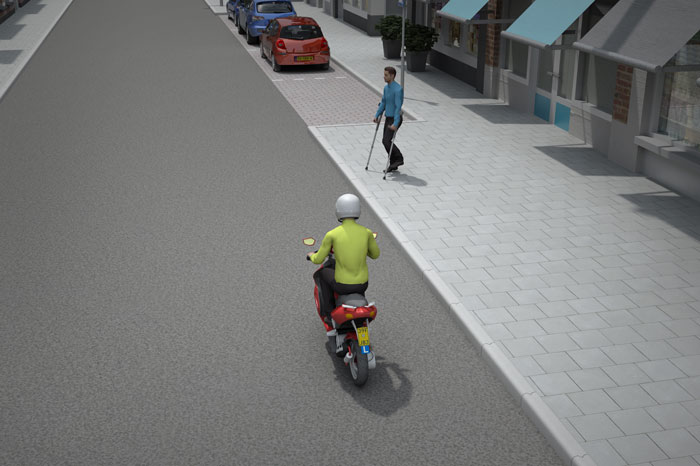
A person with a walker, cane or crutches falls under the term ‘people who have difficulty moving around’ and may therefore go before the moped rider.

A person in a wheelchair does not fall under the term ‘people who have difficulty moving around’ and may therefore not go before the moped rider.
Entrance and exit constructions
An entrance construction is the same as an exit construction. Which word you use depends on whether you enter or exit such a construction.
Entrance and exit constructions are used, among other things, at the start and end of an erf. But you can also find them at the entrance of a parking lot. They are not always easily recognisable. Most entrance and exit constructions are designed so that you must drive over the pavement to turn onto another road or parking lot. The pavement tiles continue on an entrance and exit construction.
At the hight of the construction, the kerb is lowered to make it easier to drive over it.
At entrance and exit constructions, you must give way to all other traffic, including pedestrians. This applies to both entering and exiting the construction. Sometimes one driver wants to simultaniously drive over a construction at the same time as another driver. As most entrance and exit constructions are not very wide, you preferably give way to the exiting driver.
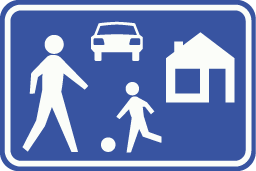
Erf
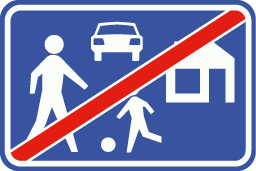
End erf
Most erfs have an entrance and exit that is designed as an entrance or exit construction. In that case, you must give way to all other traffic when entering or exiting a construction. If no entrance or exit construction is present, the normal priority rules apply.
The rule that you must give way to all other traffic has nothing to do with the erf itself, but only with the entrance and exit construction.

The driver of the brommobiel is leaving an exit construction and must give way to all other traffic when doing so. The pedestrian and cyclist may therefore go first.
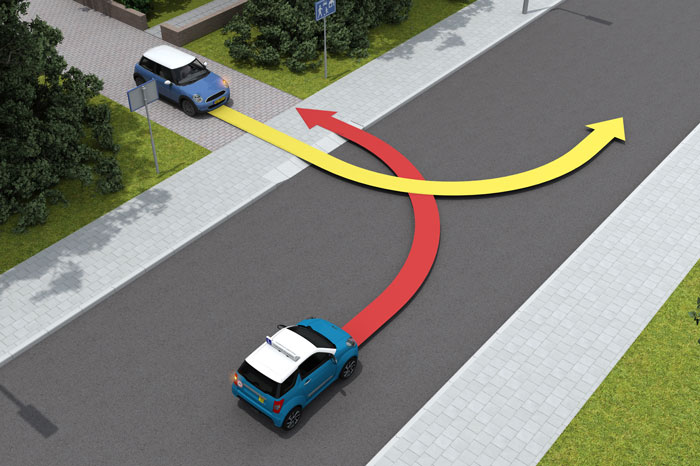
In this case, it is wise to give way to the exiting driver. This way, it is easier to enter the construction.