

Road sections
Everyone wants to participate in traffic as safely as possible. That is why there is a different place on the road for each category of road users.
- Carriageway
Any section of road used by moving vehicles, except cycle paths and cycle/moped paths. Cycle lanes are part of the carriageway! A carriageway is therefore the section between two pavements or verges.
- Lane
Section of the carriageway marked by broken or solid lines. It must be wide enough to accomodate a passenger car. This means that a bycicle lane is not a separate lane.

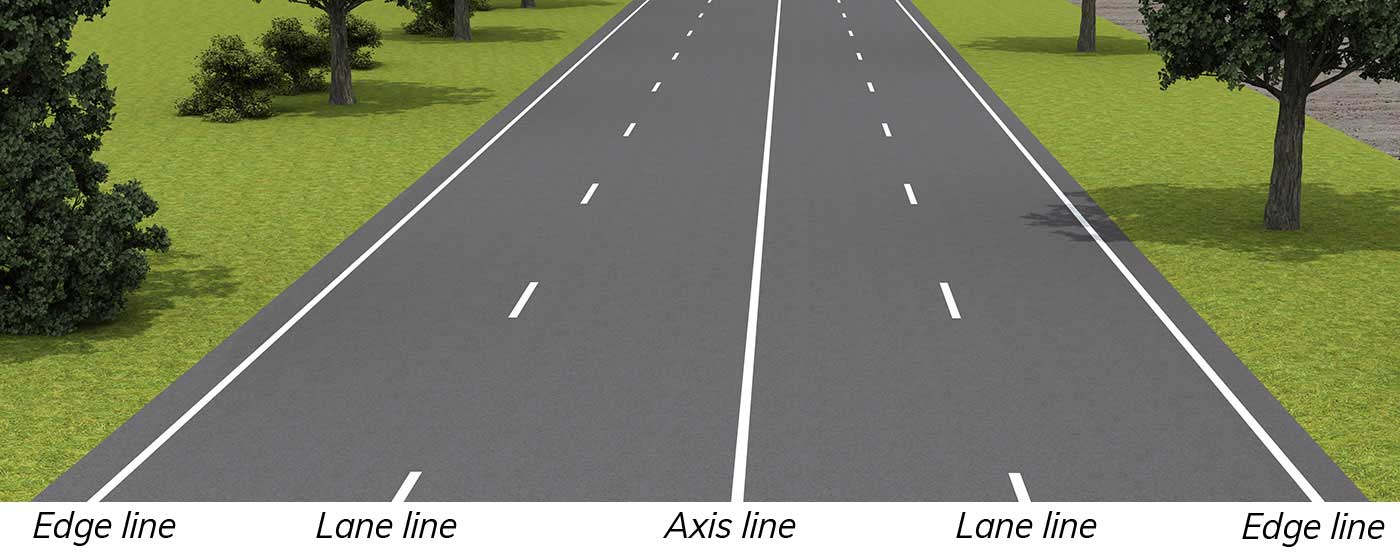
- Edge line
Line on the outer edge of the carriageway.
- Lane line
Line that divides carriageways into lanes travelling in one direction.
- Axis line
Line in the middle of the carriageway. It divides the left and right sides of the carriageway, one for each direction of travel.
- Hatched road markings
Part of the road marked with diagonal lines. Drivers are not allowed to use this area.
- Dividing point
Triangular area on the road surface at, for example, the beginning of acceleration lanes and the ends of deceleration lanes. Drivers are not allowed to use this area.
- Designated lane
Lane meant for a certain target group, such as a bus lane. This is indicated with a sign or the word ‘BUS’ or ‘LIJNBUS’ on the road surface.
- Acceleration lane
Lane meant for drivers that want to enter the through carriageway. This lane is not part of the through carriageway. Between the through carriageway and the acceleration lane are blocked markings.
- Deceleration lane
Lane meant for drivers that want to leave the through carriageway. This lane is not part of the through carriageway. Between the through carriageway and the deceleration lane are blocked markings.
- Hard shoulder
Paved section of road next to the carriageway intended for emergencies or breakdowns. You are not permitted to use it at other times.
Keep to the right
The fundamental rule for drivers is to keep to the right as much as possible. This does not mean that you should always drive all the way to the right. Sometimes there is good reason to drive more to the left. If no reason is present, keep as far to the right as possible.
On a road without lanes, it means that you drive to the right of the middle of the road, if the carriageway is wide enough for this. On a road with lanes, you drive in the middle of the lane. If you are riding a two-wheeled vehicle, it is wise to ride slightly left of the middle. If there are more lanes to choose from, then you initially take the rightmost lane first.
If there are parked cars on the right side of the carriageway, it is not necessary to move to the right in between the parked cars when there is no oncoming traffic. This leads to excessive unnecessary zig-zagging. Drive in a straight line as much as possible. Additionally, maintain enough space (about one door’s width) between the parked cars and your vehicle. This helps to avoid a collision when someone suddenly opens the door.
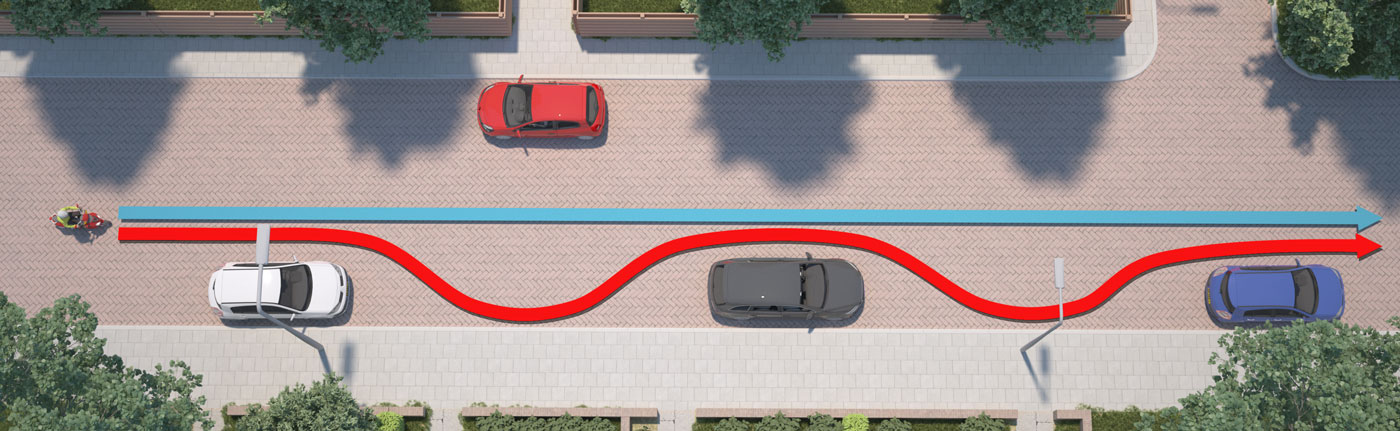
Try not to start zig-zagging, but ride in a straight line wherever possible.
Besides, you do not have to keep to the right on roundabouts or in a traffic jam. In that case, you can choose the position you think is best.
Position on the road for pedestrians
The place on the road for pedestrians is the pavement or footpath. If these are not present, they may use the cycle path or the cycle/moped path. If this is also not present, they may use the verge or far side of the carriageway.
One exception to this rule are the pedestrians that move about my means of objects, such as inline skates, a skateboard or a child’s scooter. They may decide for themselves what the safest place is and may choose between the pavement or footpath or the cycle path or cycle/moped path. Only if none of these are present, are they allowed to use the carriageway.
- Cycle lane
A section of the carriageway, marked by a solid or broken line on which symbols of a bicycle are applied.
- Cycle lanes with broken lines may be used by drivers other than cyclists and snorfietsers, to pre-sort or evade. Cyclists and snorfietsers may not be hindered when doing so.
- Cycle lanes with solid lines may only be used by cyclists, snorfietsers and drivers of disability vehicles. As a moped rider, you are not allowed to ride here, not even to pre-sort.
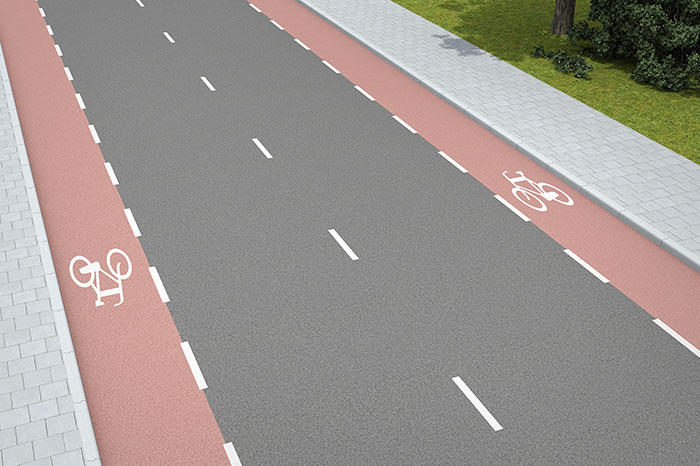
A carriageway with cycle lanes, recognisable by the symbols of bicycles on the road surface.
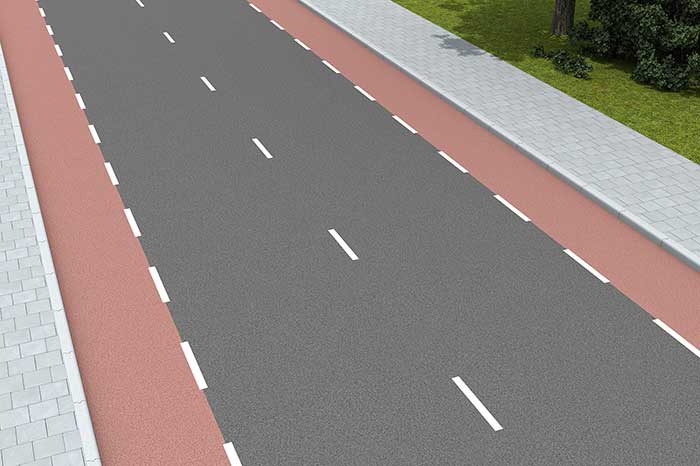
A carriageway with a suggestion (cycle) lane. The symbols of bicycles are missing, as a result this lane has no legal meaning.
- Special moped
-
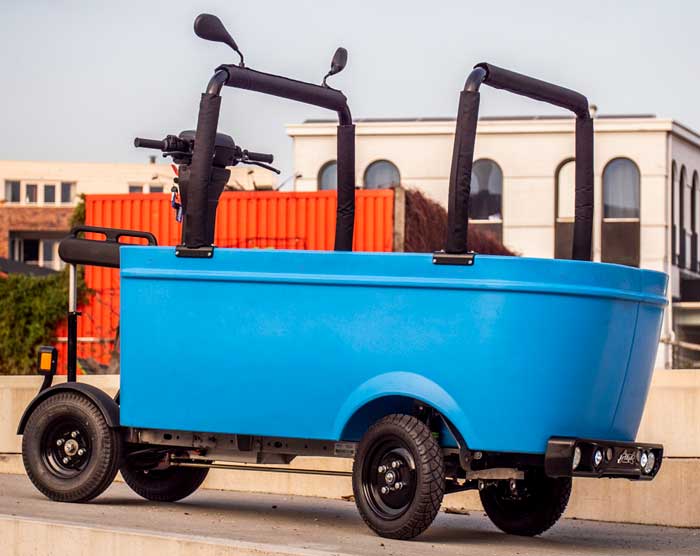
BSO bus
This group includes vehicles such as the segway and the BSO bus. Drivers of these vehicles must maintain the same place on the road and speed limit as snorfietsers.
Position on the road for cyclists and snorfietsers
Cyclists and snofietsers must use the mandatory cycle path or mandatory cycle/moped path. If this is not present, they use the carriageway. If there is a cycle lane present on the carriageway, then you must use this as a cyclist or snorfietser.
Cyclists may also choose to use the non-mandatory cycle path. This path is off limits for snorfietsers, unless they have switched off their combustion engine, or the snorfiets has an electric engine.
Drivers of bicycles on more than two wheels or bicycles with a trailer wider than 0.75 metres, including load, may always choose to use the carriageway. These are, for example, wide cargo bicycles or bicycle taxis.
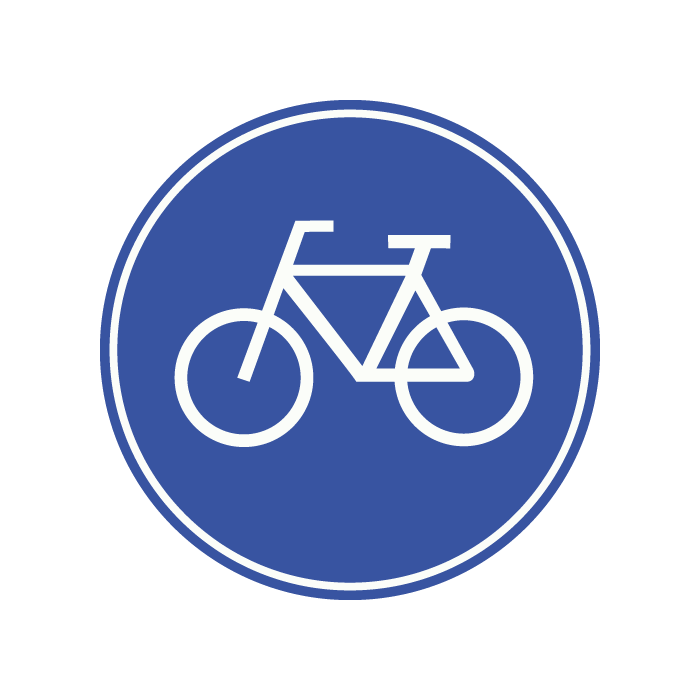
G-11
Mandatory cycle path
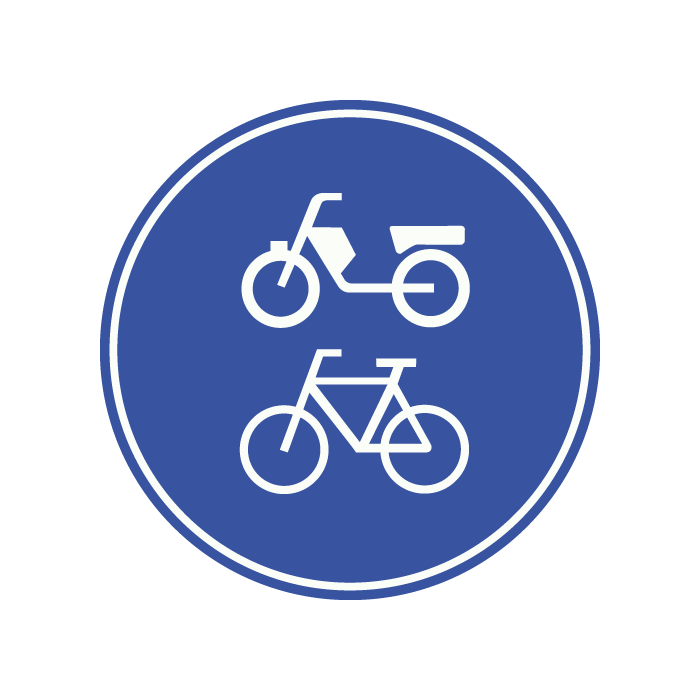
G-12a
Mandatory cycle/moped path

G-13
Non-mandatory cycle path
In some municipalities, it is not allowed for snorfietsers to use the mandatory cycle path. This must then be indicated by a supplementary plate.
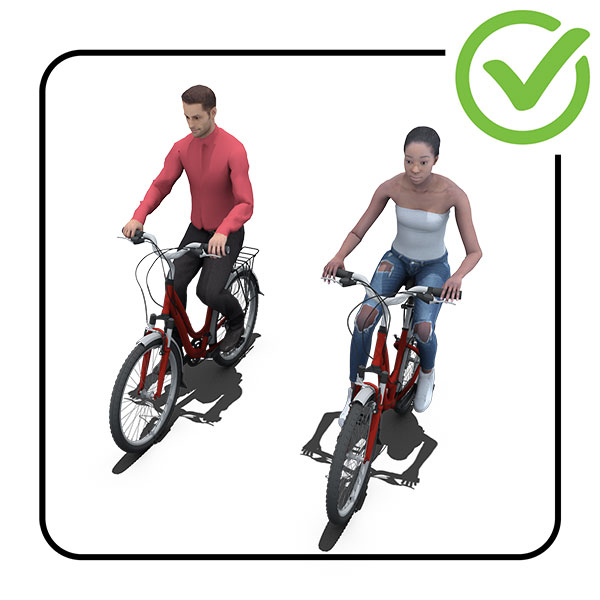
Cyclists are allowed to ride side by side next to each other.
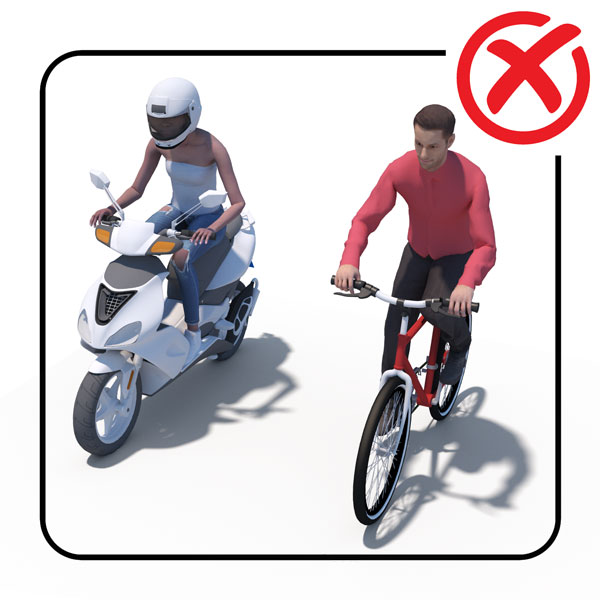
A snorfietser is not allowed to ride next to a cyclist.
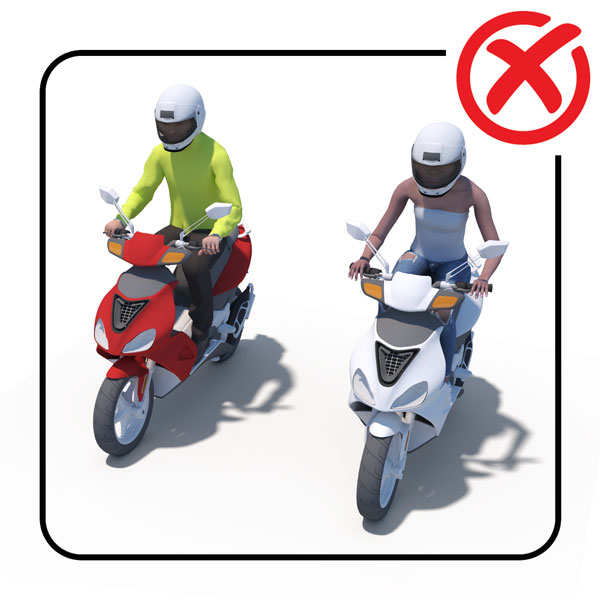
Two snorfietsers are not allowed to ride side by side next to each other.
In most cases, snorfietsers follow the rules of cyclists. There are a few important exceptions. They are not allowed to use the non-mandatory cycle path when the combustion engine is turned on. They are also not allowed to ride side by side or next to a cyclist.
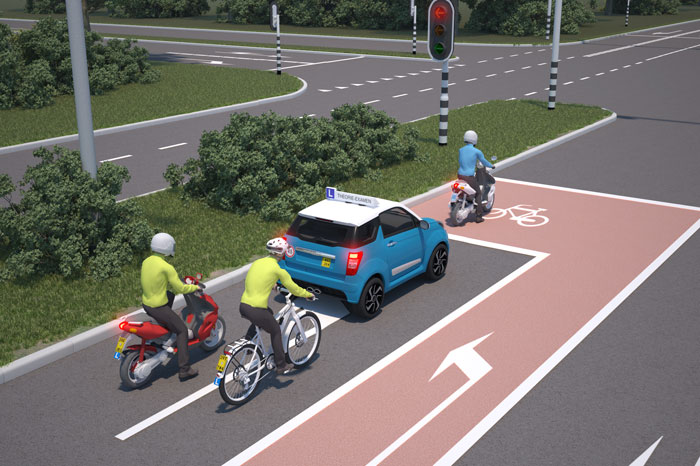
Only snorfietsers are permitted to get into the correct lane on the bike box. Drivers of microcars, mopeds and speed pedelecs must remain behind the bike box.
Bike box or ASL (Advanced Stop Line)
Sometimes, at traffic lights, cyclists and snorfietsers are given an extra pre-sorting area in front of the pre-sort lane for faster vehicles. It looks like a wide bicycle lane, with a red road surface and a bicycle symbol. Only cyclists, snorfietsers and drivers of disability vehicles are allowed to use it. As they are pre-sorted at the front, they stand out more and the vehicles behind them are forced to stay behind them on the intersection.
- Cargo moped
A moped with two wheels at the front and one at the back. Intended only to transport the driver and cargo. A passenger may be seated behind the driver.
Position on the road for moped riders (and drivers of speed pedelecs)
Moped riders must use the mandatory cycle/moped path. If it is missing, they use the carriageway. As drivers of speed pedelecs must follow the same rules, this also apply to them.
Drivers of mopeds on more than two wheels or mopeds with trailers wider than 0.75 metres including load, must use the road. Think of, for example, a cargo moped.
In many places within built-up areas, the lack of mandatory cycle/moped paths requires moped riders to use the carriageway. This is indicated by means of signs D-103 and D-104.
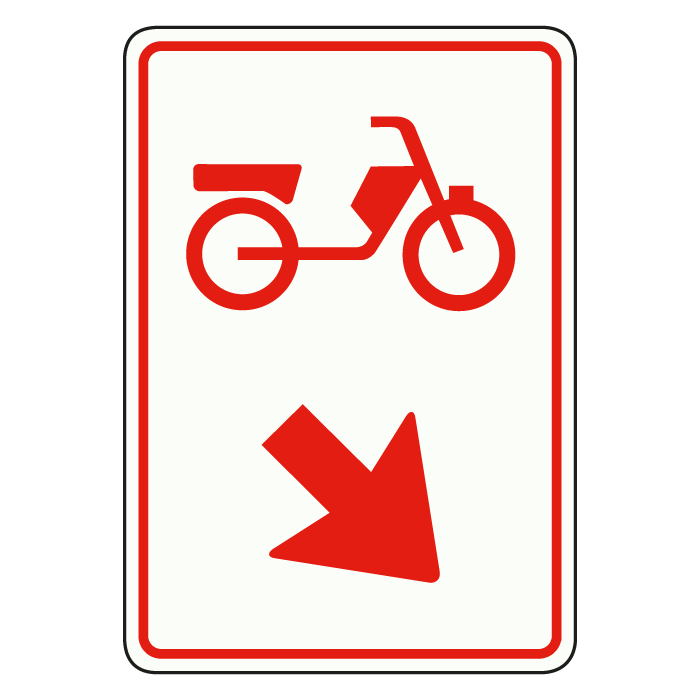
D-103
Mopeds must pass this sign on the right. It is usually placed at places where the moped rider must enter the cycle/moped path.
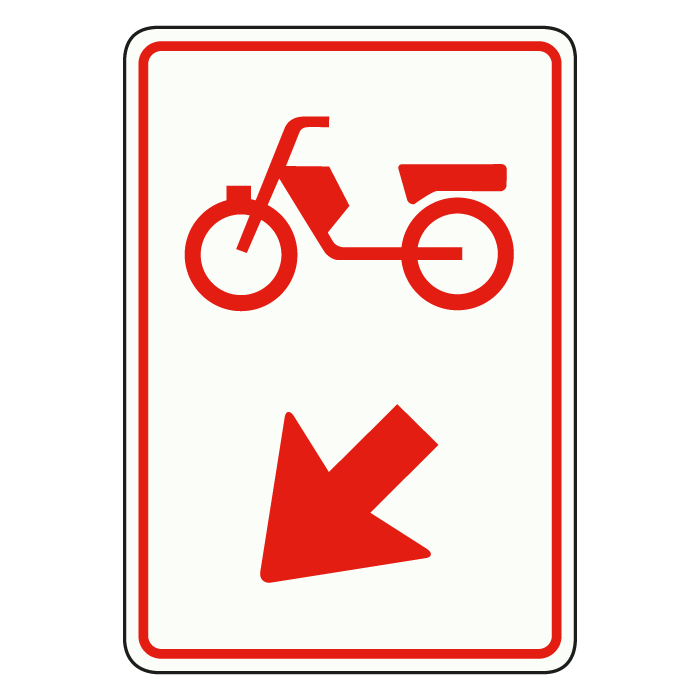
D-104
Moped riders must pass this sign on the left. It is usually placed at places where the moped rider must enter the carriageway.
Position on the road for disability vehicles
Drivers of disability vehicles may choose where it is safest to drive. They may drive on the pavement or footpath, but also on the cycle path or the cycle/moped path or the carriageway. They may also use the cycle lane on the carriageway.
If they drive on the pavement or footpath, or cross from one pavement or footpath to another, they fall under the rules of pedestrians. They may then go a maximum of 6 km/h. If they drive on a cycle path or cycle/moped path, or the carriageway, then the speed limits apply as they do to a moped rider.
Position on the road for horse riders
Horse riders are required to ride on the bridle path. If this is missing, they may choose whether to use the carriageway or the verge. If they choose to ride on the carriageway, they are not allowed to ride side by side.
Position on the road for convoys, parades and funeral processions
Groups of pedestrians may use the carriageway if walking in a large organised group such as a convoy, parade or funeral procession. This is not mandatory.
Position on the road for all other drivers
All other drivers (such as drivers of brommobielen and motor vehicles) use the carriageway.
Position on the road with a wide central reservation
Sometimes, carriageways are separated by a (wide) central reservation. In that case, it is often indicated by signs which carriageway you should use. If this is not the case, then you use the right carriageway. Despite the wide central reservation, there is only one road where your position is as far to the right as possible.
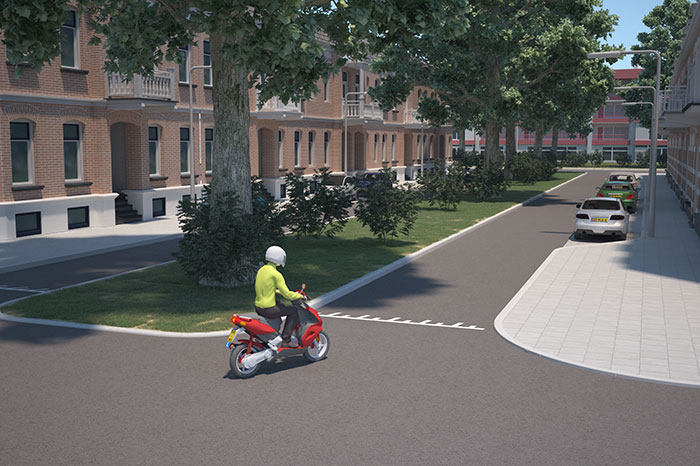
If carriageways are separated by a wide central verge, you normally use the right carriageway.
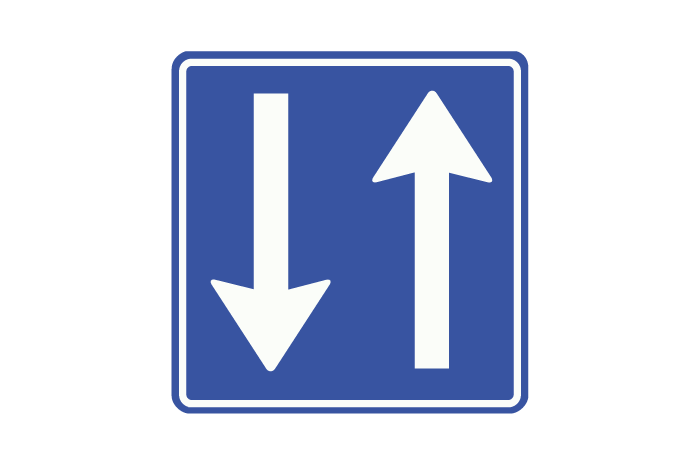
Sometimes, separated carriageways may be used in both directions. This is indicated by sign C-5.