

Vehicle requirements
If you are going to drive a vehicle on public roads, you are responsible for the technical state and the correct use of this vehicle. It does not matter whether this is a motor vehicle, moped or bicycle. The vehicle must meet the permanent requirements (general technical requirements) and the usage requirements.
- Permanent requirements
These are the general technical requirements set for a vehicle before it is admitted in the Netherlands. This assessment is done by the Road Traffic Service (RDW). For example, this is about which lighting a vehicle may and must have, how wide or tall a vehicle may be and which features it should have.
- Usage requirements
These are the requirements for, for example, transporting passengers and load or towing a trailer.
Liability permanent requirements and usage requirements
For these requirements, you are not only responsible as a driver. The owner or holder of a vehicle is also responsible for this. If you borrow a moped from someone and that moped is missing a number plate for example, then you are responsible for that, but the owner of the moped is also responsible.
The same applies when you lend a vehicle to someone who handles it the wrong way. Even then, both of you are liable, even though you perhaps knew nothing at all about this.
You are not allowed to drive, or let someone else drive, a vehicle if this vehicle:
- is not of sound (good) construction or design;
- is not well maintained;
- is built in such a way that the driver has insufficient view to the front or sides;
- does not meet the vehicle requirements in any other way.
Make sure that you always know who you lend the vehicle to and what this person intends to do with it. Make clear arrangements for its use.
Types of mopeds
To know which rules apply to your vehicle, you must know under which subcategory of mopeds your vehicle falls. Within the mopeds, there are four subcategories: the ‘normal’ mopeds, the snorfiets, the speed pedelec and the brommobiel. For all categories, a maximum cylinder capacity may never exceed 50cm3 (50cc). In case of an electric engine, the maximum power may be 4kW. There are also ‘special mopeds’. These are vehicles such as a segway or a BSO bus (previously known as Stint).
- Moped
The ‘normal’ moped normally has two wheels, but it can also have three or four wheels (cargo moped or ‘slow’ quad). The maximum construction speed is 45 km/h. So, the moped may not be able to go faster than 45 km/h. A moped has a yellow number plate.
- Speed pedelec
A speed pedelec is a fast electric bicycle where the auxiliary engine assists up to a maximum of 45 km/h. Because the speed pedelec follows the rules of mopeds, you are also not allowed to ride faster than 45 km/h. A speed pedelec has a yellow number plate.
- Snorfiets
A snorfiets looks a lot like a moped in appearance, but has a maximum construction speed of 25 km/h. So, a snorfiets may not be able to go faster than 25 km/h. A snorfiets has a light blue number plate.
- Brommobiel
A brommobiel is a three or four wheeled moped with a body. That means it has doors and a roof. It has a maximum construction speed of 45 km/h. A brommobiel has a yellow number plate and a round sticker with a red border and the number 45 on the back.
- Special mopeds
Due to their characteristics, these vehicles do not fall under any of the moped categories. The maximum construction speed is 25 km/h and, like the moped, they have a maximum cylinder capacity of 50 cm3, or an electric engine of up to 4 kW. Drivers of these special mopeds generally follow the rules of bicycles and mopeds. A special moped a blue number plate which is a bit smaller than the moped number plate. A driving licence is not required. However, the driver must be at least 16 years old.
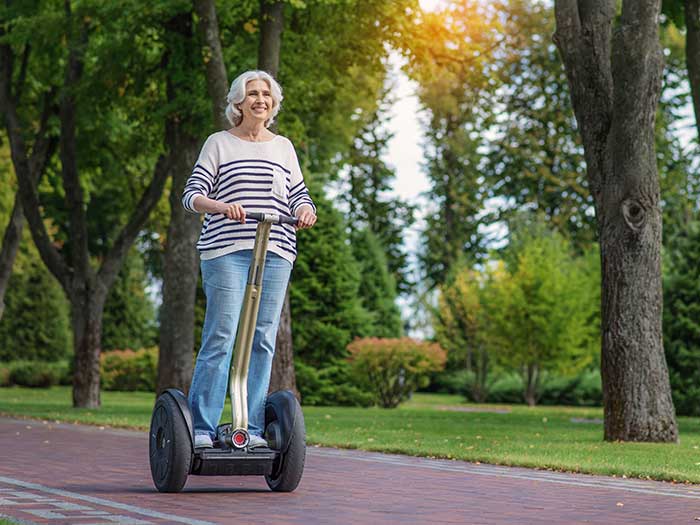
A segway falls under the category special mopeds.
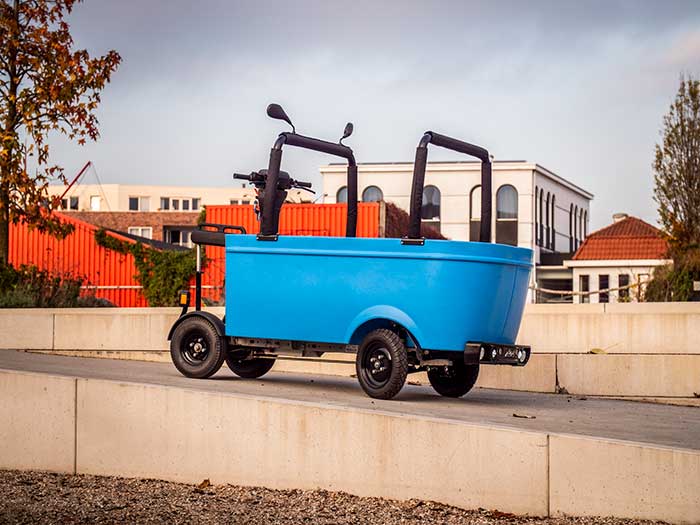
The BSO bus (Stint) also falls under the category special mopeds.