

Environment
Driving in a vehicle with a combustion engine (usually on petrol or diesel, but also gas and alcohol/ethanol are included) is by definition not good for the environment. More and more vehicles are coming with an electric motor or a combination of an internal combustion engine and an electric motor (hybrid). This sounds very environmentally friendly.
However, electricity must also be generated and that does not always happen in a clean way. The batteries of these vehicles do not have an unlimited lifespan and must also be disposed of after this. That is why it is important in all cases to drive as economically as possible and not to waste energy, regardless of whether this is energy from a combustion engine or an electric motor.
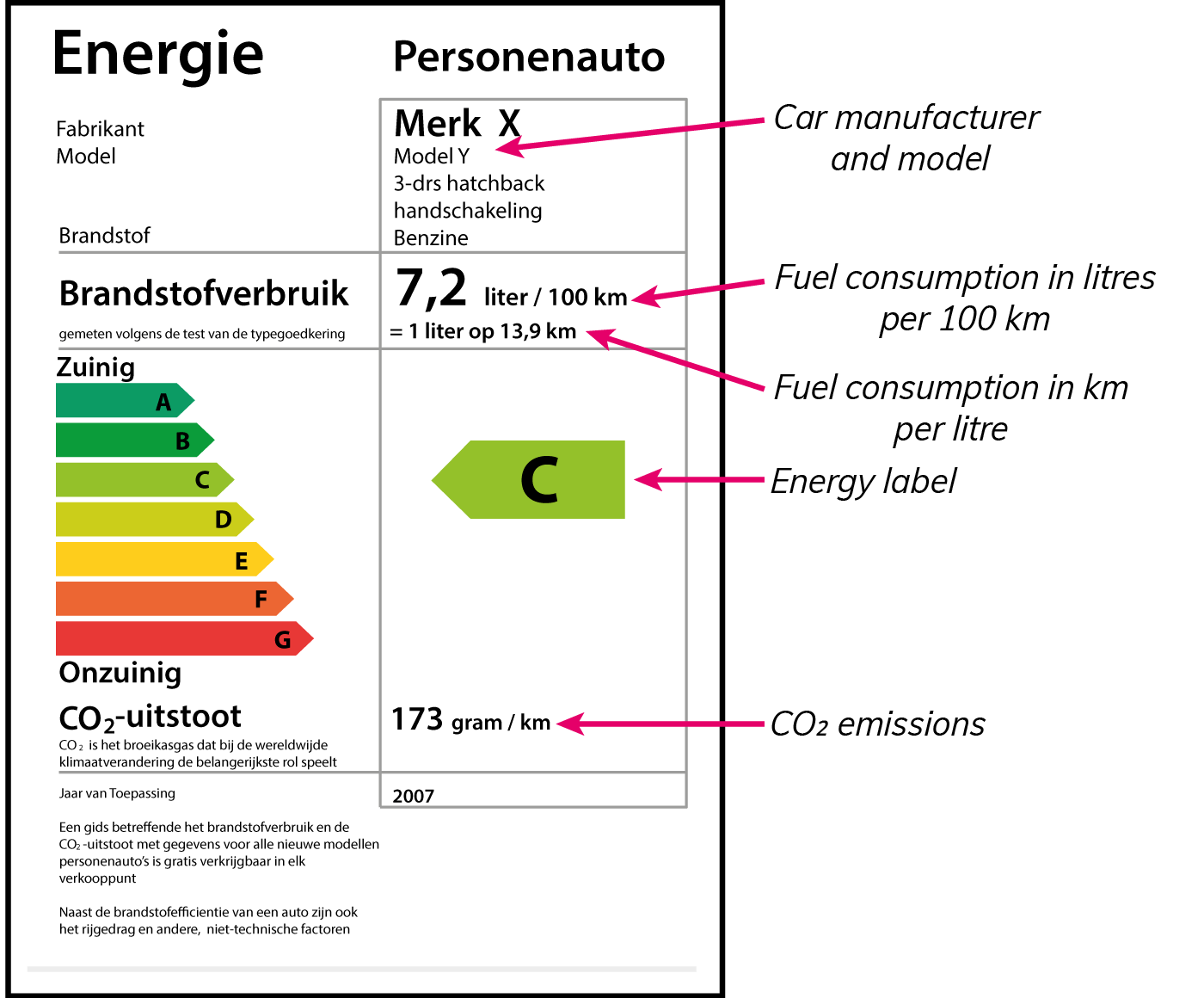
Energy label
On the basis of energy labels you can see the difference in consumption between the different brands and types. The categories on the energy label are indicated with the letters A to G and with three colours: green (A to C) for economical, yellow (D and E) for medium and red (F and G) for non-economical. The standards for these categories are reviewed every year and are related, among other things, to the fuel consumption and CO2 emissions of the vehicle.
Hazardous substances
Various hazardous substances are produced by combustion engines, such as:
- Carbon oxides (CO and CO2)
Because carbon dioxide (CO2) absorbs infrared radiation from the sun, the earth warms up (greenhouse effect). Carbon monoxide (CO) and carbon dioxide (CO2) are created when burning fossil fuels, such as petrol and diesel. A petrol engine emits more CO2 than a diesel engine. - Nitrogen oxides (NOx)
Nitrogen oxides are harmful to health and affect the ozone layer. They occur in all forms of high-temperature combustion, for example in an internal combustion engine. A diesel engine emits considerably more nitrogen oxide than a petrol engine. - Sulphur dioxide (SO2)
Sulfur dioxide is harmful to health. It is released during the combustion of certain fossil fuels. It is one of the main causes of air pollution, smog and acid rain. - Particulate matter or fine dust (PM)
Particulate matter is a form of air pollution that is harmful to health. It consists of very small particles of dust (such as soot) from combustion engines. A diesel engine causes more soot than a petrol engine, but diesel engines nowadays have a diesel particulate filter. Petrol engines do not (yet) have these. Particulate matter also consists of particles from braking friction, rubbing off rubber tires and the road surface.
Environmental zones and emission classes
Diesel vehicles are classified in a specific emission class (from 0 to 6). The higher the emission class, the cleaner the vehicle. This depends on the emission of harmful substances. Municipalities can then set up environmental zones. Within such an environmental zone, only diesel vehicles that fall within a higher emission class may enter. For example, if your vehicle falls in emission class 3, you may not enter an area that is indicated as emission class 4 or higher. The more polluting your vehicle is, the lower the emission class and the greater the chance that you are no longer welcome in certain cities with this vehicle.
Do you want to know in which emission class your vehicle falls and where environmental zones have been set? Go to www.milieuzones.nl.
Environmental measures
Passenger cars and other vehicles with an internal combustion engine are increasingly being equipped with techniques to combat the emission of harmful substances:
- Catalytic converter
A catalytic converter is part of an internal combustion engine that cleans the exhaust gases. In this way, a catalyst reduces the emission of carbon oxides and nitrogen oxides. A catalyst only works optimally when it has reached the right temperature. This is after about a 15 to 20 minute drive. That is why driving short distances is more harmful (per km) to the environment than longer ones. - Particulate filter
Diesel particulate filters are only fitted to a car with a diesel engine and reduce the emission of particulate matter. - AdBlue
AdBlue is a fluid used in diesel engines to reduce harmful emissions. AdBlue is injected into the hot exhaust gases, converting harmful nitrogen oxides into harmless nitrogen and water.
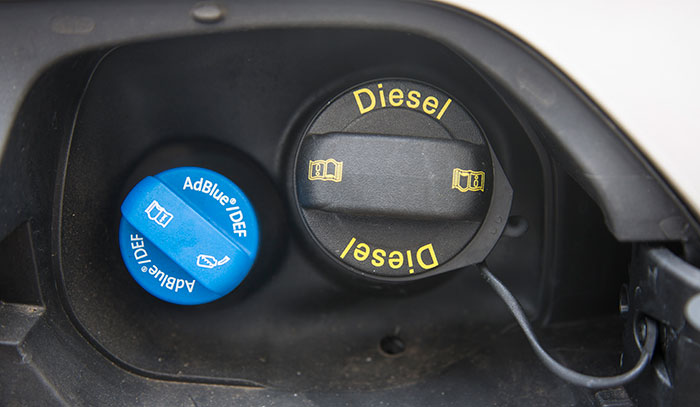
You have to refill AdBlue yourself. The filling opening is usually next to the filling opening of the diesel. But it can also be under the bonnet.
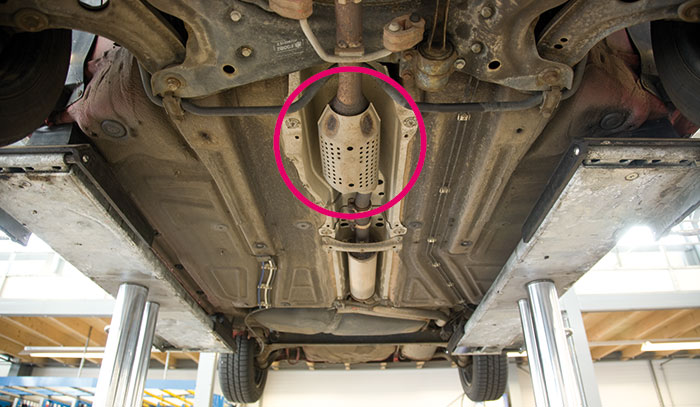
The circled part is the catalytic converter.
Environmentally-friendly driving
The greatest environmental savings can be achieved by simply not using the passenger car. If you do drive, try to limit energy consumption as much as possible and drive as energy-efficiently as possible:
- Drive away immediately after starting
Do not warm up the internal combustion engine while stationary and do not accelerate too much when driving away. - Shift gears as early as possible
In a passenger car with manual transmission, shift to higher gear as early as possible. It depends on brand and type when it is best to shift, but you can roughly say that under 1,500 rpm is too early and above 2,500 rpm is too late. - Allow the vehicle to roll
Do you expect to have to slow down or even have to stop, then let go of your gas in time and let the passenger car roll out in gear. Do not brake unnecessarily. - Maintain the tyre pressure and have it serviced on time
Ensure good tyre pressure and maintain your vehicle regularly. A well-maintained vehicle with good tyre pressure uses less energy. - Anticipate well and keep your distance
Look as far ahead as possible and anticipate other traffic. Maintain sufficient following distance, so you can drive at a more constant speed and brake and accelerate less often. - Stop the engine or use the start-stop system if you have to wait longer
If you know in advance that you will be stopping for an extended period of time, such as when waiting for a closed level crossing or an open bridge, switch off the engine if it does not do this automatically. - Use energy-saving devices
Use the cruise control, on-board computer and navigation system to drive as economically as possible. - Make the least possible use of energy consumers
Switch off air conditioning, seat heating, steering wheel heating, wing mirror heating, etc. when not needed. - Prepare in advance
Plan your route in advance. Leave on time and avoid rush hour as much as possible (traffic jams are inefficient). Avoid unnecessary weight in the car and remove a roof box, roof rack or bicycle carrier directly from the vehicle after use. Avoid short journeys. - Drive with (roof) windows open as little as possible
Open windows provide more air resistance. The passenger car is then less streamlined and therefore consumes more energy.
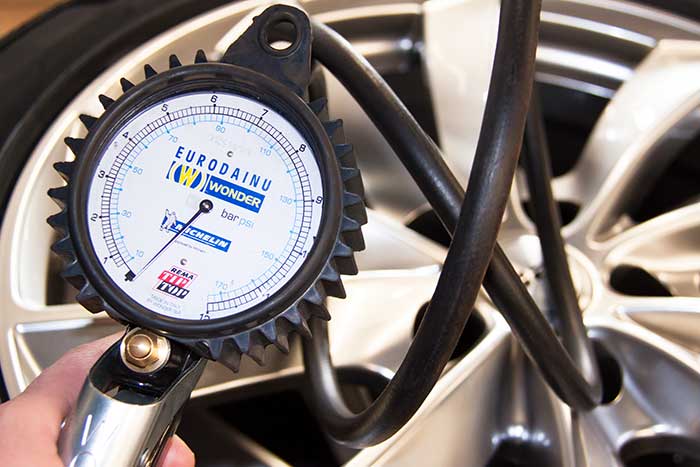
Driving with insufficient tyre pressure will increase energy consumption.
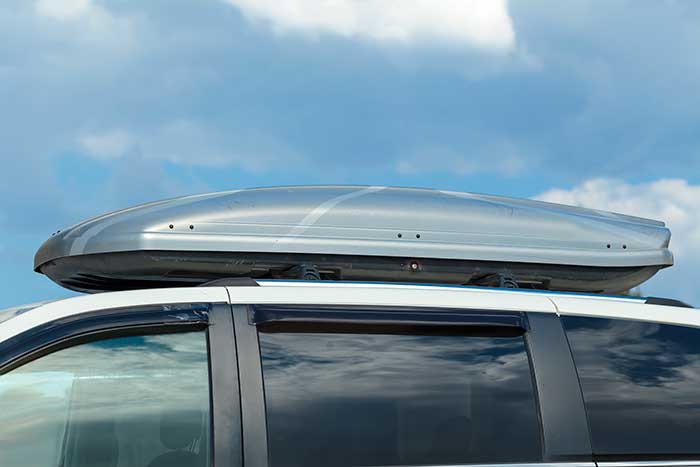
A roof box will create more air resistance and therefore increase energy consumption