

Obstacles to visibility
In addition to rain, winter precipitation, and fog, other circumstances can also severely impact visibility – both during the day and at night.
Low sun
Low sun is particularly an issue during spring and autumn, and more of a concern in the morning and late afternoon. Driving with the sun’s glare facing you significantly reduces visibility. If your windscreen has not been cleaned, this can become dangerous. You may overlook other traffic, bends, and traffic lights. If this occurs, release the accelerator to reduce your speed immediately.
Clean your windscreen regularly – on the outside and the inside! Always have extra windscreen washer fluid in your car in case it runs out. Wear sunglasses and use the sun visor to protect yourself against the sun’s glare.
If the low sun is behind you, keep in mind that oncoming traffic may not immediately notice you due to the sun’s glare impacting their visibility. Always use dipped headlights when the sun is low to remain visible to other traffic.
Shadow under trees
Dipped headlights may also become necessary on sunny days, for example when driving alongside overhanging trees and branches. The sunlight shining through the trees creates a glare that impacts visibility, and vehicles not using dipped headlights are less visible to other traffic. Drivers are also advised to keep this in mind when overtaking other vehicles on this type of road.
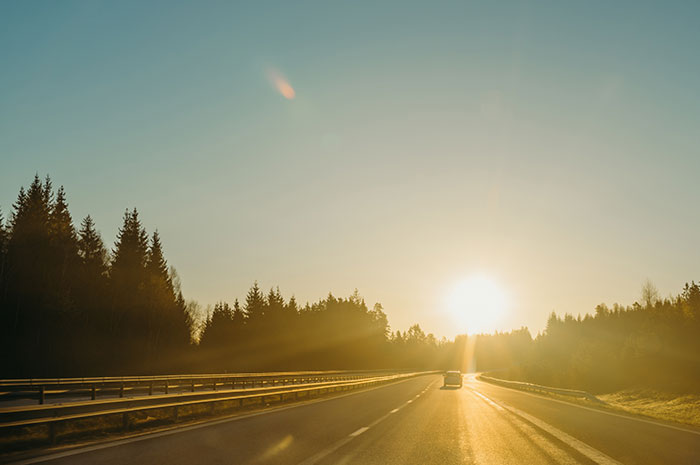
Low sun can be blinding.
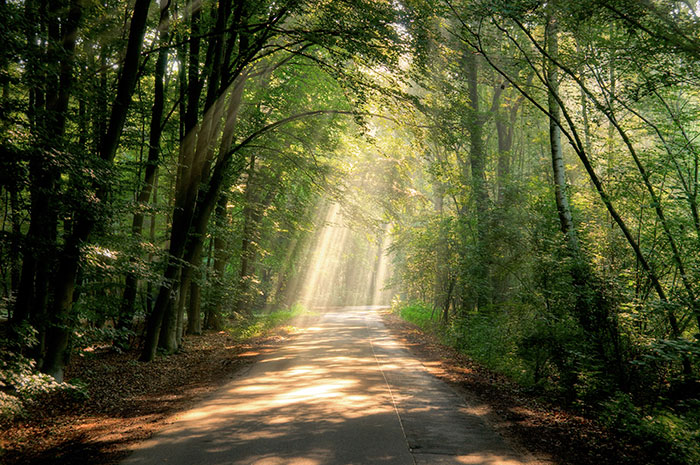
The glare of the sun’s rays between the trees can seriously obstruct the view on a sunny day.
Twilight
Your vision is always reduced in twilight hours, when colours begin to fade. Your eyes need time to adjust to the diminished light, and this happens more quickly for some than others. It is easy to assume you can still see reasonably well in twilight, and therefore do not need to use dipped headlights. This is why poorly-lit and barely visible vehicles are more commonplace when driving in twilight hours than when driving in the full darkness.
Dark
Of course, our vision is much worse at night than during the day. Even when using sufficient lighting, many things remain unlit and therefore difficult to see. Pedestrians, poorly-lit cyclists, and obstacles on unlit roads are often not immediately visible.
Adjust your speed to account for visibility. Try to anticipate the course of the road using street lamps, road markings, lighting, and road signs. Use full-beam headlights if necessary, but dim these immediately when you encounter oncoming traffic or if there is a vehicle in front of you. On roads with no lighting and no pavement, do not drive against the verge. Remain closer to the middle of the road as much as it is safe to do so. This also protects pedestrians or cyclists on the side of the road.
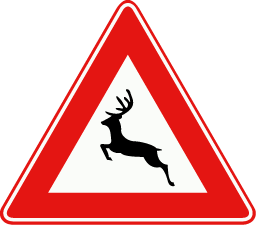
J-27
Wild animals
In the twilight and dark, also take into account any crossing wildlife. In places where this occurs frequently, the J-27 sign usually indicates this. The risk of crossing wildlife is greatest at night. Mitigate the risk of a collision by reducing your speed.
If you come across wild animals, do not try to avoid it. Prefer braking. When swerving you have a high chance of ending up on the wrong side of the road or on the verge, with a high risk of accidents.
For small wildlife such as rabbits or hares, it is safer not to make an emergency stop. Suddenly braking increases the risk of rear-end collisions, while the risks of a rabbit or hare collision are only small for you.
If you have had a collision with an animal, you are obliged to call the animal police. There is a special emergency number for this: 144. The police can take measures to help the animal if necessary, or to release it from its suffering. This is also mandatory for a pet if no owner is present.
In the event of a collision with an animal, always contact the animal police. They can be reached on telephone number 144.
Polder blindness and tunnel vision
Polder blindness arises when you look too far into the distance on long, straight and monotonous roads. You then stare and your field of vision becomes narrower. This is called ‘tunnel vision’. Side roads are therefore less noticeable. You can easily overlook vehicles approaching these side roads. This sometimes causes accidents at intersections where you would not immediately expect this due to good visibility.
Stay aware of your viewing behavior and avoid staring by shifting your gaze every few seconds.