

Maintaining distance
The more space around your vehicle, the less likely you are to collide with other vehicles. Many drivers struggle with this, and the sheer amount of traffic on Dutch roads does little to help. A lack of following distance often borders on so-called tailgating, at which point the vehicle behind has no time to react should the vehicle in front start to brake.
Tailgating is very dangerous and punishable with significant fines. In addition, drivers who collide with the rear of another vehicle are automatically at fault almost 100% of the time. Failure to maintain adequate following distance is one of the leading causes of traffic accidents on the motorway.
- Braking deceleration
A passenger car must have a statutory minimum braking deceleration. This minimum braking deceleration specifies how much slower a car should go per second if you brake heavily. Braking deceleration is indicated in m/s2. The higher this number, the shorter the braking distance.
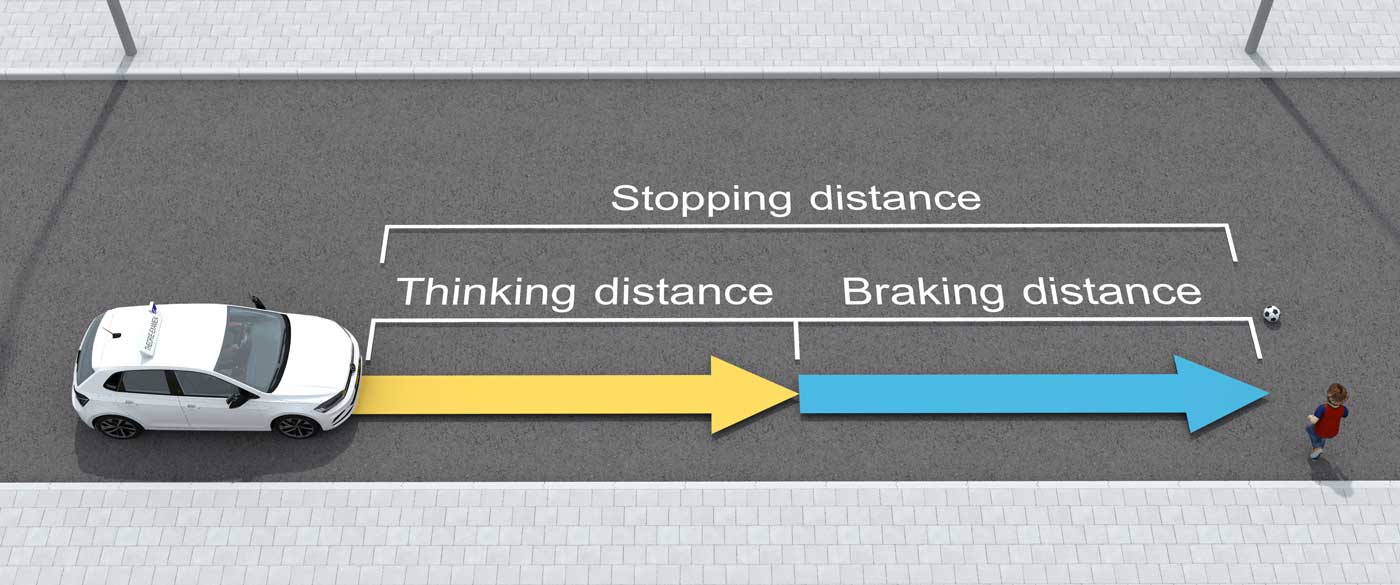
Stopping distance
Traffic regularly requires drivers to handle both expected and unexpected situations that necessitate braking. It is important to remain aware of the distance you will need to come to a stop – your stopping distance. Stopping distance includes not only braking distance, but also the distance you cover in the time it takes to begin braking – the thinking time.
Stopping distance = Thinking distance + Braking distance
Thinking time (also known as response time)
If you encounter an unexpected situation, you must respond. This follows a fixed pattern:
- Observing
Notice something that you may need to react to. - Predicting
Predict what this means for you and which options you have. - Evaluating
Compare these options. - Deciding
Selecting the best option. - Handling
Act according to your decision.
Thinking time determines how quickly you observe, predict, evaluate, decide, and act. The thinking time of a healthy, alert, and experienced driver is approximately one second. This means it takes one second from the moment you observe a reason to brake until the time you press down on the brake pedal.
During this second, you continue driving at the same speed. The distance covered during this time is the thinking distance. To calculate this, divide the speed (in km/h) by four and then add 10%. This number is the thinking distance in metres.
(Speed : 4) + 10% = Thinking distance in metres1
Example: (60 km/h : 4) + 10% = 15 + 1.5 = 16.5 metres
Braking distance
Applying the brakes does not mean the vehicle comes to a stop immediately. This
depends on the quality of the brakes (braking deceleration) and the speed you are driving at. The distance you travel in that time is the braking distance. This distance increases by a factor of four as your speed doubles, which means the braking distance becomes four times longer when the speed is twice as high.
Weather conditions and the road surface can also affect braking distance.
To calculate the braking distance, divide the speed (in km/h) by ten and multiply that number by itself, then divide the result by two. This number is the braking distance in metres.
(Speed : 10) x (Speed : 10) : 2 = Braking distance in metres1
Example: (60 km/h : 10) x (60 km/h : 10) : 2 = 6 x 6 : 2 = 18 metres
| Thinking distance | Braking distance | Stopping distance | |
|---|---|---|---|
| 60 km/h | 16.5 metres | 18 metres | 34.5 metres |
| 80 km/h | 22 metres | 32 metres | 54 metres |
| 130 km/h | 35.75 metres | 84.5 metres | 120.25 metres |
Following distance
The distance between the front of your car and the rear of the vehicle in front of you is the following distance. Failure to maintain adequate following distance is prohibited. To determine a safe following distance, use the ‘two-second rule’. This means that if the vehicle in front passes a street lamp or a road sign, it should take two seconds for you to reach the same lamp or sign.
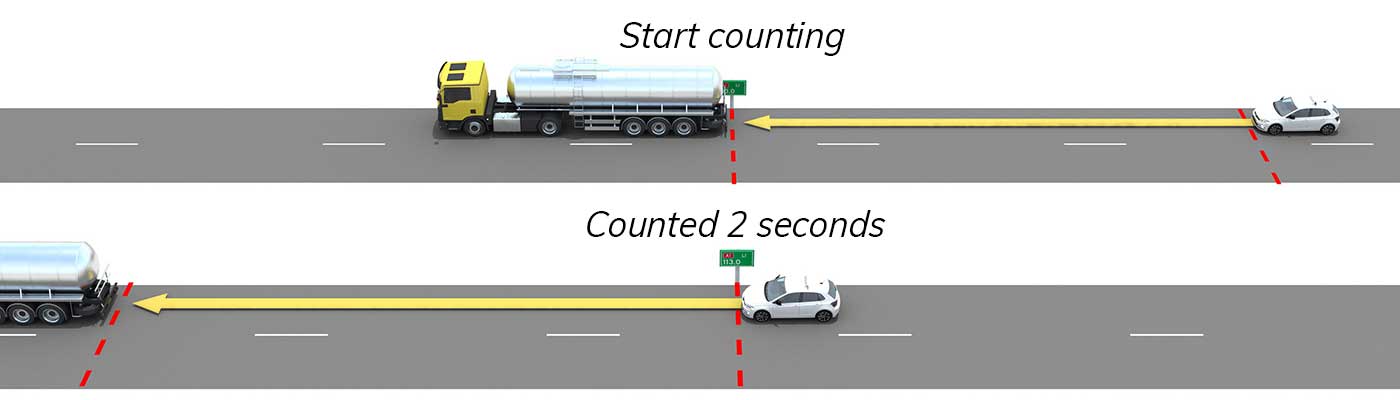
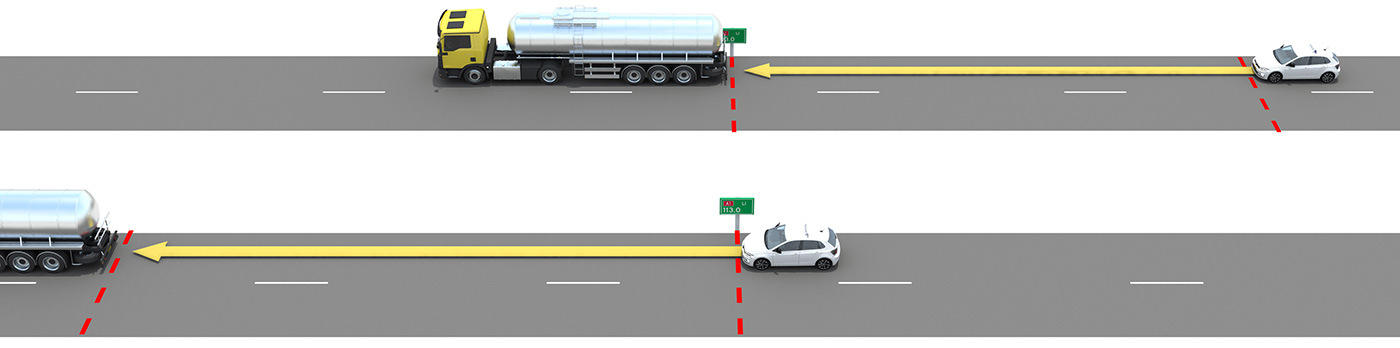
To calculate the approximate following distance in metres, divide your speed (in km/h) by two and add 10% to that number.
(Speed : 2) + 10% = Following distance in metres1
Example: (60 km/h : 2) + 10% = 30 + 3 = 33 metres
1 These calculations are mentioned here to create awareness. You will not be asked to calculate these distances at the CBR.
Poor conditions
The following distance in line with the ‘two-second rule’ is a minimum following distance based on good road and weather conditions, an alert driver, and adequate road holding.
The braking distance for a car in poor condition will be longer. The same applies in bad road or weather conditions, during which the road provides less grip. In these cases, drivers are advised to maintain an increased following distance.
Poor visibility due to rain, fog, or snow, or reduced alertness, can affect your perception and reaction, which increases the thinking distance. Also in these cases, drivers are advised to maintain an increased following distance.
Estimating the minimum following distance in these types of situations requires insight and experience. However, guidelines state that three or four seconds should suffice.
To find out how to recognise poor road surfaces and subsequent reduced road holding, look at:
- Type of road surface and its condition
A wet road surface provides less grip, just like a road surface with holes or loose gravel or sand. In addition, for example, a paved road gives less grip than an asphalt road. - Road banking
In bends, roads are usually sloped slightly, with the inner bend being slightly lower than the outer bend (positive road banking). This provides more grip when cornering. If the outer bend is lower than the inner bend due to circumstances (negative road banking), you will have less grip in the bends.
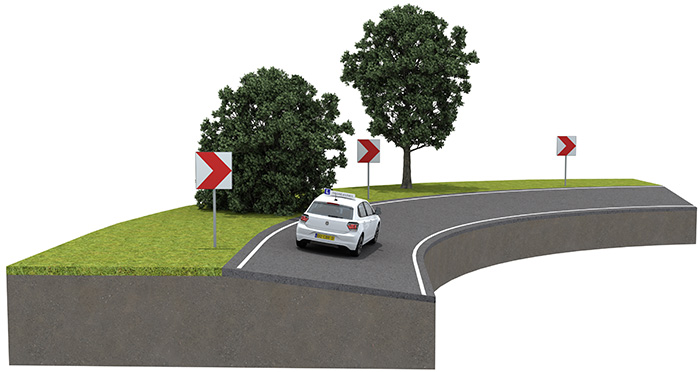
Positive road banking.
The inner bend is lower than the outer bend.
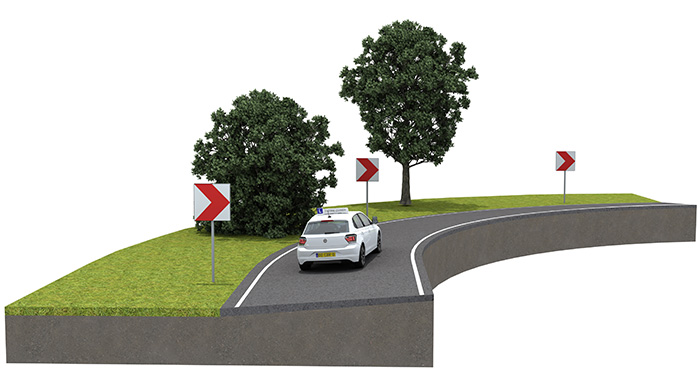
Negative road banking.
The outer bend is lower than the inner bend.
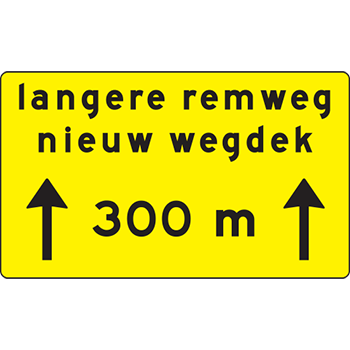
- New road surface
With a new road surface, you would expect that the grip is good right away. However, this is not the case. A road must first be ‘broken in’ before it is rough enough. A new road surface is therefore slippier in the beginning.