

Road (surface) markings
In addition to traffic signs and traffic lights, traffic is also controlled by markings on the road surface. These can be markings such as lines, but also road-painted numbers that indicate the speed limit or markings such as priority triangles and arrows.
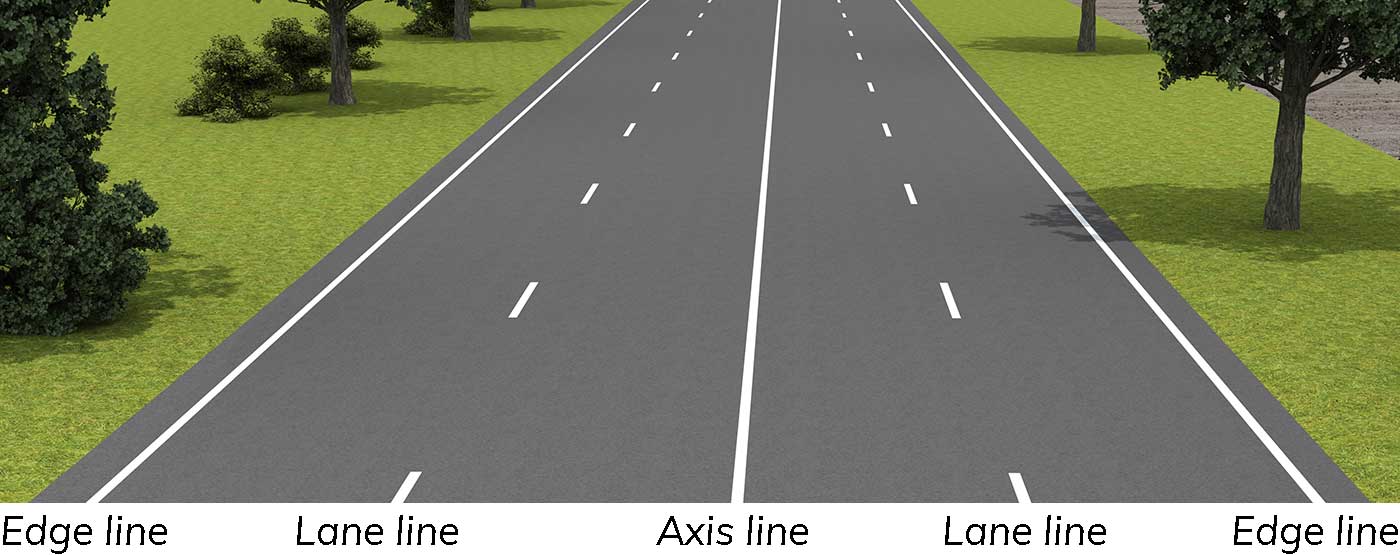
- Edge line
Line on the edge of the carriageway.
- Centre or axis line
Line in the middle of the carriageway, marking the separation between your side of the road and that of oncoming traffic.
- Lane line
Line that divides a carriageway or part of the road for one direction into lanes.
Solid line
Edge lines, axis lines and lane lines can be implemented as a solid line. Solid lines may not be crossed. In the case of a solid axis line, you may not drive at the left of this line (on the side of the oncoming traffic). In case of a solid line you may not change lanes or overtake.
The following exceptions apply:
- An edge line may be crossed, for example to park in the verge.
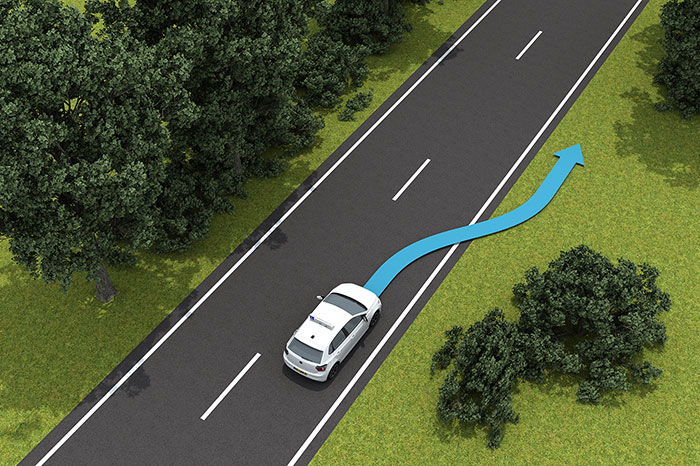
- A solid line between the carriageway and the adjacent refuge, hard shoulder, or rush hour lane may be crossed if you have to use this refuge or lane.
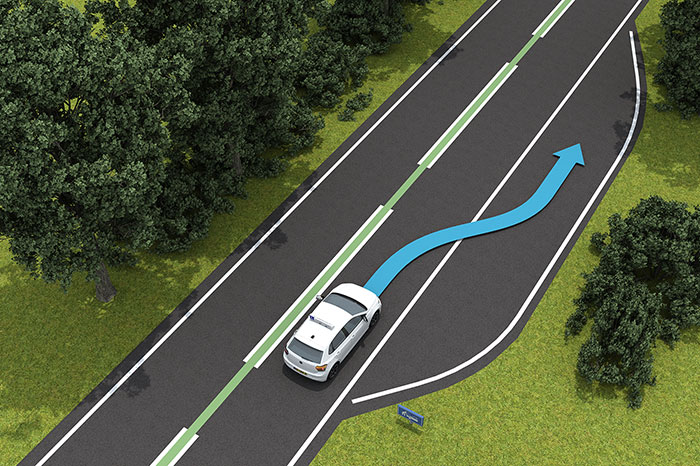
- If there is a broken line on your side of the solid line, you may cross the solid line.
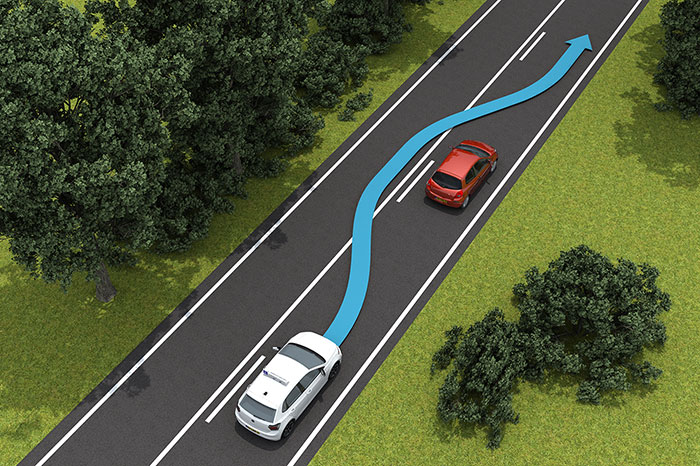
- Drivers who are allowed to use a cycle lane with solid line may cross this solid line, for example to overtake another cyclist.
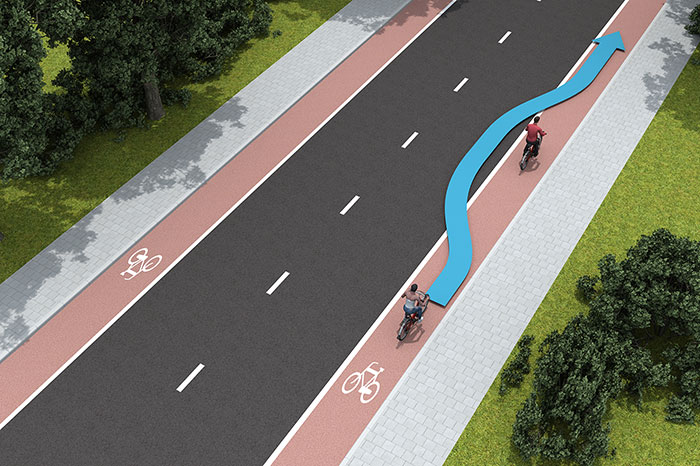
Broken lines and warning lines
If an axis line or lane line is implemented as a broken line, it may be crossed. In that case, if you can do so safely, you may overtake or change lanes.
Normally, with a broken line, the line is shorter than the space between the lines. If the line is longer than the space between the lines, you should see the broken lines as warning lines. This means that you are allowed to overtake, but that overtaking is more dangerous here than with a normal broken line.
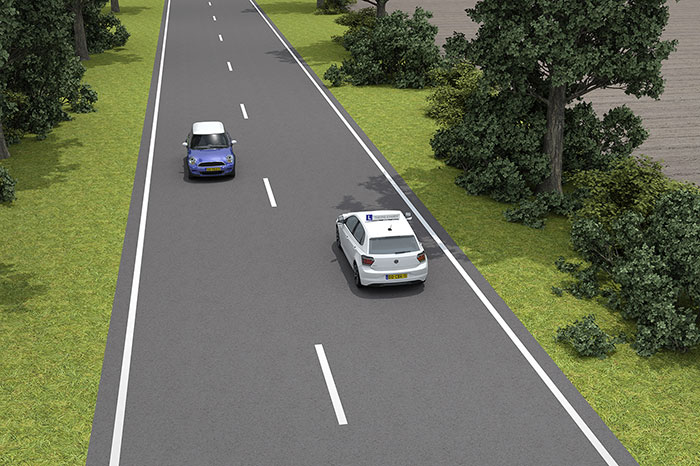
Normal broken axis line.
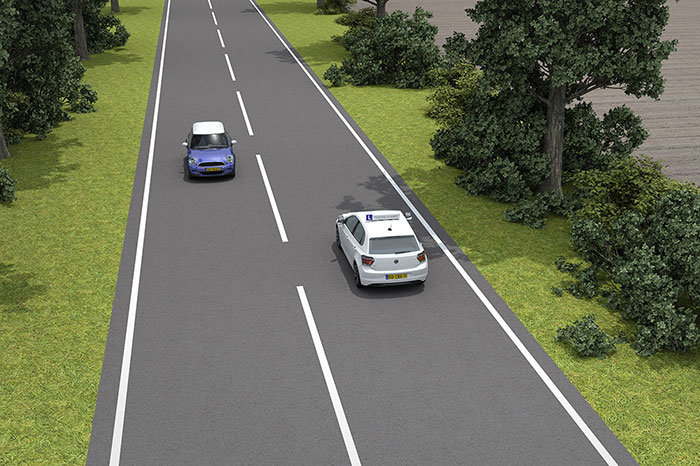
Axis line designed as a warning line.
Hatched road markings
These surfaces consist of oblique lines and may not be driven on. For example, hatched road markings are used in places where a lane ends and drivers have to merge into an adjacent lane.
Dividing point
You will find a dividing point especially at the acceleration and deceleration lanes of autowegen and motorways. This should not be crossed.
Hatched road marking and dividing points no longer apply if they are on an open rush hour lane. In that case, it is allowed to drive over them.
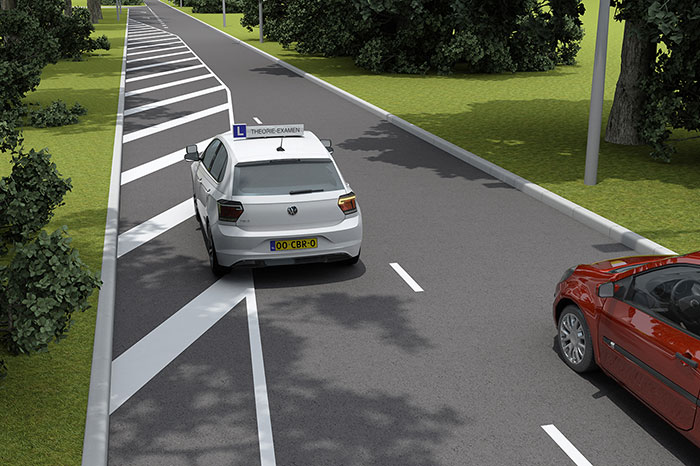
Driving over hatched road markings is not allowed.
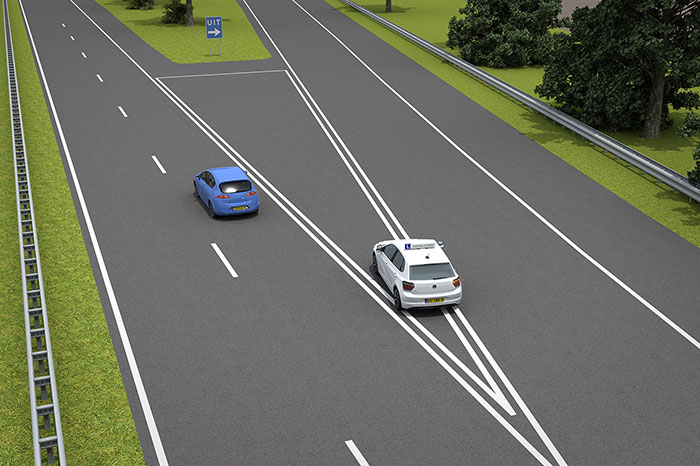
Driving over dividing points is also not allowed.
Pre-sorting lanes, deceleration lanes and arrows

Pre-sorting lanes are located at (large) intersections and divide the carriageway into lanes for different directions. Arrows on the lanes indicate the direction. Block marking is applied between the lanes in different directions. Exceeding this block marking is allowed until the block marking transitions into a solid line. At the intersection, drivers are obliged to follow the direction indicated by the arrow on the pre-sorting lane used. Pre-sorting before turning left and then driving straight ahead at the intersection is therefore not permitted.
A special arrow that can appear on the pre-sorting lane is an arrow with a hammerhead symbol. In most cases, this indicates that there is a side road ahead of the turn. You may not turn into this side road.
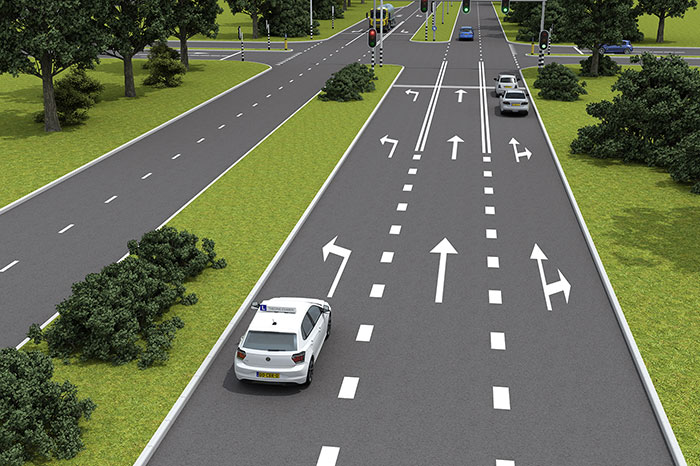
Pre-sorting lanes with directional arrows. You can still change direction here.
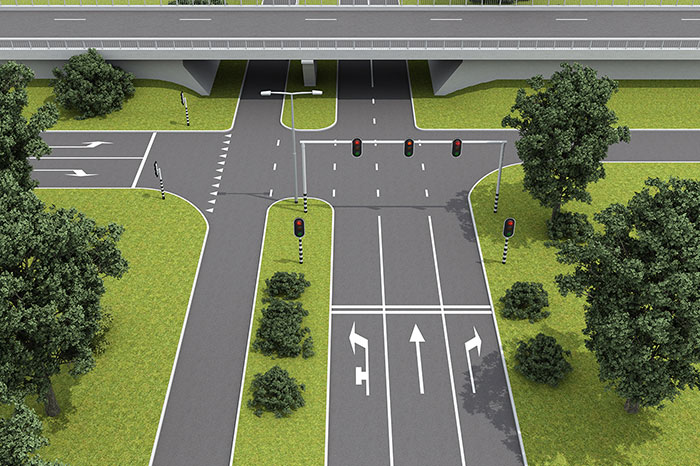
The pre-sort lane for turning left has a directional arrow with hammerhead symbol. You are not allowed to enter the first side road on the left.
Deceleration lanes are lanes adjacent to the main carriageway that are used to exit the main carriageway, primarily on autowegen and motorways. These lanes are also separated from the main carriageway by block marking.
As soon as there are arrows on the deceleration lane, you may no longer return to the main carriageway from the deceleration lane. This rule is there to prevent traffic jams from being passed over a deceleration lane or weaving lane (combined acceleration and deceleration lane).
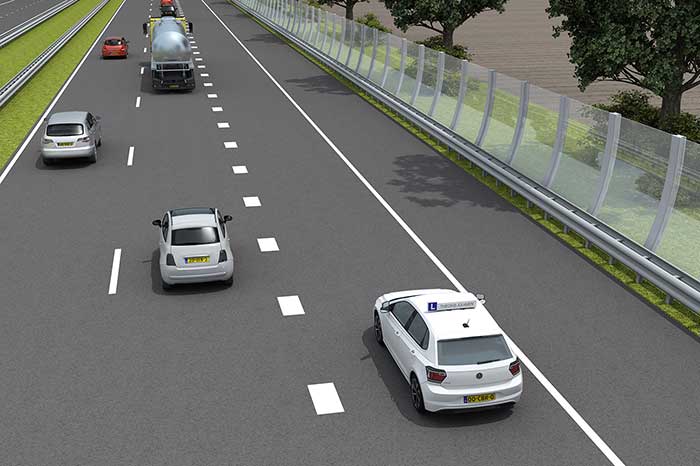
Weaving lane without directional arrows. You are still allowed to return to the main carriageway.
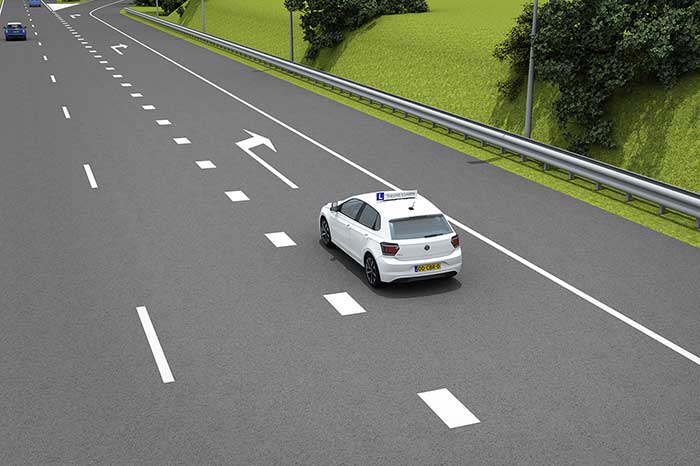
Deceleration lane with directional arrows. You are no longer allowed to return to the main carriageway.
Stop line (yield line)
At an intersection where the sign ‘STOP’ is placed, a stop line must be placed on the road surface. Drivers must stop in front of the stop line, regardless of whether other traffic is present or not.
Usually stop lines are applied in such a way that you have a good view from the stop line of the situation for which you have to stop, such as an intersection or crossing. The line at a traffic light is also called a stop line. In that case, you only have to stop in front of the stop line if the traffic light is yellow or red.
Priority triangles (shark teeth)

These are white triangles that are placed on the road surface. Priority triangles mean: ‘give priority to drivers on the intersecting road.’ They are usually used in conjunction with sign B-6, but this is not mandatory. Even without this sign, they have the same meaning.
Before you reach the priority triangles, the priority situation is sometimes already announced by means of a large warning triangle on the road surface.
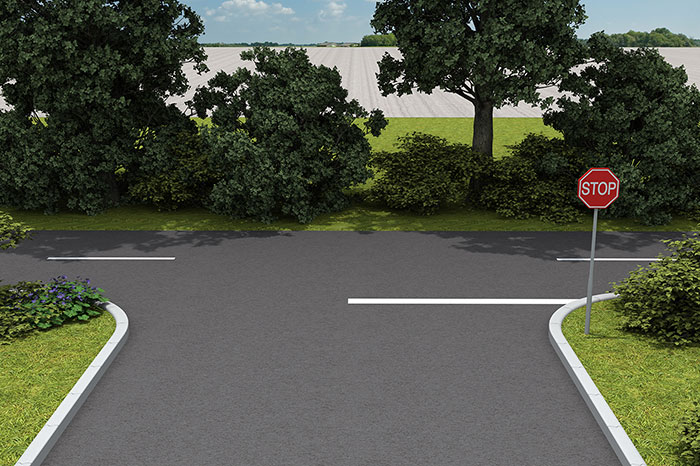
Stop sign B-7 with stop line.
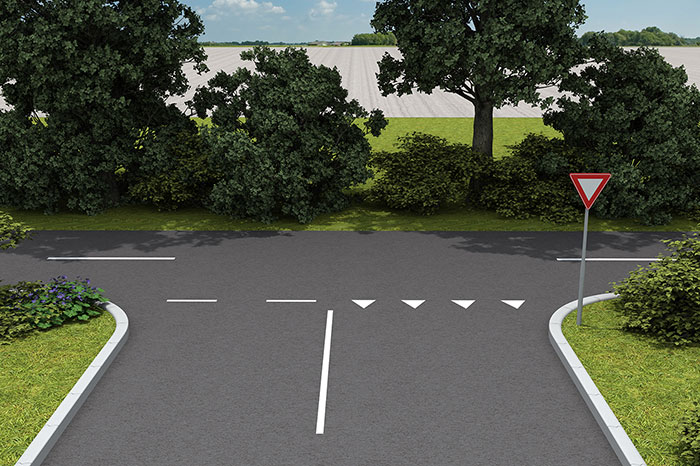
Priority sign B-6 with priority triangles or shark teeth.
Bus lanes and bus carriageways
This is a lane or carriageway with the word ‘BUS’ or ‘LIJNBUS’ (public bus) applied. A bus lane is separated from the rest of the carriageway by a broken or solid line.
In the case of the word ‘BUS’, only drivers of buses (including coaches) and public buses may use this lane.
In the case of the word ‘LIJNBUS’, only drivers of public buses may use this lane.
Emergency vehicles are also allowed to use the bus lane or carriageway as they do not have to adhere to closed declarations, provided they have an urgent task to fulfil.
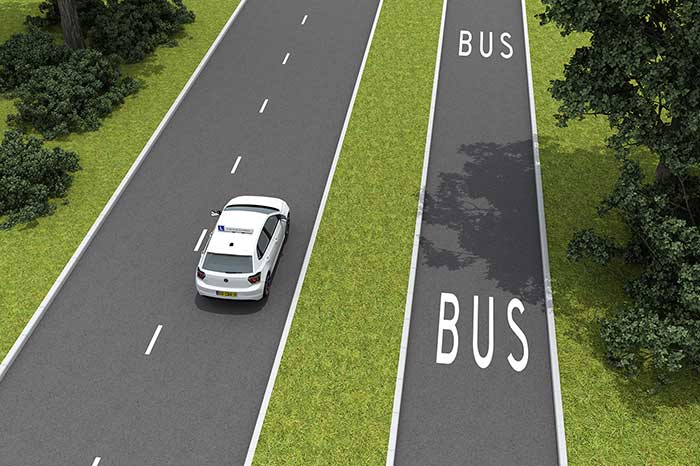
A bus carriageway lies separate from the main carriageway.
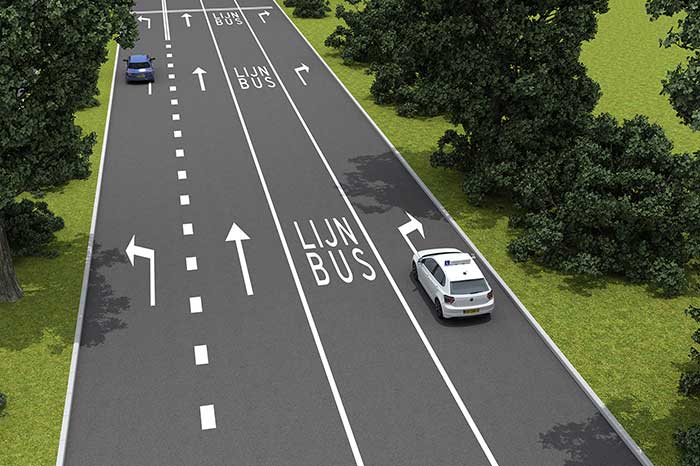
A bus lane is part of the carriageway, separated with a solid or broken line.
Cycle lanes and suggested (cycle) lanes
A cycle lane can be separated by a broken or solid line. In addition, a symbol of a bicycle must be affixed to the road surface. If this is not the case, then this is a suggestion (cycle) lane and no official cycle lane.
Suggestion (cycle) lanes have no legal meaning. They can be used by anyone. You are even allowed to stop and park on it.
A special type of cycle lane is the bike box. This is an extended cycle lane in front of the normal presorting lane. The purpose of this area is to keep vulnerable road users, like cyclists, more safe and visible to the other drivers while waiting at the traffic light.
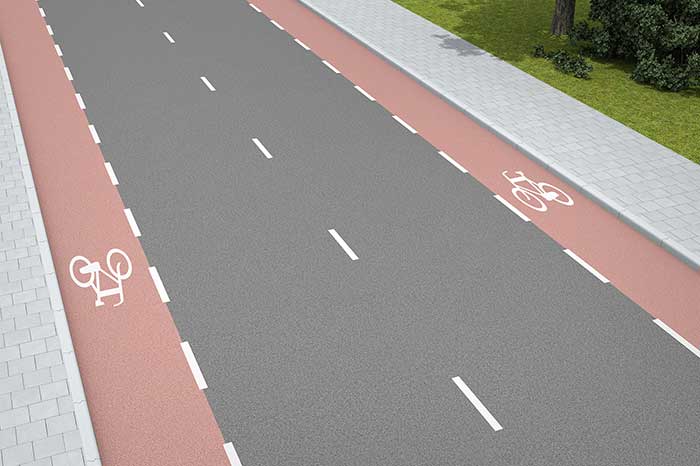
A cycle lane can be recognised by the bicycle symbols on the road surface. If these are missing, it is not an official cycle lane but a suggestion (cycle) lane.
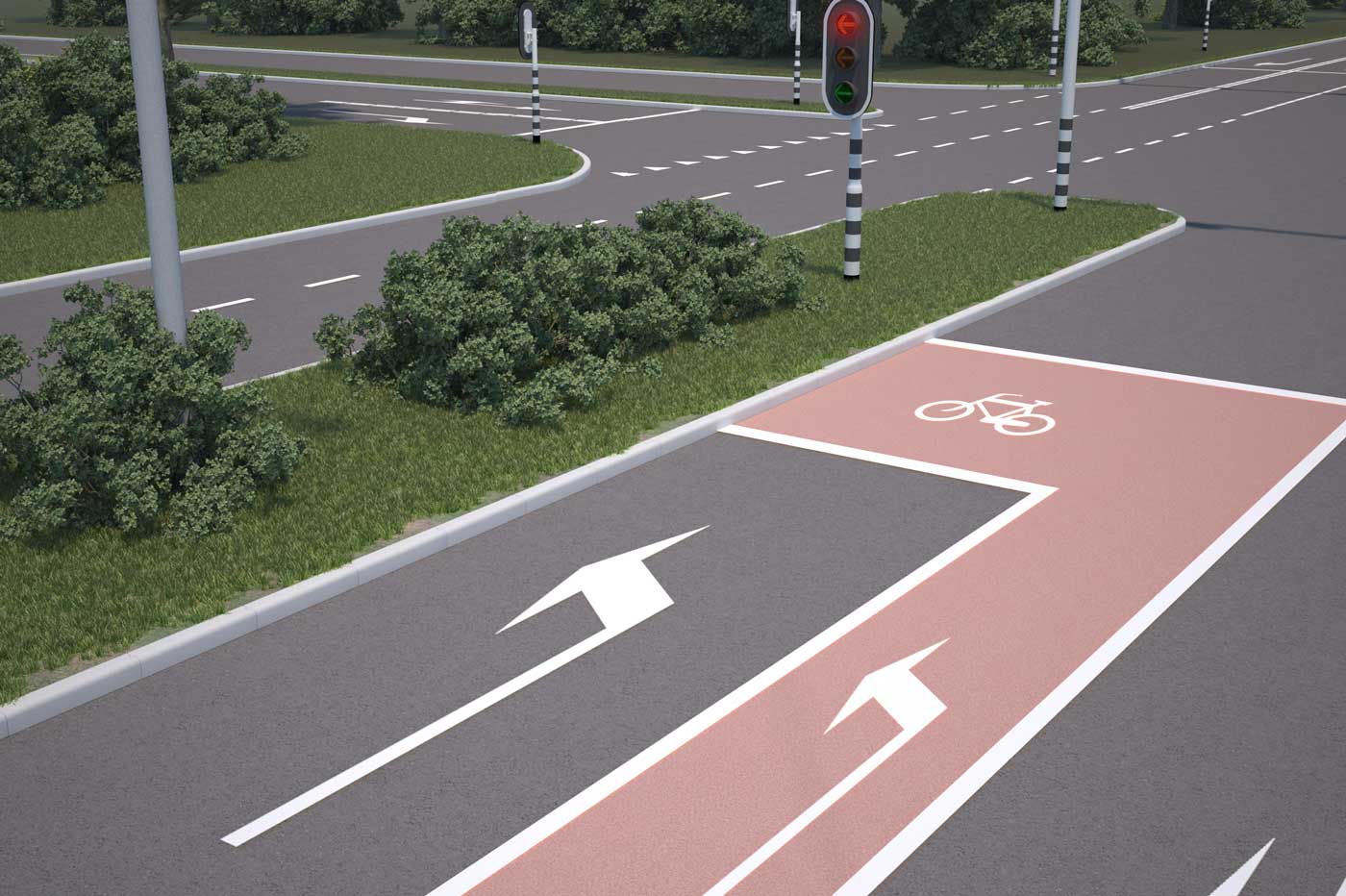
This bike box keeps cyclists, snorfietsers and drivers of disability vehicles more visible while waiting at the red light. Other drivers have to presort behind the bike box.
Yellow lines on the side of the road
Solid and broken yellow lines can be found on kerbs or carriageway edges. Next to a broken yellow line, only parking is prohibited. Next to a solid yellow line, not only parking but standing still is also prohibited.
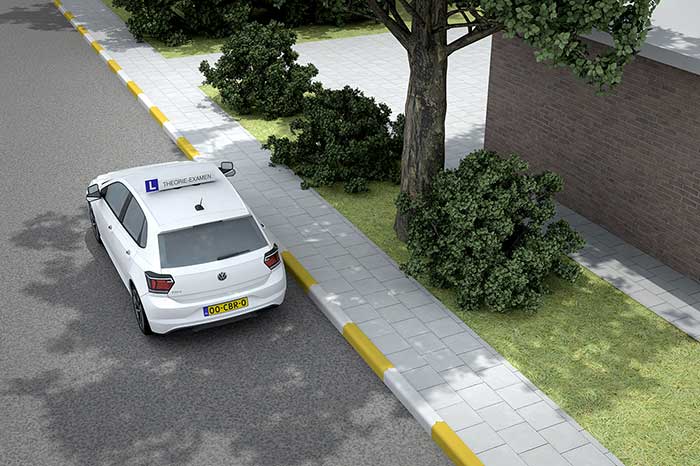
Broken yellow line on the kerb. You are not allowed to park here.
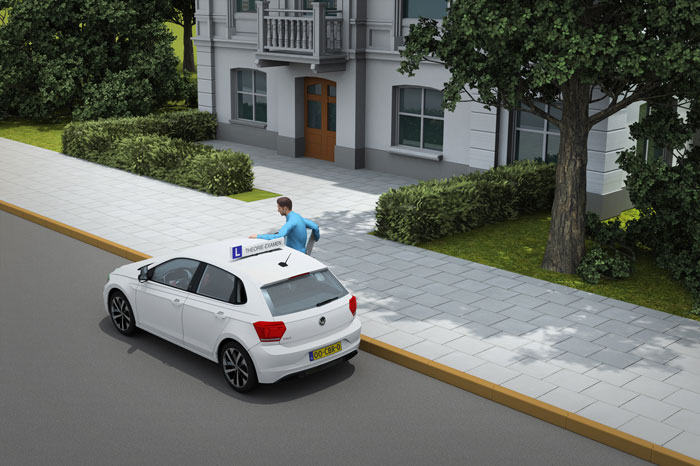
Solid yellow line on the kerb. It is not allowed to stand still here, not even to drop off or pick up a passenger.
Yellow lines on the road surface
Yellow lines can also be seen on the road surface as temporary lines and markings during roadworks. These then go above the local white lines and markings. Be aware that maximum speed limits are often lower here, and lanes can be narrower. Especially the left lane on motorways during road works.
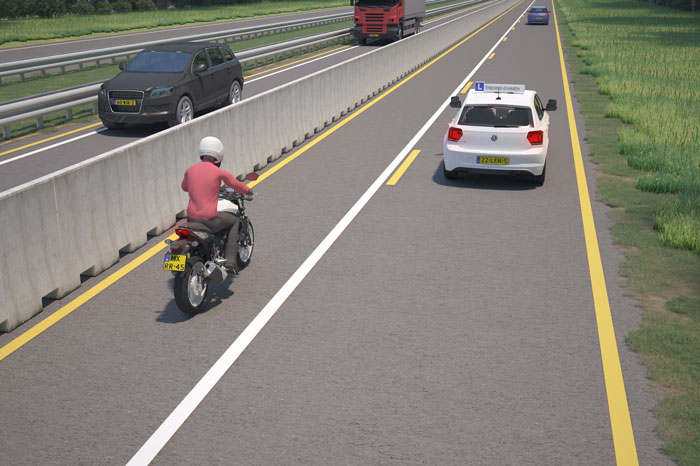
Yellow lines on the road surface during roadworks. These go above the white lines. The left lane is narrower here.
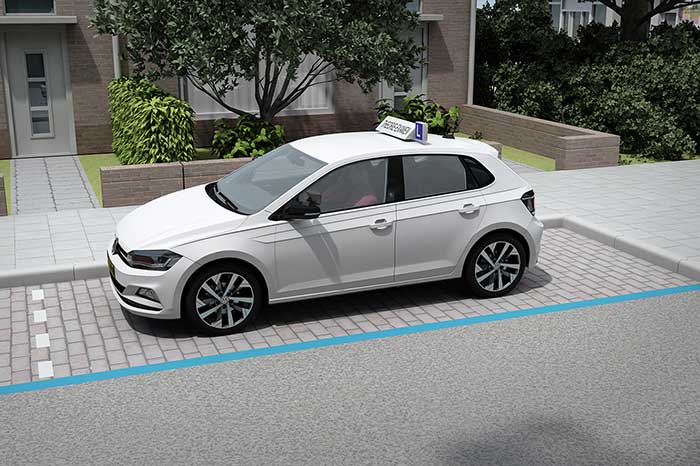
Blue line next to the parking space. Here you must use a parking disc.
Blue lines
Blue lines are used on the road in parking bays and parking lanes where the use of a parking disc is mandatory.
Blocked or checkered markerings
You will find this marking on the pavement at bus stops and it shows which space the bus needs to be able to stop at the bus stop. The blocked markings immediately indicates a prohibition. You may not stop at this marking, except for picking up or dropping of passengers.
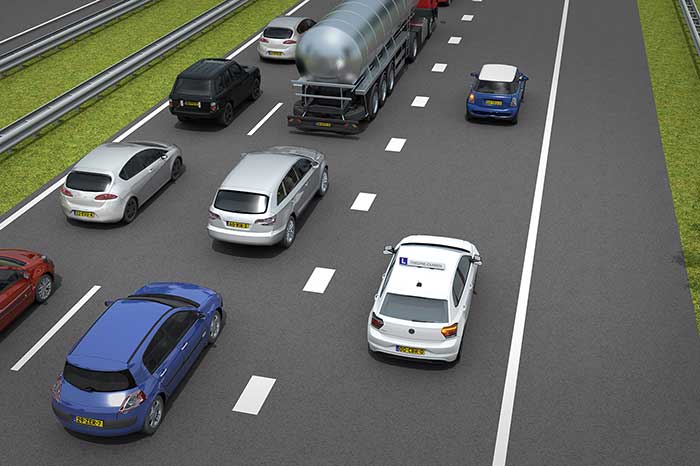
Here you see block marking, for example, between the weaving lane and the main carriageway.
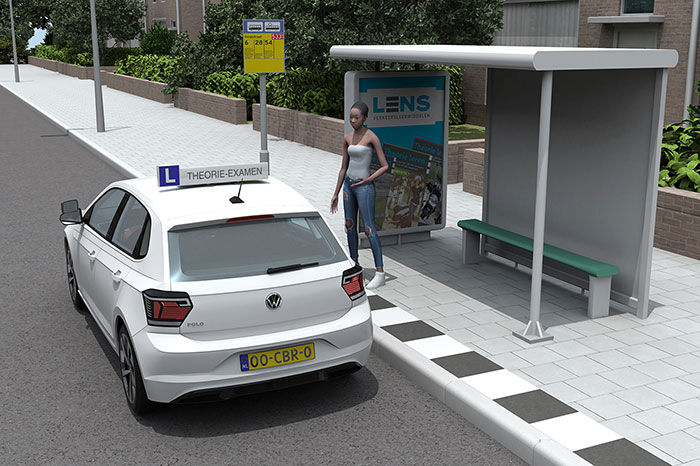
You often find blocked (checkered) markings at a bus stop.
Block marking
This is different from blocked markings at bus stops. Block marking is encountered on the carriageway between two lanes, for example at acceleration, deceleration and weaving lanes and pre-sorting lanes.
Zigzag lines
These are lines that have been placed on the road to warn you of a dangerous point. This could be a crossing point or a dangerous intersection, for example. This marking says nothing about the prevailing priority, but in that case it is wise to reduce your speed.
Auxiliary markings
This includes markings applied to the road as an aid. For example, the speed limits that are applied to the road surface. But also the lines that indicate that you enter or leave a zone and the lines that mark a speed bump are classed as auxiliary markings.

Speed bump markings
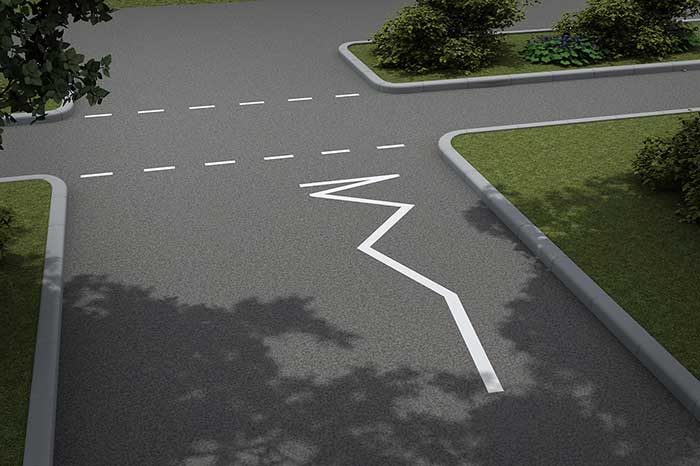
Zigzag lines warn you of a dangerous point.

Zone markings are an additional aid to clarify the zones.
Speed limit markings
Especially on newer roads you can tell the speed limit by looking at the markings (lines) on te road. Those markings are not legally binding, but suggest a speed limit. The actual speed limit should always be indicated by signs.
Autoweg (100 km/h)
An autoweg with a single carriageway has solid edge lines, and two solid or broken axis lines. Between those white axis lines lies a green line.
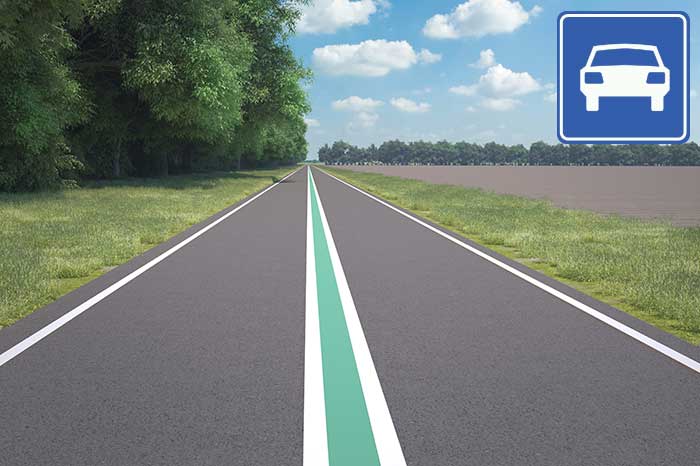
The green axis line indicates that you are on an autoweg. Overtaking is prohibited due to the solid white axis lines.
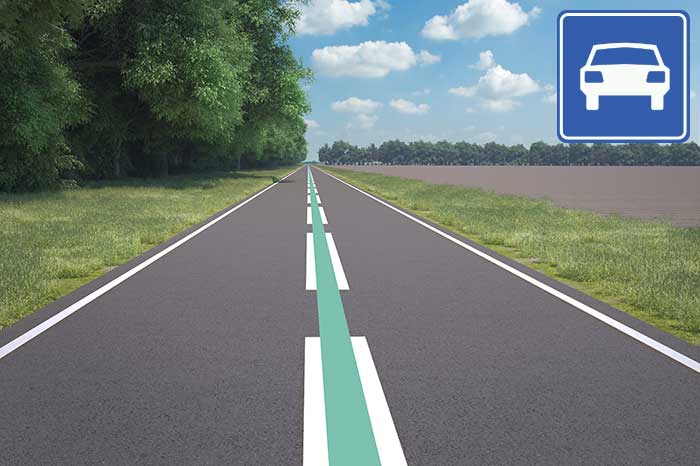
The green axis line indicates that you are on an autoweg. Overtaking is allowed due to the broken white axis lines. Use caution while overtaking.
Road outside built-up area (80 km/h)
A 80 km/h road normally has broken edge lines, and one or two solid or broken axis lines. There is no green line between the axis lines.
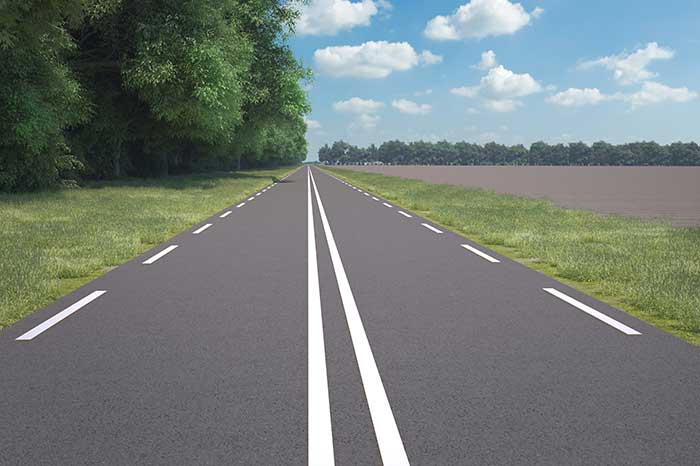
There is no green axis line. This is a normal 80 km/h road outside built-up areas. Overtaking is prohibited due to the solid white axis lines.
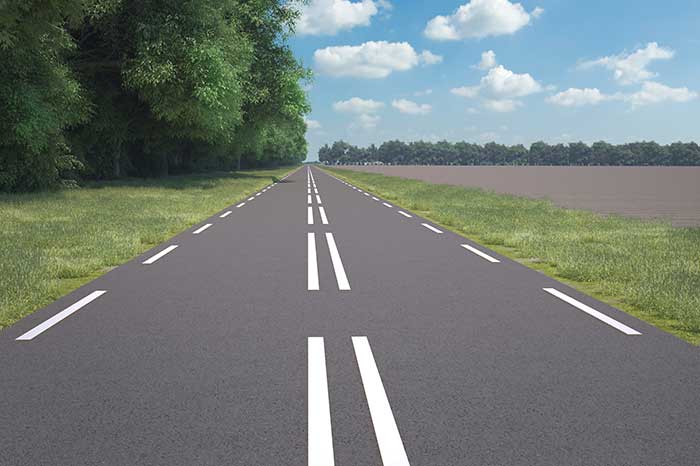
There is no green axis line. This is a normal 80 km/h road outside built-up areas. Overtaking is allowed due to the broken white axis lines.
Reduced speed road outside built-up area (60 km/h)
A road within a 60km-zone normally has broken edge lines, which are placed slightly further from the verge. Sometimes the road has red suggestion (cyle) lanes. There is no axis line. And sometimes the lines are not present at all.
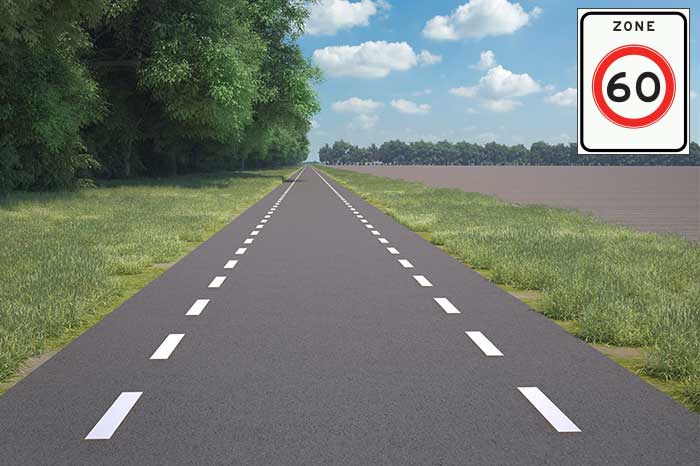
There is no axis line, which indicates that this is a 60 km/h road outside built-up areas. However, there has to be a 60km-zone sign for it to be a 60km-zone!
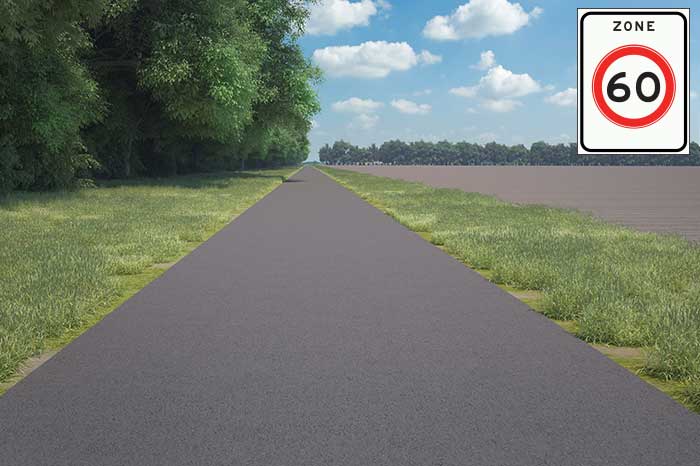
There are no lines at all, which indicates that this is a 60 km/h road outside built-up areas. However, there has to be a 60km-zone sign for it to be a 60km-zone!