

Turning off
If you do not want to drive straight on at an intersection, but turn left or right, you still have to deal with a number of traffic rules. In that case you have to give way to many more road users than when simply driving straight on. Also take road users in the blind spot into account.
- Blind spot
The area next to and diagonally behind the vehicle that you cannot see through the mirrors. This area can only be (and sometimes only partly) overlooked by turning your head and looking closely next to and diagonally behind you. In larger vehicles, the blind spots are also larger and more blind spots are added, such as directly behind and just in front of the vehicle.

The coloured part can be seen with the mirrors. Outside the coloured part cannot be seen with the mirrors, you have to look by turning your head.
Giving way
Once at the intersection, the following rules apply:
- You must give way to oncoming traffic on the same road – including pedestrians!

The driver of the lesson car must let the pedestrian pass. After all, the pavement is also part of the road.
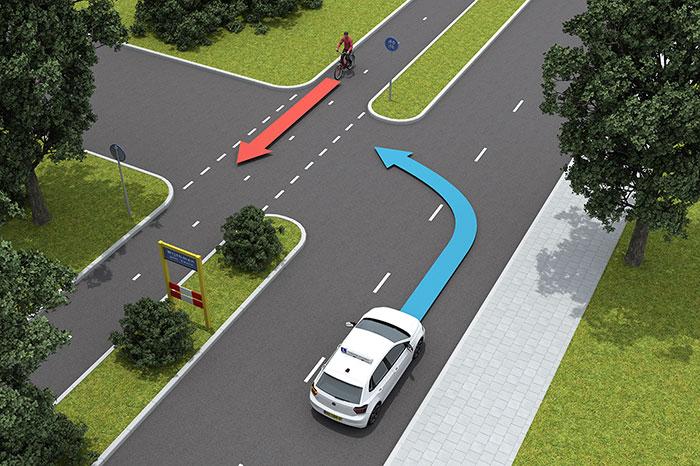
The driver of the lesson car must let the cyclist go first. This is located on a separate cycle path, but also on the same road as the lesson car.
- You must give way to through traffic next to you or behind you – including pedestrians!

The cyclist next to the lesson car is going straight on and therefore has right of way. The lesson car must wait.

The pedestrian continues straight on, on the same road as the lesson car. The pedestrian has therefore right of way.
- If oncoming drivers want to drive the same way as you do, the driver who turns right will go in front of the driver who turns left. This is also described as ‘short turn goes before long turn’.

The lesson car has the short turn. The driver of the blue car must let the lesson car go first.

The driver of the lorry may take the turn first. The lorry has the short turn.
- A turning tram has right of way over all traffic the tram approaches from the front, or is next to, or that is diagonally behind the tram.
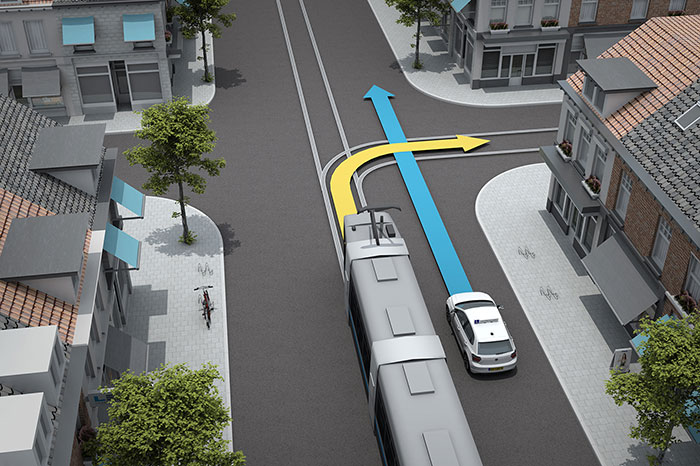
The turning tram has right of way. The lesson car should wait here.

It does not matter whether the tram approaches the lesson car from the front or the rear. The turning tram has right of way.
Divergent priority road
Some priority roads do not go straight, but curve. These divergent priority roads must be seen as the main road. If you go off this road, it is called turning off. Only then will the rules ‘through traffic before turning traffic on the same road’ and ‘short turn goes before long turn’ come into play.
This can be confusing because there is a bend on the road. In your head, try to think of the entire priority road as a straight road, with one (or more) side roads. The drivers on the divergent priority road are, seen from the side road, crossing drivers.
They therefore have priority over the drivers from the side road.

If you come across a divergent priority road, try to ‘straighten’ it in your head and then apply the right of way rules. The divergent priority road should be seen as the main carriageway. In these two situations the right of way is the same, the motorcyclist has right of way because it is driving on the priority road.

The rules for priority are the same in these two situations. The cyclist has right of way in both situations. The cyclist is the ‘straight through traffic’ here, despite the fact that it seems as if he turns left in the first situation. The cyclist continues to follow the priority road, just as in the second situation. The driver of the lesson car turns off in both situations.
Although it does not constitute a turn if you continue to drive on the divergent priority road, you are expected to indicate direction in that case. It is clear to the other road users that you keep driving on this road.
Divergent priority roads are usually indicated with supplementary plates under the sign ‘priority road’ or ‘priority intersection’. These plates show the thick line for the divergent priority road and the thin line or lines for the side roads that must give right of way.

B-1 with supplementary plate
Divergent priority road to the left with two side roads

B-4 with supplementary plate
Divergent priority road to the rightwith one side road