

Driving behaviour at intersections
Different rules apply for when you encounter other traffic at intersections. With these rules, it is important that you understand the difference between road users (all traffic, including pedestrians) and drivers (all traffic without pedestrians). In addition, it is important that you understand the difference between traffic on the intersecting road and traffic on the same road.
- Intersection
Intersection or junction of roads. At an intersection it is possible to change direction. This means that you can turn left or right.
Intersections can be designed in many different ways.
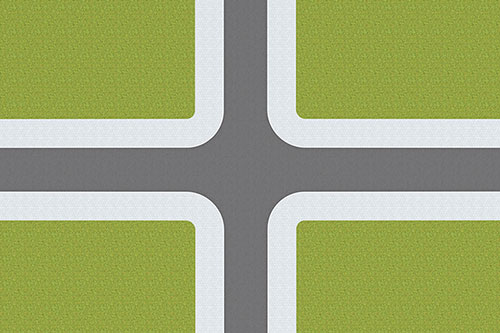
Normal intersection
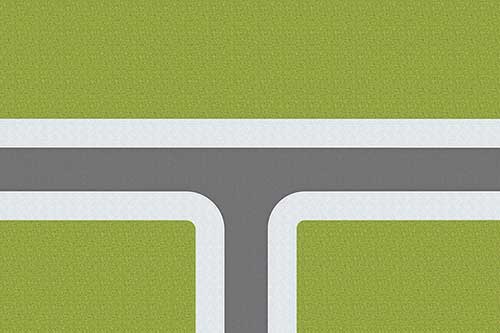
T-junction
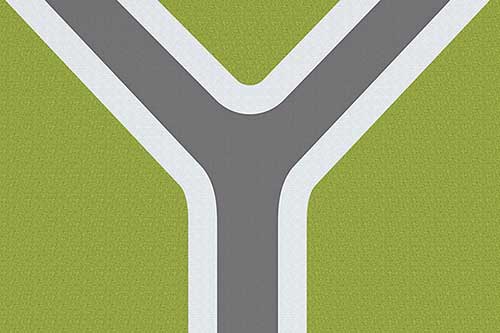
Y-junction or fork
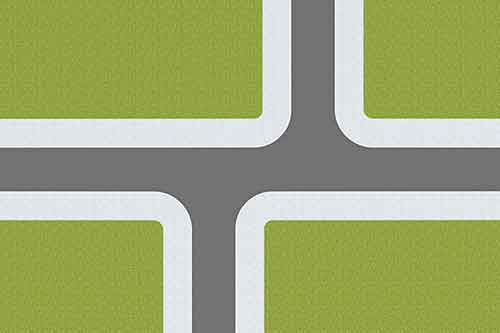
Bayonet intersection
- Intersecting road
This is a road that crosses the road you are on. This does not always have to be at an angle of 90 degrees (perpendicular). It can also be a road that is more oblique to the road you are on, such as at a Y-junction.
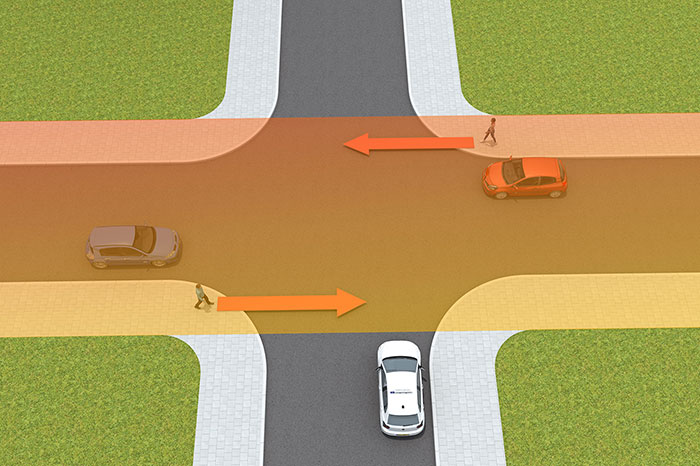
Compared to the white lesson car, the coloured part is the intersecting road.
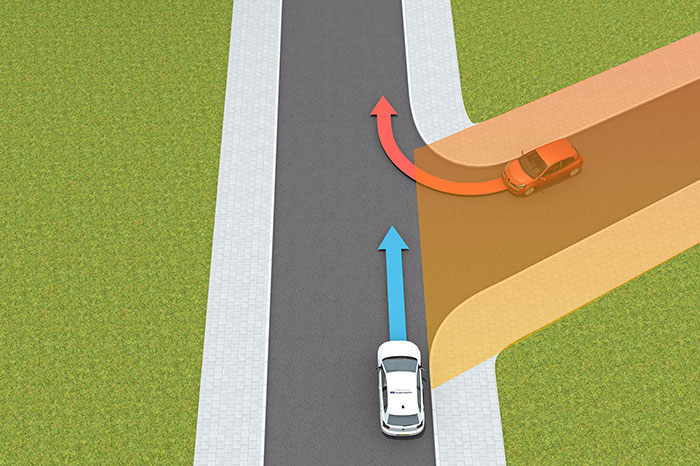
Compared to the white lesson car, the coloured part of the Y-junction is the crossing road.
- The same road
This is the road you are on. Traffic on the same road approaches you from behind or from the front. It does not matter whether these are pedestrians on the pavement or on the verge, or drivers of passenger cars on the carriageway. If you drive on a roundabout, all traffic that also follows this roundabout is traffic on the same road.
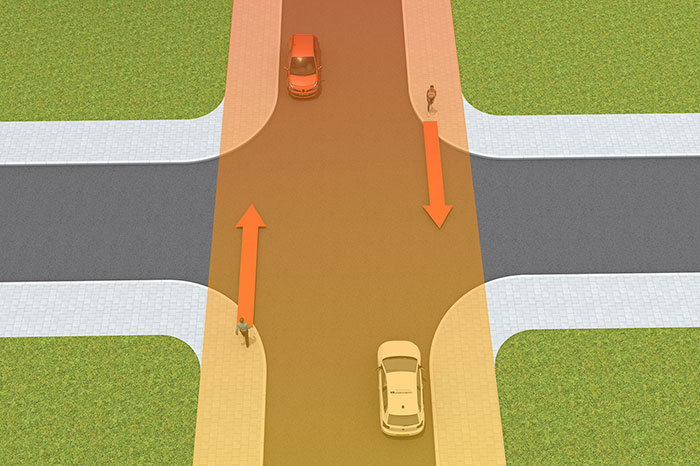
All these road users are on the same road (coloured part).
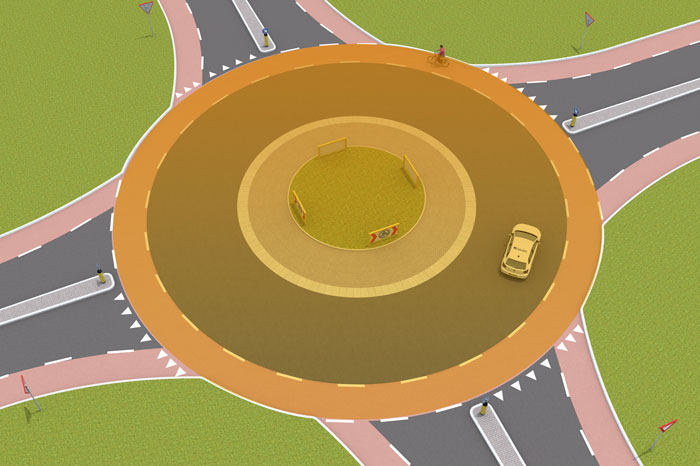
On a roundabout, the circular stretch of road counts as ‘the same road’. The lesson car and the cyclist are therefore on the same road.
- Giving way
Allows the drivers involved to proceed without hindrance. This means that the driver who has priority must also have the idea that he has priority. This driver must be able to drive unhindered.
Giving way
If the priority at an intersection is not regulated by signs, markings on the road surface or traffic lights, these are known as equivalent roads. On equivalent roads, drivers give right of way to drivers from the right.
You do not have to give a pedestrian priority, because they are not classed as drivers.
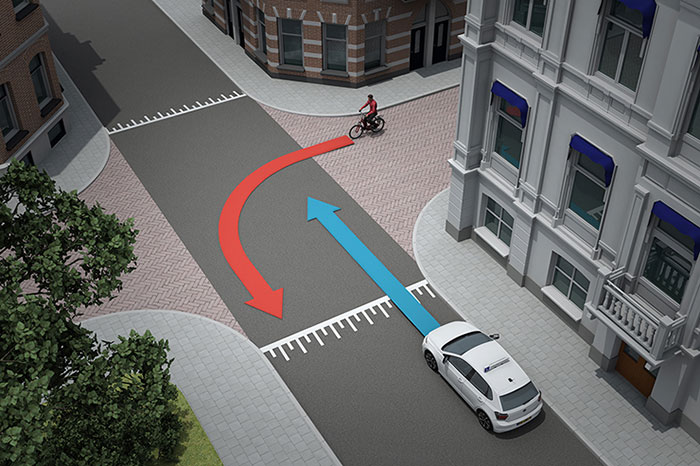
The cyclist coming from the right has priority over the lesson car.
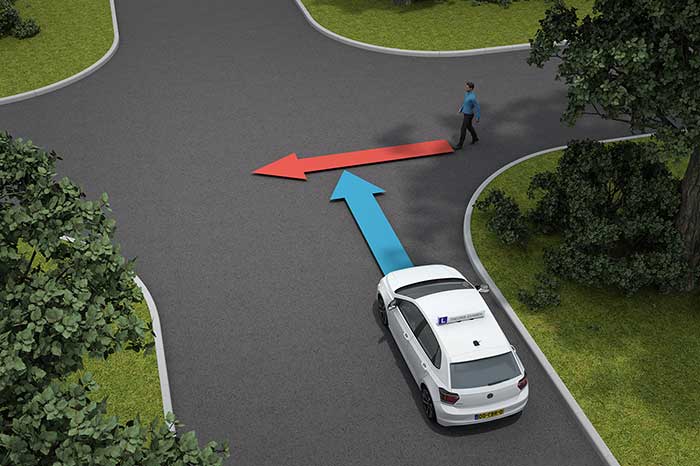
The pedestrian coming from the right is not a driver and must therefore let the lesson car pass.
There are two exceptions to this rule:
- Drivers give priority to tram drivers.
- Drivers on unpaved roads give right of way to drivers from the left and right on a paved road.
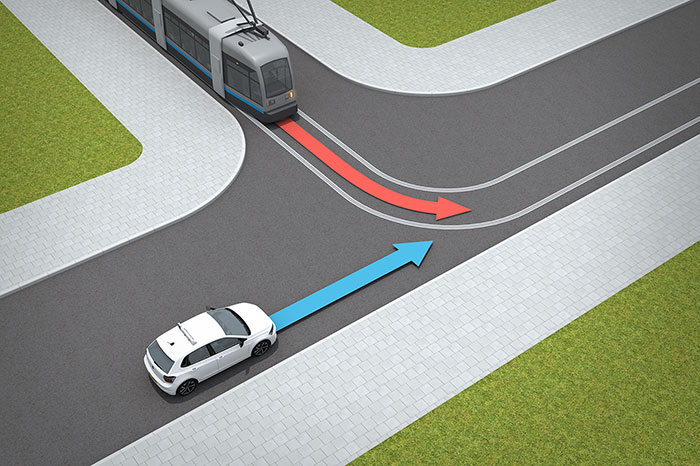
The lesson car coming from the right must give right of way to the tram coming from the left.
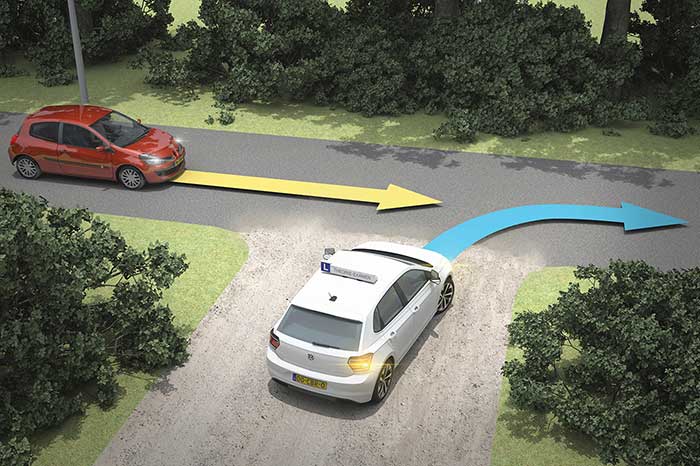
The lesson car comes from an unpaved road and must give right of way to the driver on the paved road.
- Priority triangles (shark teeth)
White triangles on the road. These are usually used with, but sometimes also without, sign B-6. In both cases, these triangles mean that you must give right of way to drivers on the intersecting road.
Priority indicated by signs or road markings
If right of way at an intersection is controlled by signs or markings on the road surface, the priority rule that drivers from the right have right of way is then irrelevant. There are various signs that regulate the priority.
- Being given right of way – priority road
-

B-1
The B-1 sign indicates that you are on a priority road. You must be given priority by the crossing drivers. This sign is repeated within the built-up area before and outside the built-up area after every intersection. That way you can tell from these signs whether you are driving inside or outside built-up areas.

B-2
The B-2 sign indicates the end of this priority road. After this sign the normal priority rules apply.
- Being given right of way – priority intersection
-
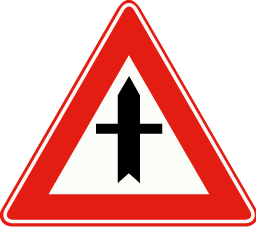
B-3
The B-3 sign indicates a priority intersection. You must be given priority by the crossing drivers. The thick arrow indicates the road you are driving on. The cross marks indicate the side roads. In this case, there are side roads on both the left and the right. This sign, as well as the B-4 and B-5 sign, only apply to the intersection you are approaching.
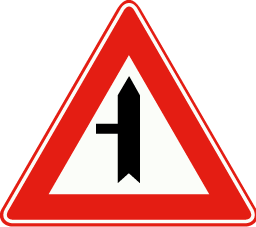
B-4
The B-4 sign indicates a priority intersection. In this case there is one side road on the left. You must be given priority by the crossing drivers from that side road.
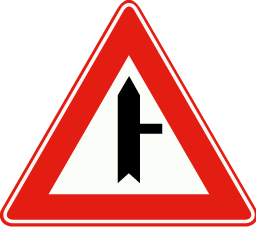
B-5
The B-5 sign indicates a priority intersection. In this case there is one side road on the right. You must be given priority by the crossing drivers from that side road.
- Giving right of way
-
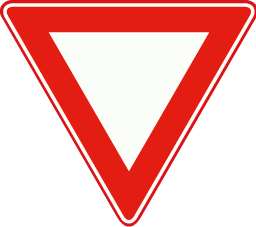
B-6
The B-6 sign indicates that you must give priority to drivers on the intersecting road. It may be that this intersection is a priority road, but it may also be a priority intersection. Stopping is not mandatory, as long as you are able to give priority to the crossing drivers.

B-7
The B-7 sign indicates that you must give priority to drivers on the intersecting road. It may be that this intersection is a priority road, but it may also be a priority intersection. In this case, stopping is always mandatory! These signs are applied at intersections where there is poor visibility, or a high accident risk.
The difference between these two signs is that you always have to stop at the ‘STOP’ sign. Even if you have seen that there are no drivers on the intersecting road. In addition, the sign B-6 is always combined with priority triangles and the sign B-7 with a stop line.
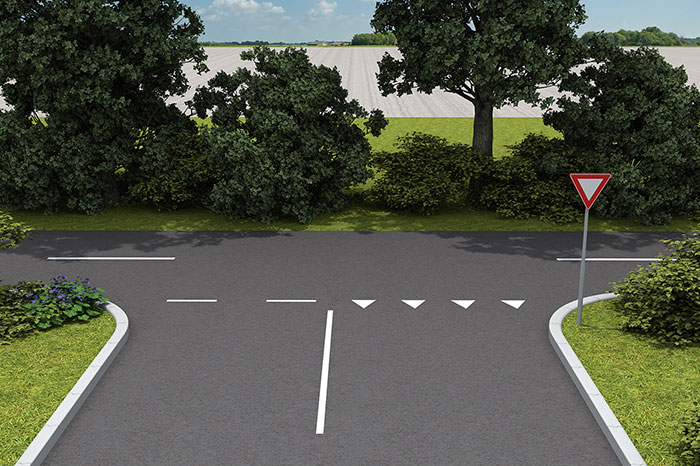
The B-6 sign is always combined with priority triangles.
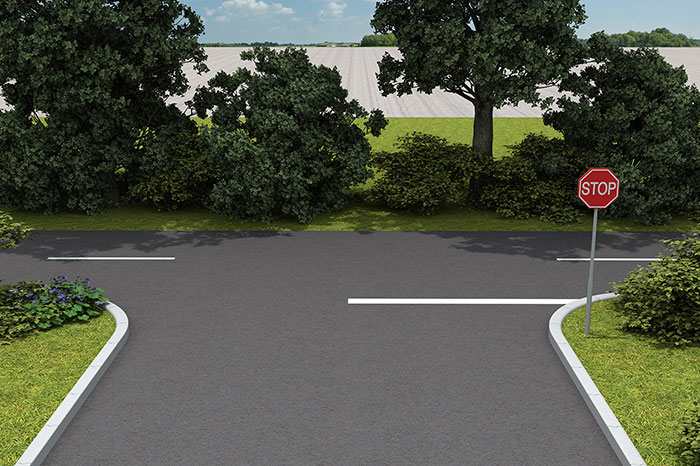
The B-7 sign is always combined with a stop line.
These signs and markings are also only intended for drivers. Pedestrians are not subject to these priority rules.
Examples
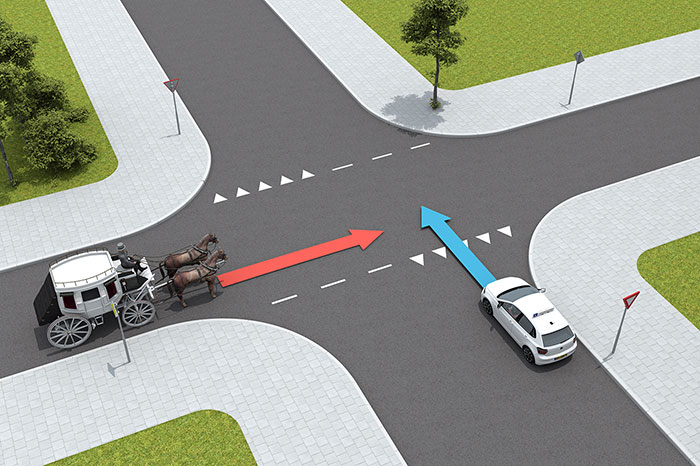
When approaching sign B-6 and priority triangles, give priority to drivers on the intersecting road. In this case, a horse-drawn vehicle comes from the left on the intersecting road. The lesson car must give right of way to this driver.
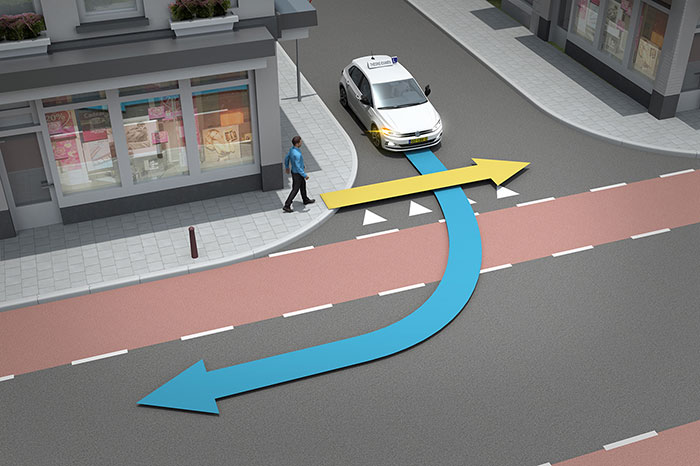
In this case, the lesson car is also approaching priority triangles. The pedestrian on the intersecting road must wait for the lesson car. The lesson car only has to give drivers priority and no pedestrians on the priority triangles.
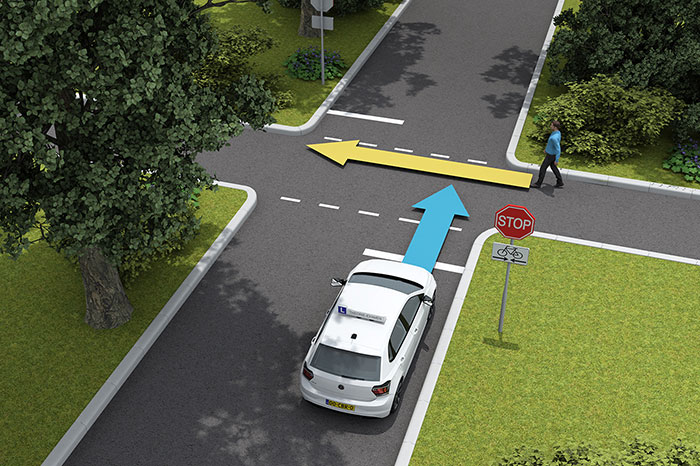
Here, too, the pedestrian must wait for the lesson car. This is approaching a stop sign with stop line. Due to the stop sign, the lesson car must stop, but can immediately drive away if no drivers come from the left or right. A pedestrian is not a driver.
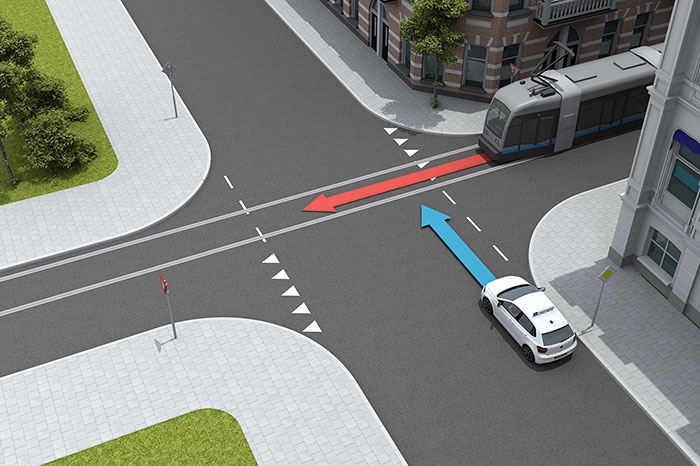
Tram drivers always have priority at an equivalent intersection. As soon as there are signs and road markings that regulate the priority, the tram driver must follow these. In this case, the tram driver must wait for the lesson car.