

Road sections
Each category of road user has their own designated space on the road to facilitate safe participation in traffic.
- Carriageway
Any section of road used by moving vehicles, except cycle and moped paths. Cycle lanes are part of the carriageway! A carriageway is therefore the section between two pavements or verges.
- Lane
Part of the carriageway marked by solid or broken lines. It must be wide enough to accommodate passenger cars. This means that cycle lanes are not separate lanes.

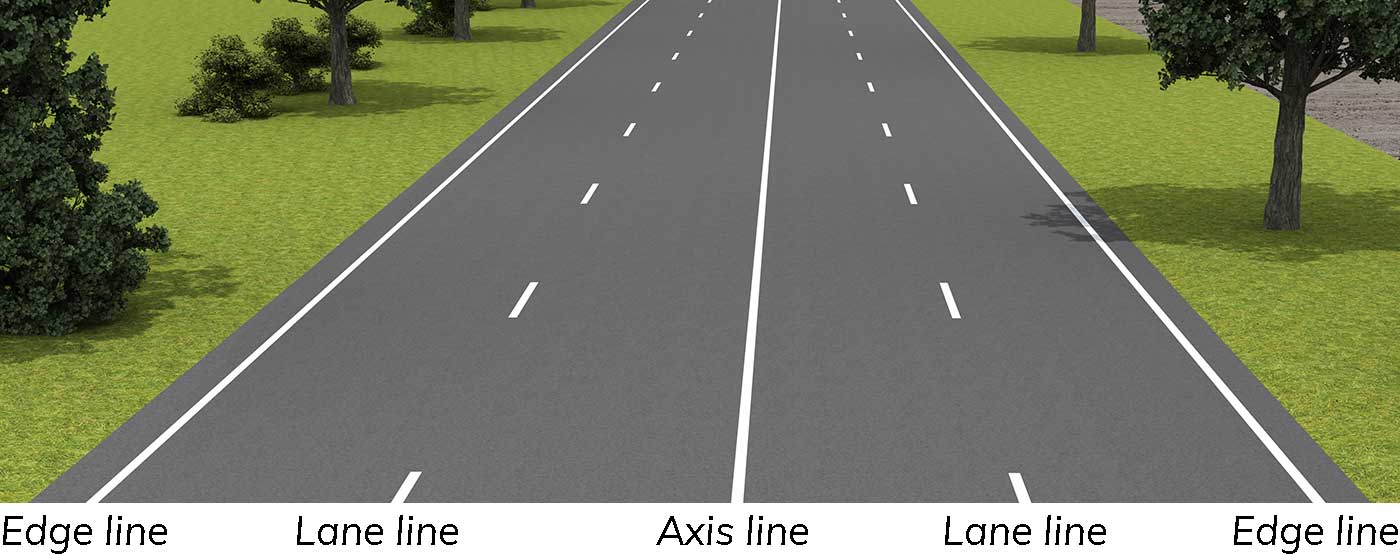
- Lane line
Line that divides carriageways into lanes travelling in one direction.
- Edge line
Line on the outer edge of the carriageway.
- Axis line or centre line
Line in the middle of the carriageway that divides the left and right sides of the carriageway – one for each direction of travel.
- Hatched road markings (gores)
Part of the road marked with diagonal lines. Drivers are not permitted to drive here.
- Dividing point
White triangle on the road surface at, for example, the beginning and end of slip roads. Road users are not permitted to drive here.
- Designated lane
Lane intended for a specific traffic group, such as a bus lane. This is indicated by a sign or the word ‘BUS’ or ‘LIJNBUS’ painted on the road surface.
Keep to the right
A fundamental rule for all drivers is to keep to the right wherever possible. This does not mean you should always drive in the rightmost lane. There is sometimes a good reason to drive in the left lane. However, if no reason is present, keep as far to the right as possible.
On carriageways without lanes, this means driving to the right of the centre, if the carriageway is wide enough to permit this. On carriageways with lanes, drive in the middle of the lane. If there are several lanes, take the right lane first.
When passing cars parked on the right, if there is no oncoming traffic, there is no need to drive between the parked cars. This leads to excessive unnecessary zigzagging. Drive in a straight line as much as possible, and maintain enough space (approximately a door’s width) between your vehicle and the parked cars. This helps avoid a collision should the door of a parked car open unexpectedly.
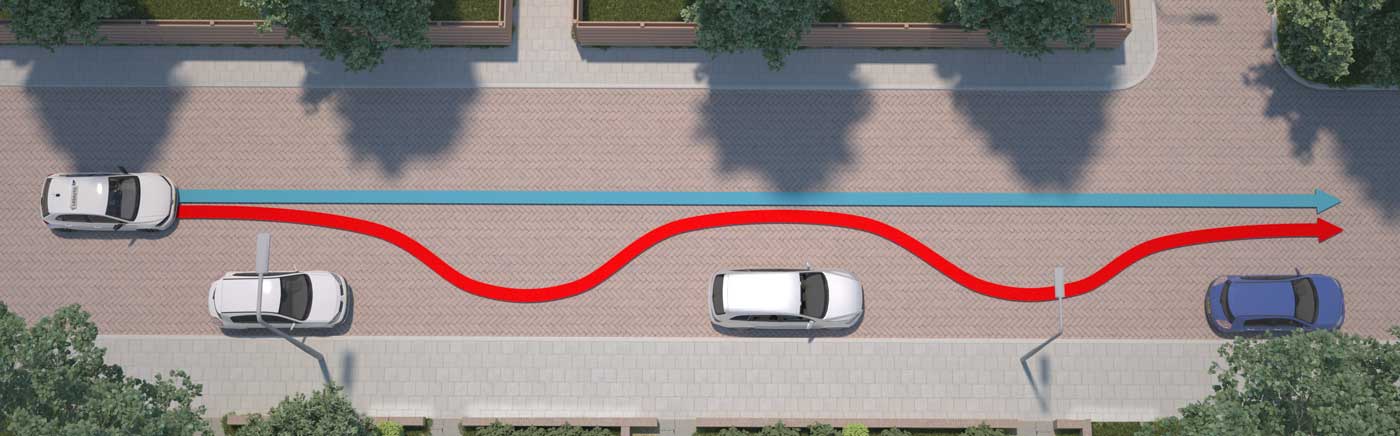
Try not to zigzag unnecessary, but drive in a straight line as much as possible.
Keeping to the right is not required on and just before roundabouts and in traffic jams. In these cases, choose the best option at your own discretion.
Section of road for pedestrians
A pedestrian’s place on the road is the pavement or footpath. If there is no pavement or footpath present, pedestrians can use the cycle path, or the cycle/moped path. If there is no cycle path or cycle/moped path present, pedestrians may use the verge or the far side of the carriageway.
Pedestrians using rollerblades, skateboards, or scooters are exempt from this rule and may use their own discretion to determine whether they should use the pavement or footpath, or the cycle or cycle/moped path. Only if none of these are present should they travel on the carriageway itself.
- Cycle lane
Section of carriageway marked with solid or broken lines and a pictogram of a bicycle.
- Cycle lanes with broken lines may be used by drivers other than cyclists and snorfietsers to pre-sort or evade. Cyclists and snorfietsers must not be hindered.
- Cycle lanes with a solid line may only be used by cyclists, snorfietsers, and disability vehicles. As a driver of a passenger car, use of this lane is prohibited – even for pre-sorting.
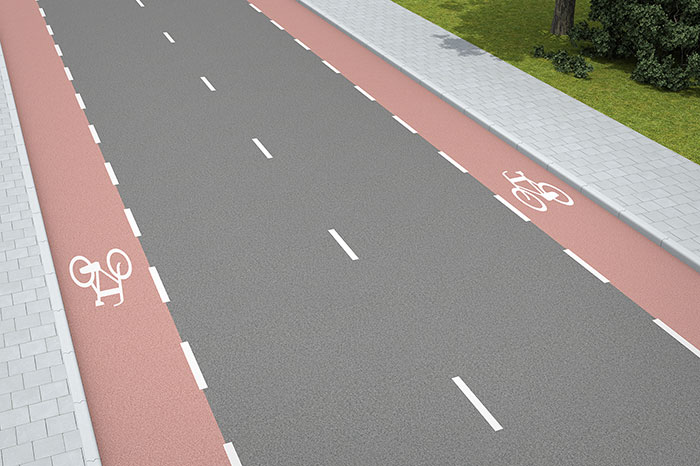
A carriageway with a cycle lane, recognisable by the pictograms of bicycles on the road surface.
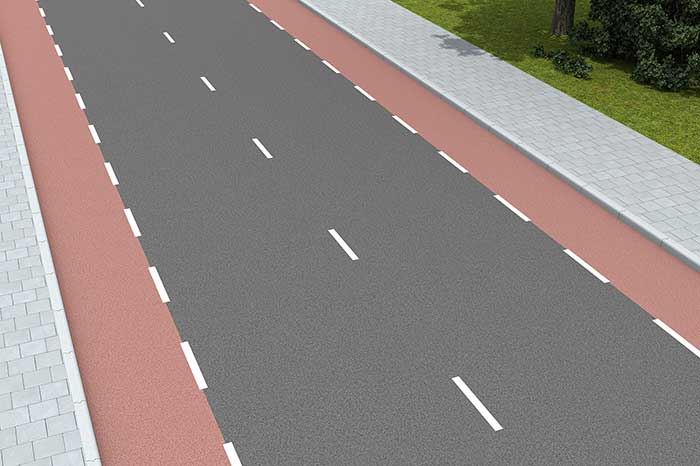
A carriageway with a suggestion (cycle) lane. This type of lane has no pictograms and therefore no legal status.
- Special mopeds
-

BSO bus
This group includes vehicles such as the segway and the BSO bus. Drivers of these vehicles must maintain the same position and speed limit as snorfietsers. They have no helmet obligation. However, there is a minimum age limit of 16 years.
Section of road for cyclists and snorfietsers
Cyclists, snorfietsers and riders of special mopeds must use the mandatory cycle path or cycle/moped path. If this is not present, they can use the carriageway. In some cases, snorfietsers are not permitted to use the mandatory cycle path. However, this must be indicated by a sign.
Cyclists may also opt to use the non-mandatory cycle path. This path is off-limits for snorfietsers unless they have switched off their internal combustion engine or have an electric motor.

G-11
Mandatory cycle path
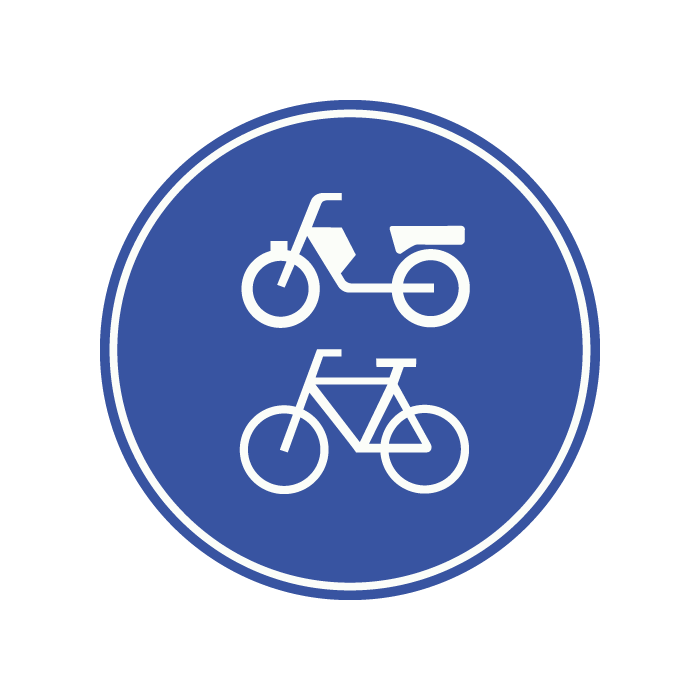
G-12a
Mandatory cycle/moped path

G-13
Non-mandatory cycle path
Riders of bicycles with more than two wheels and/or bicycles with trailers, including loads wider than 0.75 metres, may opt to use the carriageway at any time. Such vehicles include wide cargo bikes or pedicabs.
In most cases, snorfietsers are subject to the rules applicable to cyclists. There are a number of important exceptions to this. They must not use the non-mandatory cycle path when their internal combustion engine is switched on. Snorfietsers are also prohibited from riding side by side or next to a cyclist.
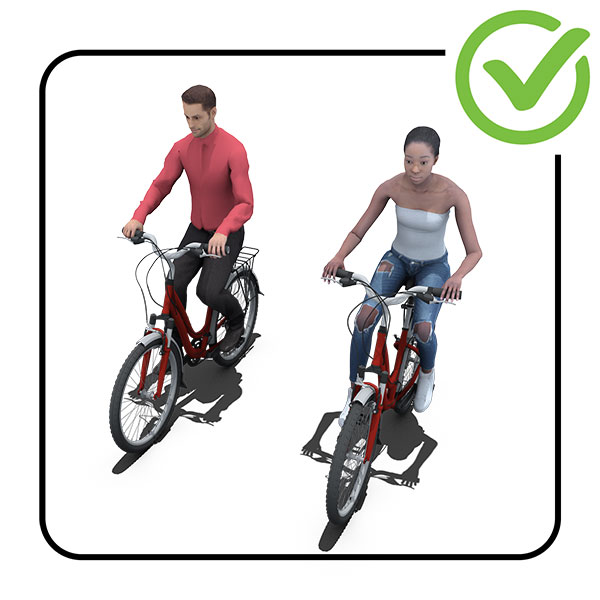
Cyclists are allowed to cycle side by side.
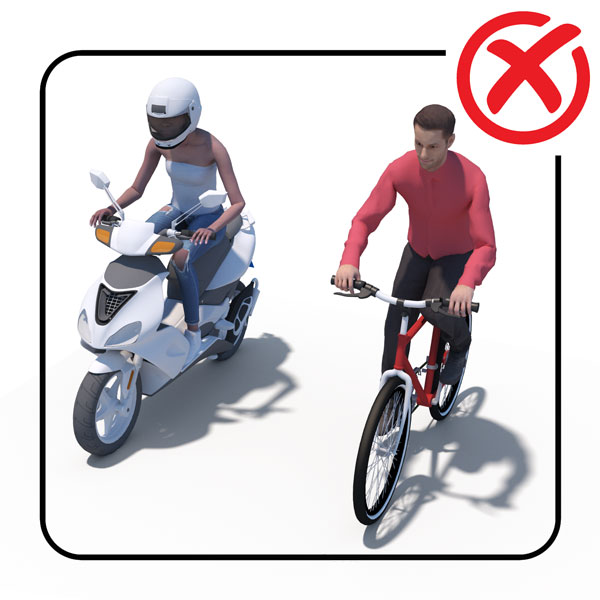
A snorfietser is not allowed to ride next to a cyclist.
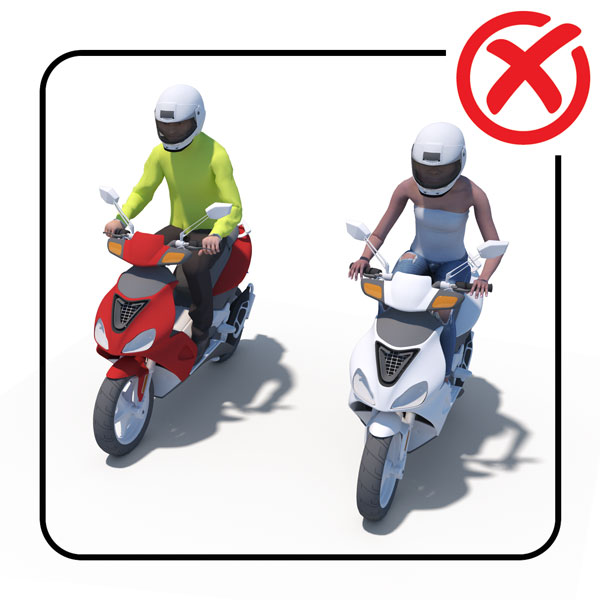
Snorfietsers are not allowed to ride side by side.
- Three wheeled cargo moped (Dutch: brombakfiets)
Moped with two wheels at the front and one at the back. Intended only to transport the driver and cargo. There may be a passenger behind the driver.
Section of road for moped riders (and speed pedelec drivers)
Moped riders must use the mandatory cycle/moped path. If there is no cycle/moped path present, moped riders can use the carriageway. This also applies to speed pedelec drivers, who are subject to the same rules.
Riders of mopeds with more than two wheels (such as cargo mopeds) and/or mopeds with a trailer, including loads wider than 0.75 metres, may use the carriageway at any time.
A lack of mandatory cycle/moped paths in many built-up areas means moped riders are required to use the carriageway. This is often indicated with the D-103 and D-104 signs. Moped riders should pass this sign on the side of the arrow. Depending on which side of the road the sign is placed, this means they must enter the carriageway from the cycle/moped path or vice versa.
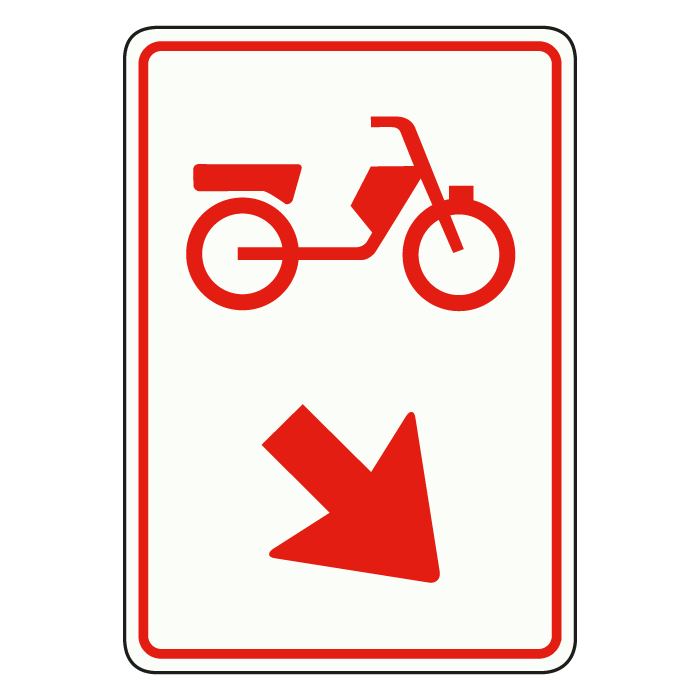
D-103
Moped riders must pass the sign on the right.
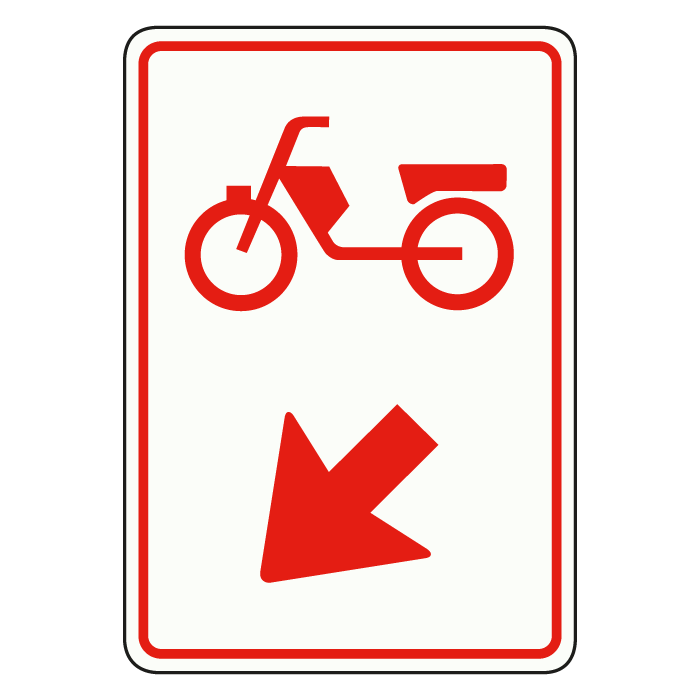
D-104
Moped riders must pass the sign on the left. This is
usually located where the moped rider has to enter the
carriageway.
Section of road for disability vehicles
Disability vehicle drivers may use their own discretion regarding the best section of road to use. This may be the pavement or footpath, cycle path, cycle/moped path, or the carriageway. Disability vehicles are also permitted to use cycle lanes on carriageways.
The rules disability vehicle drivers must follow depends on which part of the road they are driving on. If a disability vehicle driver is using the pavement or footpath, or crossing from one pavement to another, they are subject to the rules applicable to pedestrians. The speed limit in this case is 6 km/h. If a disability vehicle driver is using a cycle path, cycle/moped path, or the carriageway, they are subject to the rules applicable to drivers. This includes the speed limits applicable to moped riders.
Section of road for horse riders
Horse riders must use the bridle path. If there is no bridle path present, horse riders may use the verge or the carriageway. Riding side by side on the carriageway is prohibited.
Section of road for convoys, parades, and processions
Groups of pedestrians may use the carriageway if walking in a large, organised group such as a convoy, parade, or funeral procession. This is not mandatory, however.
Section of road for all other drivers
Any other driver not mentioned here may use the carriageway.
Section of road with a wide central reservation
Some carriageways are separated by a (wide) central reservation. In these cases, signs often indicate which carriageway you should use. If no signs are present, use the right-hand carriageway as much as possible. Despite the wide central reservation, this is just one and the same road where the best place to drive is as far to the right as possible.
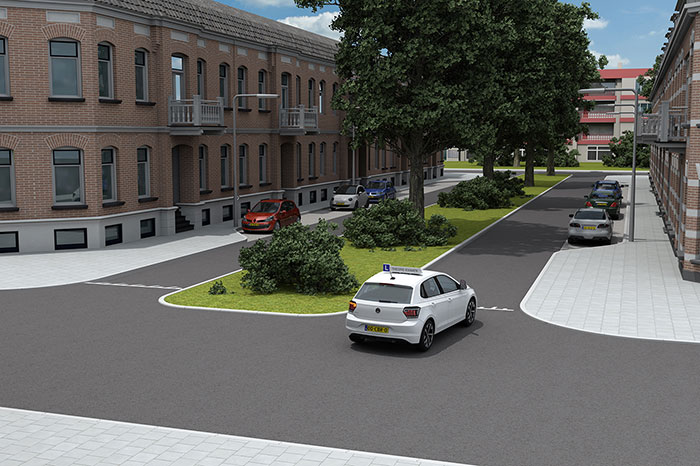
If carriageways are separated by a wide central reservation, you normally use the right-hand carriageway.
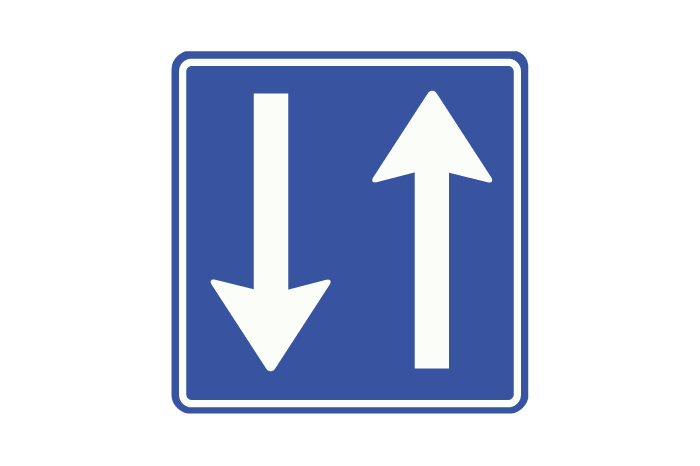
Sometimes separate carriageways may be used in both directions. This is indicated by sign C-5.