

Permanent requirements for trailers
Like cars, trailers are also required to meet a number of permanent technical requirements. Pulling a trailer that does not meet these requirements is prohibited.
Same requirements as passenger cars
Trailers are also subject to many of the requirements applicable to passenger cars. This applies to:
- maximum dimensions (4 metres high, 2.55 metres wide, 12 metres long);
- tyre requirements (no damage, sufficient tread depth);
- presence of sharp and protruding parts (shielded or not present).
Closing loading flaps and doors
Many trailers have a flap at the rear that can be folded open for better access to the loading floor. Some closed trailers have rear doors instead. These flaps and doors must be able to close properly and remain closed while in transit.
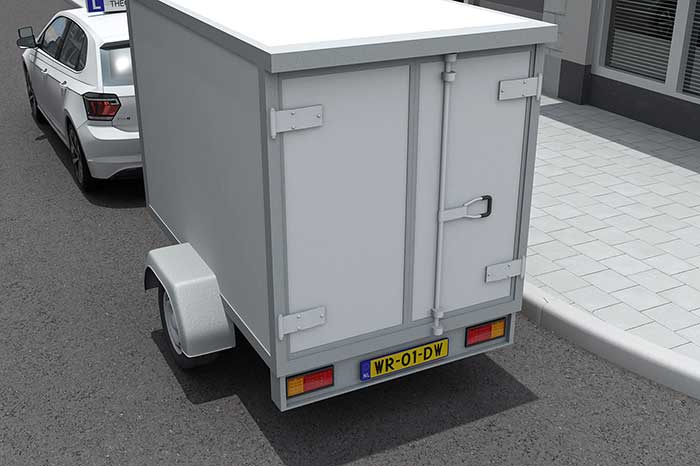
The loading doors must close properly and stay closed while driving. Trailers with a maximum authorised mass above 750 kg must also be fitted with a yellow number plate.
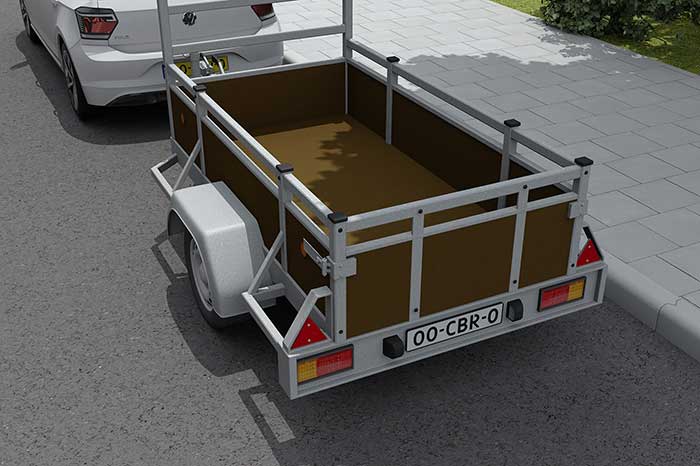
The loading bay flaps must close properly and stay closed while driving. Trailers with a maximum authorised mass up to 750 kg must also be fitted with a white number plate.
Number plate
Mounting a number plate on the rear of a trailer must be possible. Trailers require original number plates which must be properly secured.
Braking system
Most trailers are braked, which means they are equipped with their own braking system. Braking systems on braked trailers must be properly functioning. This means the trailer must not swing while braking, which can occur when the brakes are not equally powerful on both sides.
All parts in the braking system must be undamaged, properly attached, rust-free, and leak-free. The brake hoses must be in good condition and must not come into contact with other parts.
Lighting
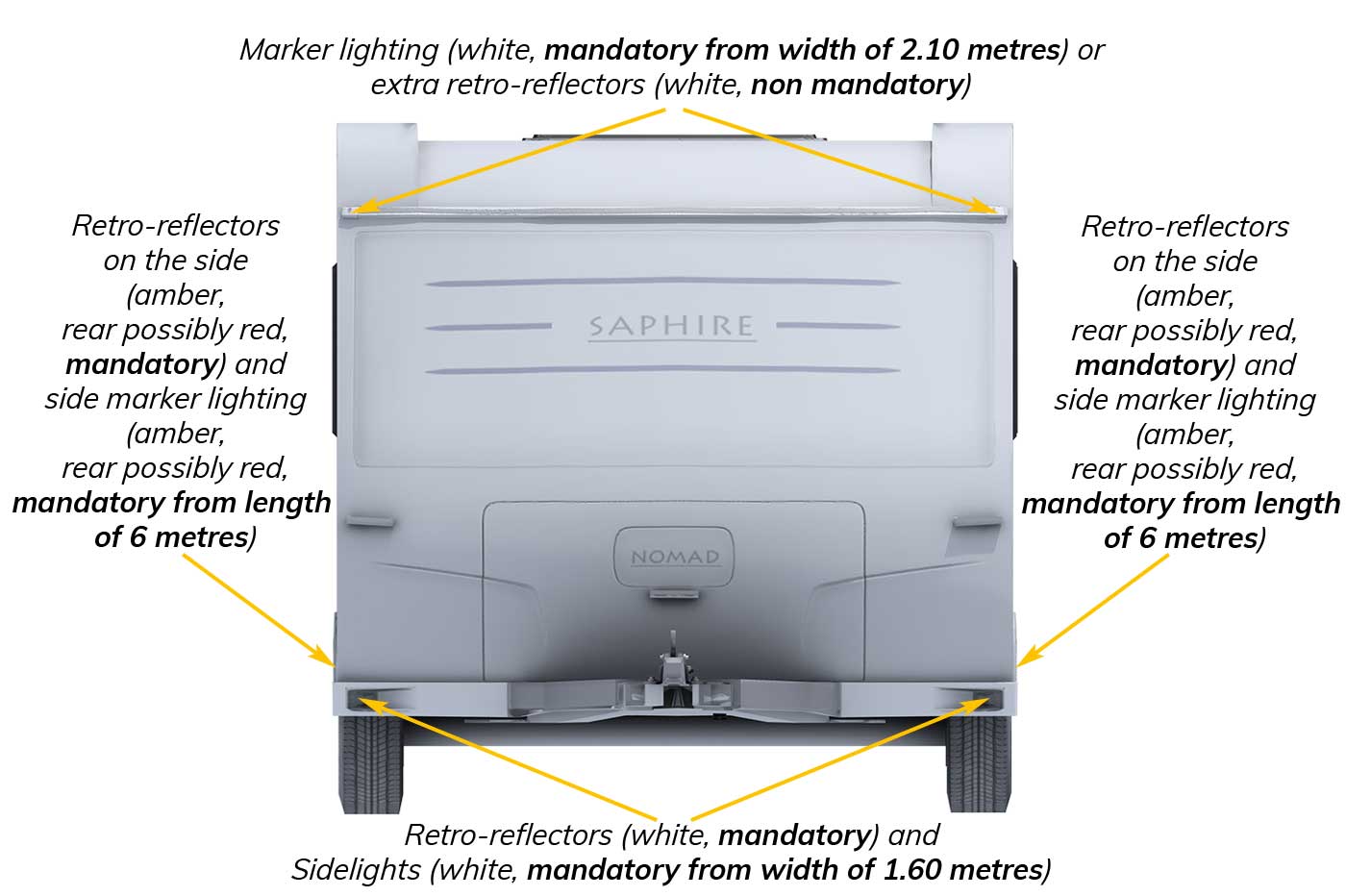
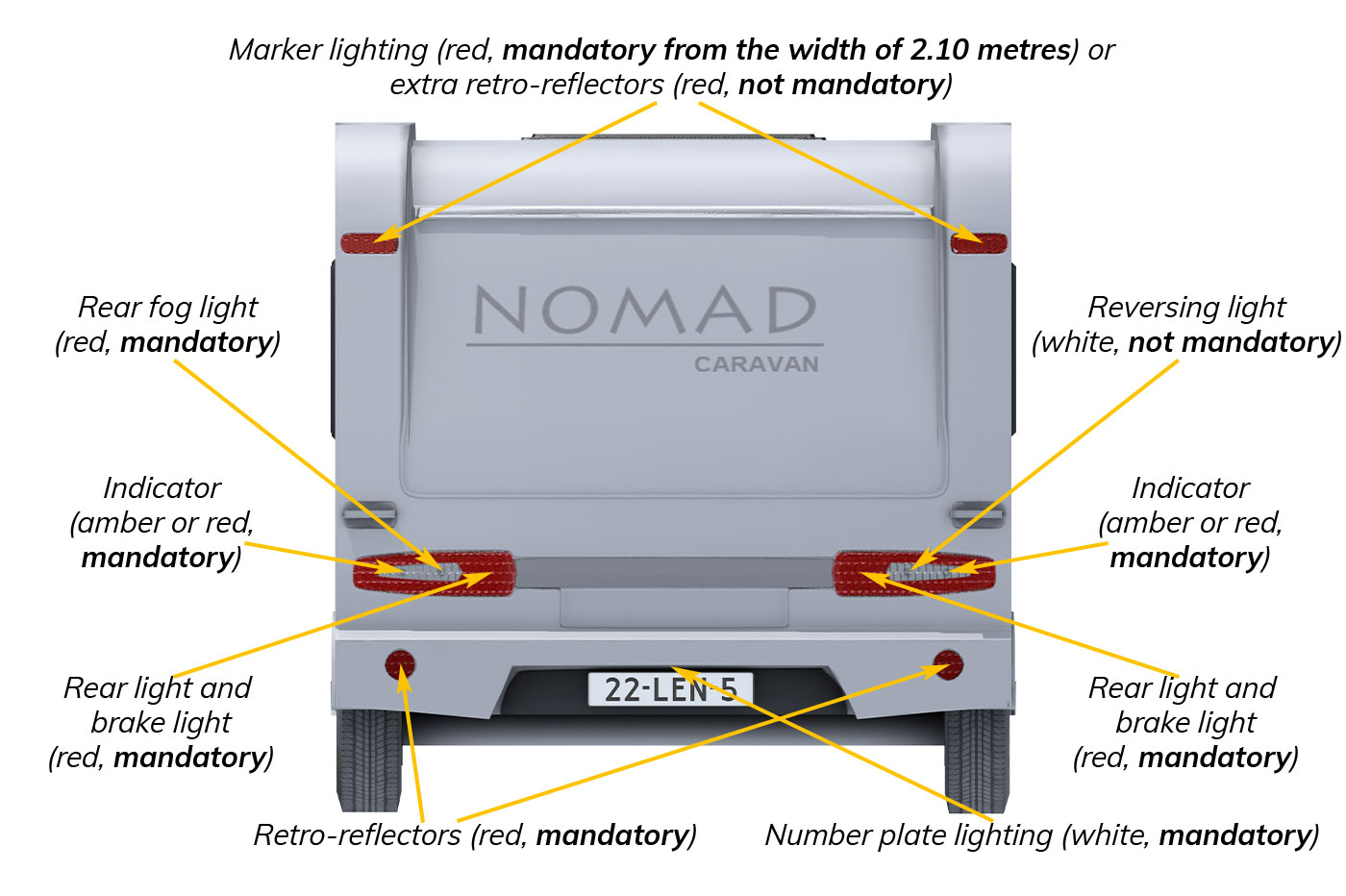
Trailer lighting is subject to a number of rules that do not apply to passenger car lighting. For example, reversing lights are not mandatory for trailers up to 750 kg.
Sidelighting on the front and marker lighting on the front and rear are only mandatory on wider trailers. Side marker lighting is only mandatory on trailers longer than six metres. These sidelights and marker lighting may be present on shorter and narrower trailers.
Additional retro-reflectors may also be fitted on the front (white), rear (red), and side (amber, rear possibly red) of the trailer.
Placement and operation of mandatory lighting
Trailer lighting must comply with the following rules:
- All lighting must be placed on the trailer so that it is clearly visible, cannot be confused with other lighting and the size of the trailer is well emphasised.
- All mandatory lighting must work properly and be properly attached. The light output must not have decreased by more than 25% due to broken lamps or damaged/dirty lamp glasses. The lamp glasses must also not be removed.
- All lamps with the same function must have the same appearance and be arranged symmetrically to the left and right.
- All mandatory retro-reflectors must reflect well.
Prohibited lighting
Only the aforementioned mandatory and permitted lighting may be present on a trailer. Trailers may not be equipped with lighting on the inside that beams outwards. The vehicle must not be equipped with blue flashing or blinking lights, even if these are switched off, as this may confuse other road users.
Hitch
The hitch, the part of the trailer that attaches to the passenger car, is located on the drawbar or draw triangle – a metal frame at the front of the trailer. This part must be in good condition (no bends or cracks) to ensure the trailer does not come loose.
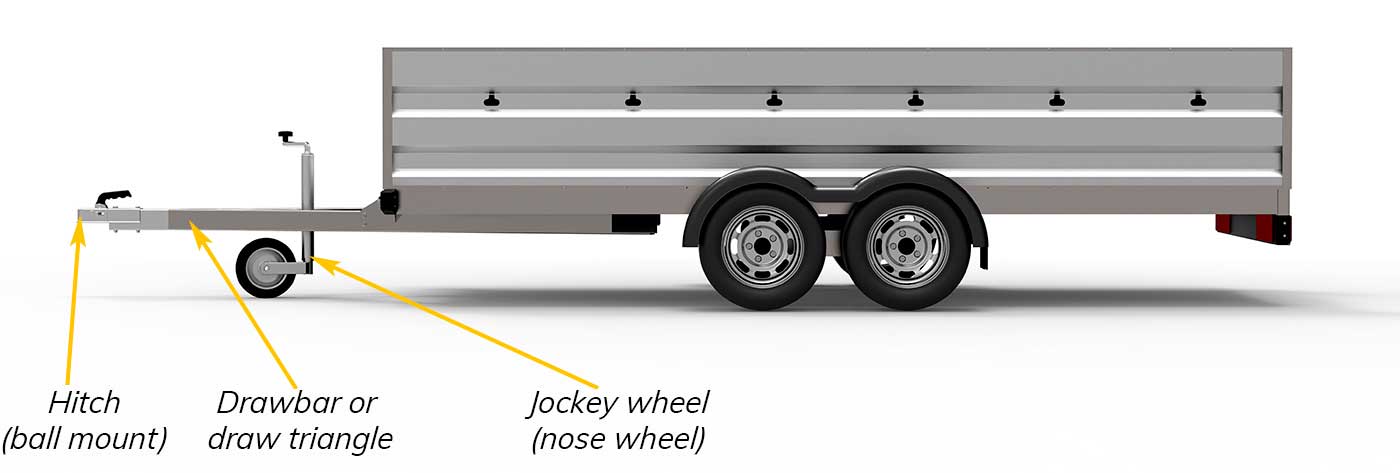
To mitigate the situation should a trailer unexpectedly come loose while driving, trailers must be equipped with an emergency brake or auxiliary coupling. Having both equipped simultaneously is prohibited, as each one cancels out the other.
Emergency braking system
The emergency braking system ensures that the trailer’s handbrake is immediately applied should the trailer come loose from the tow bar. This is a thin steel cable (break-away cable) connected to the trailer’s handbrake, with a hook or ring attaching it to the car. If tension occurs due to the trailer coming loose, the emergency brake applies the trailer’s handbrake, at which point the cable snaps. The trailer then comes to a stop, separate from the car, instead of rolling out of control.
This device is mandatory on trailers with a maximum authorised mass above 1,500 kg.
Auxiliary coupling
Many lighter trailers and all unbraked trailers are not equipped with an emergency braking system. These trailers must therefore be equipped with an auxiliary coupling, which ensures the car and trailer remain connected should the trailer come loose from the tow bar. An auxiliary coupling is a thicker steel cable that is connected to the body of the trailer, with a hook or ring attaching it to the car.
This cable does not snap when tension occurs, but keeps the trailer and the car connected so that the driver can safely stop the car and trailer at the earliest opportunity.
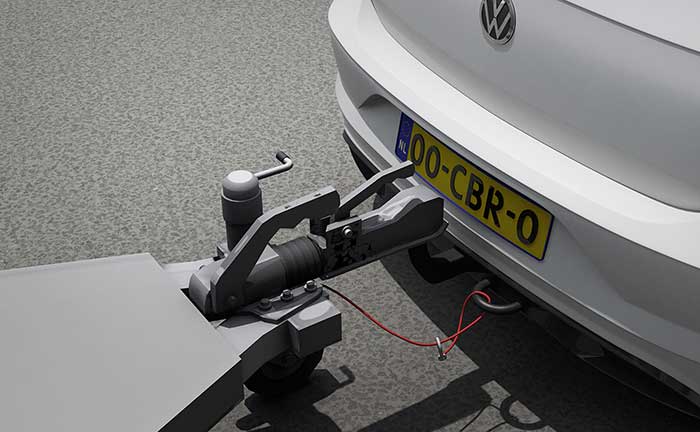
The red cable is the break-away cable. This is mandatory on a trailer with a maximum authorised mass above 1,500 kg.
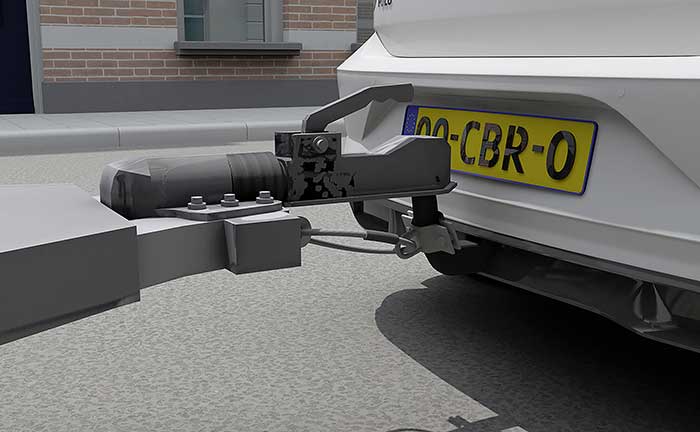
The round cable is the auxiliary coupling. This is mandatory on trailers that do not have an emergency braking system.