

General safety requirements
Much has been said about safety already. Actually, one thing is very important in the context of safety: your own common sense. If something seems unsafe, it probably is. It is often underestimated how much force is applied to certain components and loads during accelerating, riding, braking and steering. Load that is not properly secured can become life-threatening while riding. Passengers can also influence the road holding, steering and riding behaviour of the motorcycle.
Load
Load may not form an obstruction while riding. Properly secure loads so that it stays in place while accelerating, steering and (heavy) braking. Make sure that a possible tank bag does not obstruct steering. Also think of loose straps. If these get caught between the moving parts of the motorcycle while riding, There can be serious consequences.
Load may also not cause the lights or the number plate to be less visible. Therefore, always check this as soon as you have mounted loose load to the motorcycle.
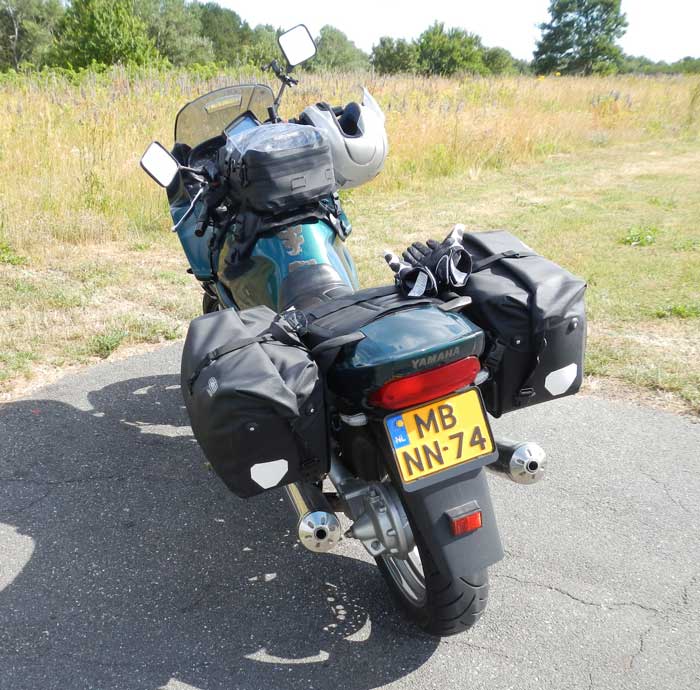
Load may not hinder you while riding and must be properly secured.
Carrying load in top or side cases or specially designed motorcycle cases always has the preference here. Then you know, when used in the right way, that the load is properly secured.
Because, if you lose load, then the chances are high that you will have to pay for the damages this load has caused.
Passengers
Adult passengers and children from the age of 12 are themselves responsible for how they are transported. But that does not mean that you no longer have a say in it as the driver. As the driver, take responsibility and make sure that everything and everyone is safely transported. Do not go riding with a passenger without a helmet. Indicate if you are bothered by your passenger, for example because they counter-hang too much or otherwise imbalance the motorcycle. Also make sure that passengers are dressed in a safe manner.
You must make sure that you stay concentrated while riding. Do not let yourself be rushed by passengers and keep to the rules. If something goes wrong because you were distracted or dared, you will be the one who will pay for all the damages.
Clothing requirements
Even though there are no official clothing requirements prescribed by law, wearing protective clothing while riding a motorcycle is a must. After all, as a motorcyclist you are more vulnerable than a motorist. There are no passive safety features such as roll cages, crumple zones and airbags.
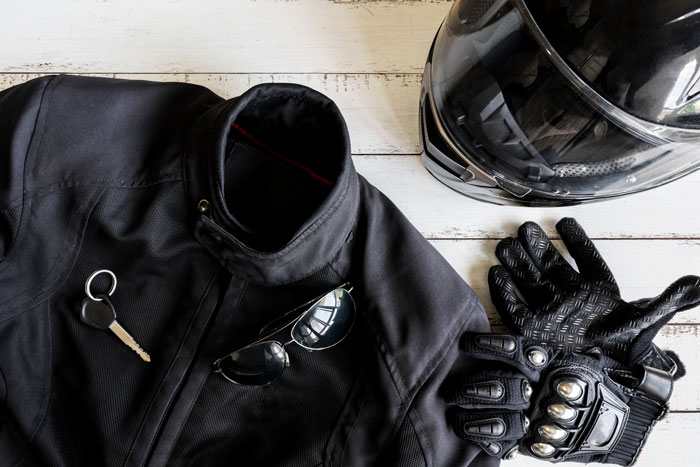
Therefore, at the CBR, it is mandatory to wear protective clothing while taking the practical exams. These are an approved helmet with visor or (sun)glasses, motorcycle trousers and jacket or a motorcycle suit, motorcycle gloves and boots. riders and passengers of motorcycles, with or without sidecar, are better protected using the following gear:
- A well fitting helmet that meets the legal requirements (mandatory).
- A motorcycle suit, preferably of a bright colour and provided with reflecting stripes, so that the driver is also clearly visible during the dark. Wearing striking clothing, especially during the dark, will always contribute to visibility. However, it is not a guarantee. A good riding style is in that regard even more important.
- Leather or textile padded gloves that fit snugly around the hands and wrists. These are not only for warmth but mainly for protection.
- Boots of supple leather with a firm nose. These must be at least high enough to protect the ankle in case of a fall.
- Eye protection, such as a visor or motorcycle goggles. Individual motorcycle goggles only fit on police and jet helmets. Most helmets are fitted with a visor which makes individual goggles unnecessary.
- Hearing protection. Not a requirement though very sensible. Especially while riding on motorways, the wind can cause hearing damage. Provide hearing protection with a filter, so that you can still hear the environmental sounds. The best are personalised hearing protectors (otoplasties).
Riding in a group
Riding a motorcycle happens in groups with some regularity. When riding in a group, a few things are important:
- Maintain enough distance
It is tempting to ride closer to each other, but this is unwise. After all, your thinking time does not become shorter when riding in a group. - Keep looking in your mirrors!
Because you are usually riding behind another motorcyclist in a group, you will often look too much at the rider in front of you instead of in your mirrors. Keep checking your mirrors regularly. - Do not ride immediately behind or next to one another
Ride in the so-called staggered formation. Here, motorcyclist ride alternately diagonally left and right behind each other. The first motorcyclist rides slightly to the left of the middle of the lane, the second behind them on the right, the third behind them on the left and so forth. Before a bend you lose the staggered formation in the bend every motorcyclist rides their own ideal line. - Stay responsible
Even though you are riding in a group, you must keep doing your own thing. Do not blindly follow someone when crossing intersections but see for yourself whether it is safe to do so. Also maintain your own speed, do not let yourself get rushed. - Make clear agreements
For example, Agree on what you do if someone loses the group. For example, by agreeing on a resting point halfway through the route, where you can then meet again. - Look for a group with the same riding style
This prevents you from crossing your boundaries because you feel rushed. Or that you become annoyed by the, in your eyes, slow riding style of a fellow motorcyclist. Also keep in mind your position in the group. Ride more calmly in the front of the group so the riders behind you can keep up with you. Keep in mind that you must brake and accelerate more often at the back of the group. - Inexperienced motorcyclist ride at the front
At the front of the group, the riding speed is more constant. That is why it is wise to let inexperienced motorcyclists ride at the front of the group. At the back of the group, it is sometimes necessary to ride a little quicker to keep up with the group. This is best left to the more experienced motorcyclists.
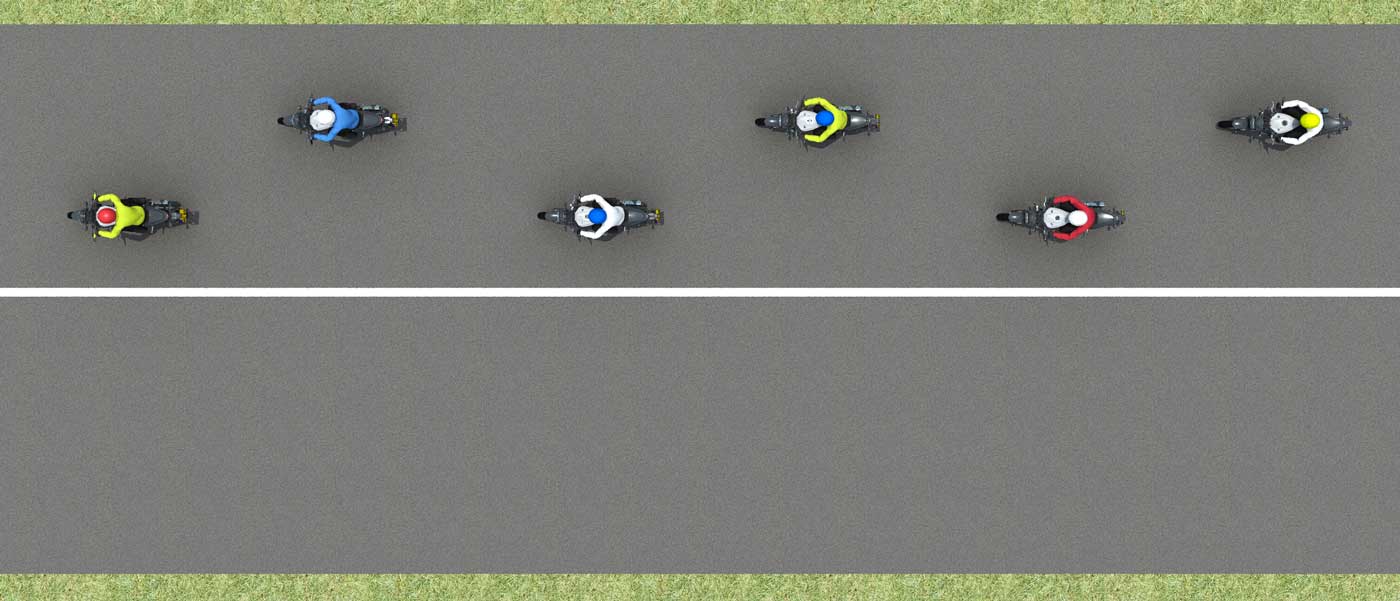
Ride in a staggered formation on the straight sections.
Riding with passengers
Only take a passenger (also called a ‘duo’) with you if that passenger also sees fit to do this. In advance, agree to how to go about it, indicate how the passenger can make something clear to you on the way. Also explain what you expect from them during the ride.
Make sure that your passenger is sitting correctly and thus taking on a good sitting position. This means that they sit as closely against you as possible, so that they can follow your movements. It is often wise to adjust the rear suspension more heavily, in accordance with the weight of the passenger and possible packing. Sometimes it may also be necessary to adjust the front suspension differently. A too heavily loaded suspension tends to sag, and the spring component can be damaged as a result. In bends, the passenger looks with you. In the left bend, left past the rider and in the right bend, right past the rider.
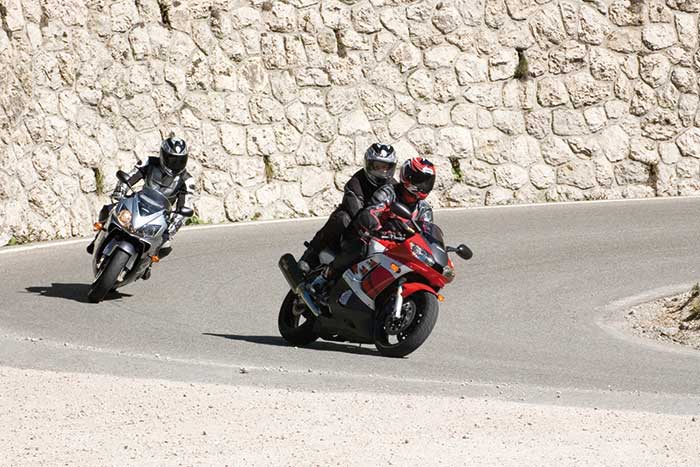
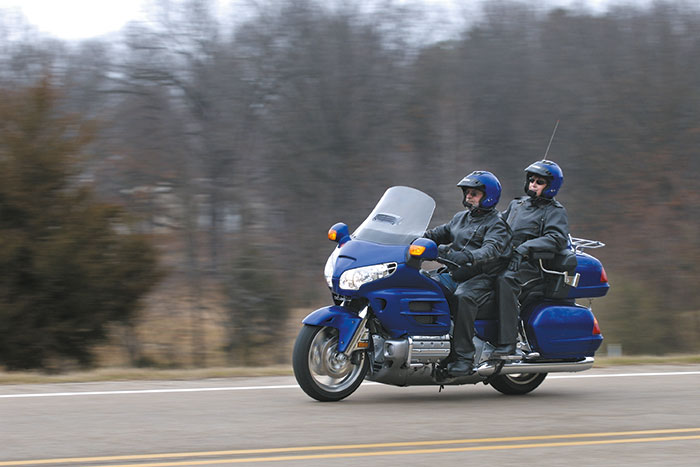
Keep in mind that the braking distance (and with that the stopping distance) with a passenger will be longer due to the increased weight. The braking technique is also slightly different. Due to the increased pressure on the rear wheel, and the greater weight dispersion to the front wheel while braking, you can (in good weather conditions!) brake harder than without a passenger. This is necessary to limit the braking distance. Because this takes some practise, it is important to ride even more defensively with a passenger. This is to ensure that you do not have to brake abruptly. While accelerating, you must account for the front wheel coming off the ground (wheelie) sooner than without a passenger. Therefore, accelerate gently.
Taking children as passengers
Legally speaking in the Netherlands, not much is arranged regarding taking children on the back of a motorcycle, except for the good fitting helmet. Still, careful consideration should be given to whether to take your child with you. Children are very vulnerable and riding a motorcycle is per definition more dangerous than driving a car. The advice is to take (smaller) children in a sidecar only.
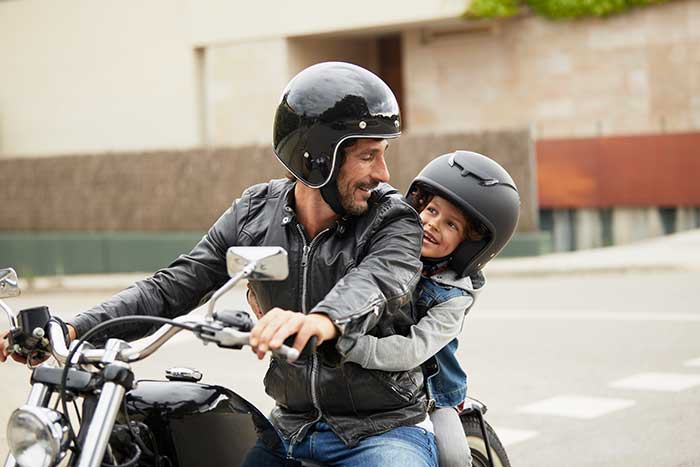
Even though there is no regulation for children riding along, it is strongly recommended not to take small children with you.
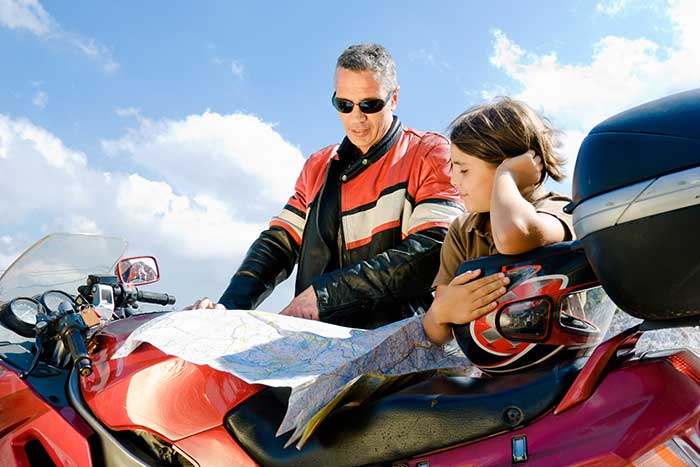
If your child is big enough and is riding along, ensure good clothing and make good arrangements.
If you do decide to take a child with you, do keep in mind the following points:
- Only take a kid on the back if they have enough strength to hold on to you. There are special belts you can put around your waist as a rider that have handles on them. Holding on to this is easier for a child than holding onto your waist.
- On a motorcycle fitted with side cases and a top case, a child is generally safer and more protected than on a motorcycle without these accessories.
- Only go riding when the child can properly reach the footrests.
- Always keep in mind the character of the child. One child is better suited to be carried on the back of a motorcycle than another child. In advance, agree on clear signs, so that the child can immediately indicate that you need to stop, without difficulty.
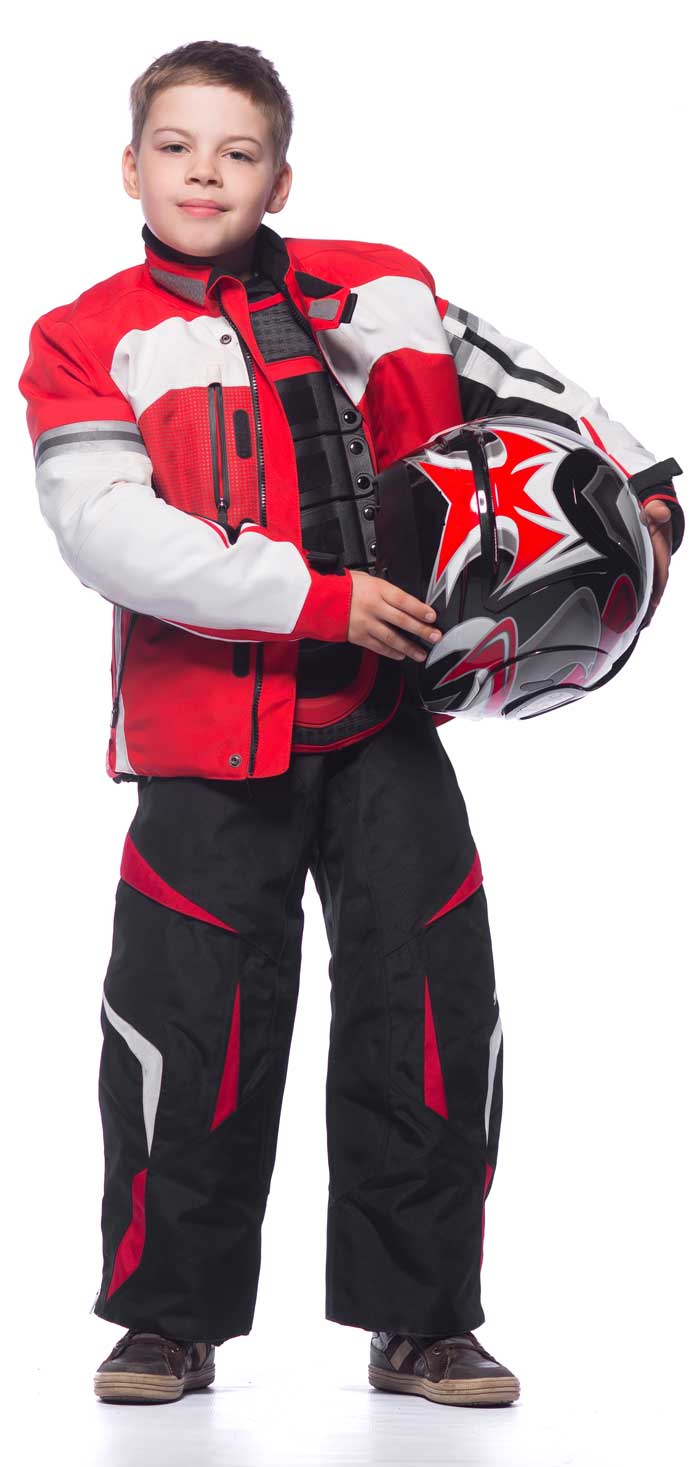
- Provide a well-fitting helmet. Mainly make sure that the helmet is not too heavy. During an accident enormous forces are put on the neck.
- Always buy real motorcycle clothing for the child, even if it is just for the few Sundays that you take the child with you. It is a big expense, but the costs do not outweigh the consequences of a fall with a motorcycle if the child is not wearing proper and safe motorcycle clothing.
As driver, you are responsible for the helmet obligation of a passenger up to 12 years of age. From the age of 12, the passenger itself is responsible. But it goes without saying that you will never go for a ride if the passenger does not wear an approved and well-fitting helmet. Especially with children, also make sure they wear the helmet correctly and that is secured properly.