

Maintenance and checks
For a motorcycle, an inspection obligation only applies as soon as the vehicle is allowed on Dutch roads for the first time. This is the type-approval inspection which is provided by the manufacturer. With normal use and good maintenance of the motorcycle, it does not need to be inspected again. For example, there is no such thing as the General Periodic Inspection (APK) as there is for passenger cars.
The only exception to this is three-wheeled motor carriages (such as heavy trikes) with a maximum authorised mass of more than 400 kg.
According to the law, as the owner (or holder) and as a driver you are responsible for the state of the vehicle. Even more importantly, regular checks and good maintenance of the motorcycle are essential for safety.
Standard checks
The most important standard checks that should be done before each trip are:
- tyres
- brakes
- transmission
- lighting
- oil
Tyres
You do not have to check the tyre pressure with a tyre pressure gauge before every ride. You do this about once a month, or if the tyre pressure appears to be low. If this is the case, check the tyre pressure always when the tyres are cold, so not during or after a ride.
What you should always check before every ride is if there are no imperfections on the tyre. Think of cracks (dehydration), bulges or apparent loss of pressure. The tyre may also never show damages where the tyre carcass is visible.
Below 2 millimetres, you will already experience a considerable loss of grip during rain. As a comparison: a new rear tyre has a tread depth between 6-8 millimetres, a new front tyre between 4-6 millimetres.
If the tyre wears unevenly, then this may indicate a problem with the balance of the motorcycle, the shock absorbers or a poor wheel tracking. With poor wheel tracking the wheels are not quite straight, or not neatly aligned.
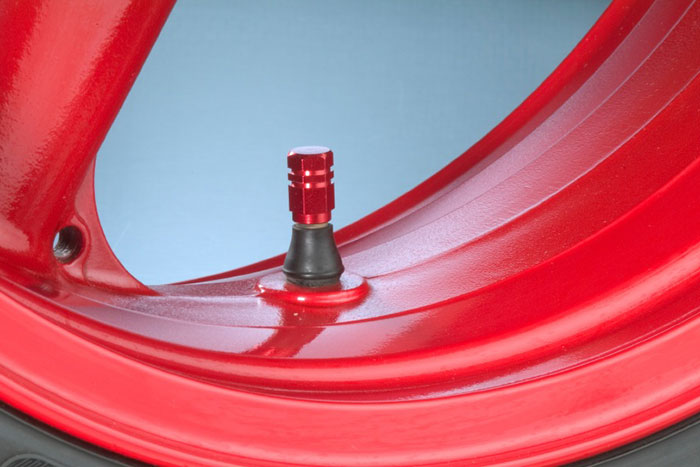
Check whether both valve caps are present.
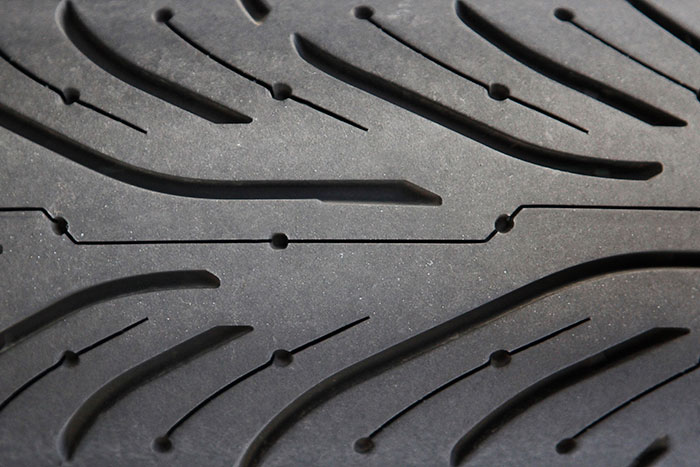
Check whether you still have enough profile on the tyres and whether it wears evenly.
Check whether the valve caps are present. Valve caps are there to keep dirt out of the valve. Check the profile by eye. If this seems to be decreasing too much, then you measure the profile more precise. Even though the legal minimum tread depth is 1 millimetre, changing the tyre sooner is strongly advised.
How high the tyre pressure should be, depends on the type of motorcycle, but also load. Always check this for your type of motorcycle. Both a (way) too high tyre pressure and a too low tyre pressure is not ideal. With a too high tyre pressure, the grip lessens and the motorcycle rides less comfortably. A too low tyre pressure also causes less grip and, in addition to that, cause more wear and a higher fuel consumption.
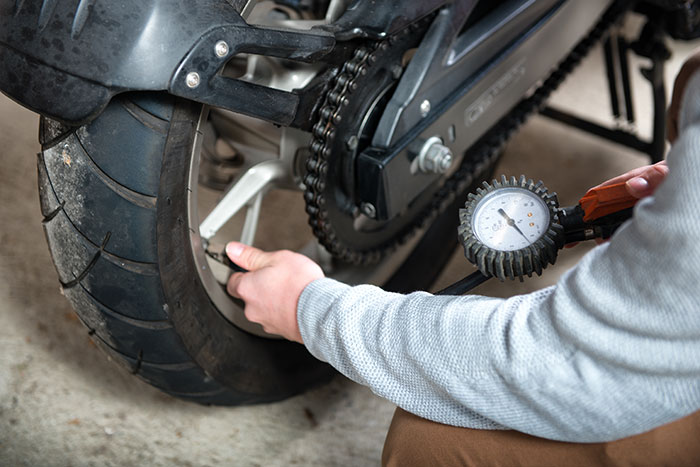
You check the tyre pressure by eye before every ride. If you doubt the tyre pressure, measure it with a tyre pressure gauge. In any case, do this at least once a month.
Generally, the front tyre is a little less inflated than the rear tyre. If the motorcycle is more heavily loaded, because you are riding with luggage or a passenger, then increase the tyre pressure.
Do you have new tyres? Then ride more calmly for the first 100 km. New tyres are provided with a slicker topcoat which first needs to be roughened up a bit before the grip of the tyre is optimal.
- Winter tyres
-

Alpine symbol
Winter tyres are less common for motorcycles than for passenger cars. Most motorcyclists do not ride in winter, making winter tyres unnecessary. If you do ride during winter, then winter tyres are advised as soon as the temperature dips below 8 degrees. The rubber of winter tyres is softer, and the profile is different, which ensures a better grip during low temperatures and wintry precipitation than summer tyres. Above 15 degrees you actually have a disadvantage of winter tyres, because then the grip is less and the wear and tear increases. You can recognise winter tyres by the alpine symbol.
Brakes
The brakes are the most important part of the motorcycle. Checks are therefore very important. Both brakes must always work perfectly.
- Check the brake pressure always before riding off but after you have started the motorcycle. You do this by squeezing the brake lever and pressing the pedal. Can you squeeze or press them all the way through? Then the brake pressure is not okay. Do not go riding but get it checked.
- Check the brake fluid. The brake fluid level must be between the minimum and maximum marking. A too low level could be because of worn brake pads or due to a leak in the system. Never top up the brake fluid yourself but have this checked if it is not right. If necessary, have the brake pads replaced.
- Check the brake discs. They must still have sufficient thickness, and they may not show large burrs. They must also be perfectly straight.
- Check the brake cables. They may not be frayed or worn.
- If you push the motorcycle forward in neutral, the brake shoes of a drum brake may not rub. The disc brakes may drag slightly. Especially if the motorcycle has been standing for a longer period of time, this can give a slight scraping sound. This should reduce quickly after moving. If the brakes keep making scraping sounds during braking, stop immediately. This usually means that the brake pads are worn.
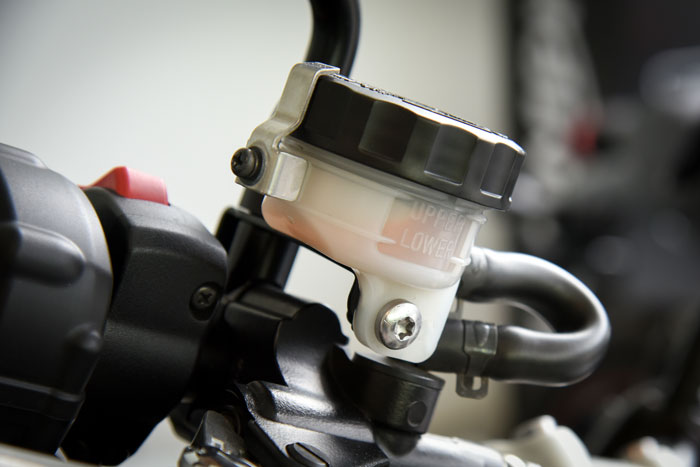
You can usually find the reservoir of the brake fluid on the handlebars of the motorcycle.
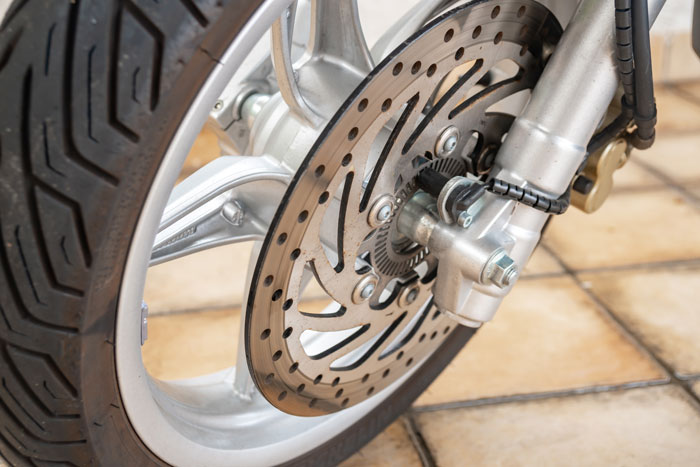
Check the disc brakes for thickness and burrs.
Transmission
A motorcycle can be propelled by a chain, transmission belt or a cardan (or shaft drive). Of these three transmission possibilities, the chain needs the most maintenance and the cardan the least.
Chain maintenance
- Lubricate the chain regularly. For example, about every 500 kilometres. Do you ride in the rain or on muddy roads more often, then cleaning and lubricating the chain more often is advised. Always lubricate the chain after a ride. If you do this right before, most of the grease will by flung off the chain during the ride. The grease also creeps better into the chain when it is still warm from the ride.
- Check the tension of the chain. A motorcycle chain may have some slack but should not rattle. You notice this rattling during braking and accelerating. How much slack a chain may have depends on the type of motorcycle, but it will usually be between 2-3 centimetres.
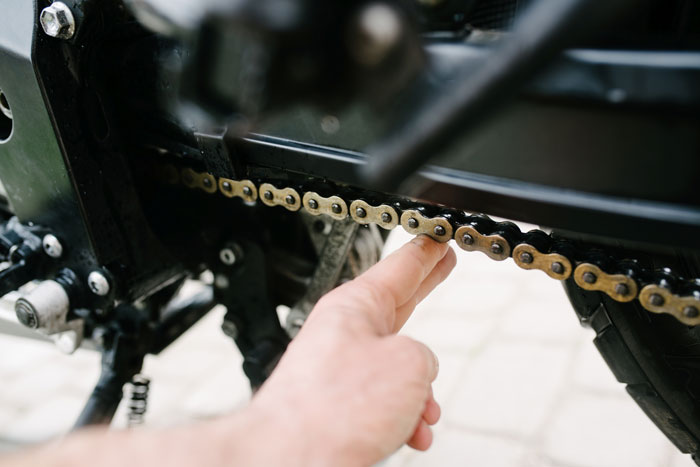
You measure the chain slack by pushing up the chain on the bottom side. It can normally only be pushed up a little bit.
- Replace a worn chain. It is best to replace it together with the cogs. Used cogs are no longer symmetrical, but only wear on one side which makes them pointier or even hook shaped. In that case, they need to be replaced. The front cogs wear quicker than rear cogs, because the front cogs make more rotations. You usually have to replace a chain and cog set between the 20,000 – 30,000 km. The better you maintain the chain and cogs, the longer they last.
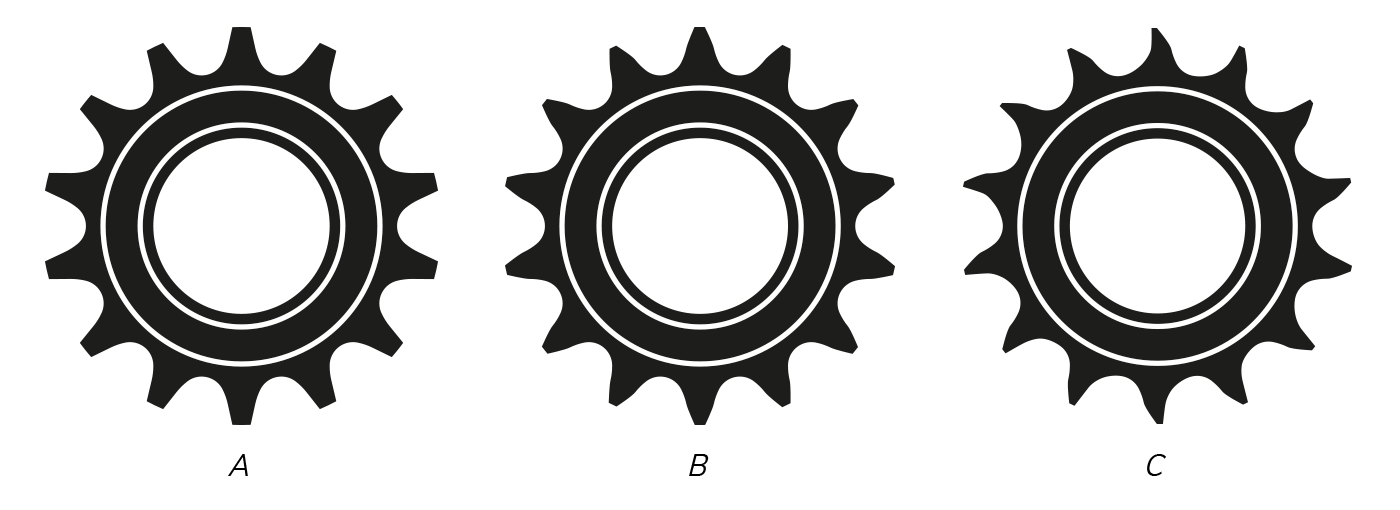
With a new cog (image A) the teeth are flat on the top. The more it wears, the pointier the teeth become (image B). This cog needs replacing. If you keep riding with this, then eventually ‘shark fins’ arise (image C), the teeth are too worn down here.
Belt maintenance
A belt needs little maintenance. A belt does not need to be lubricated or adjusted between replacing it. Replacing is generally needed after about 40,000 – 50,000 km. You often have to replace the pulleys (around which the belt sits, similar to the cogs of the chain) at the same time. Replacing a belt is generally more expensive than replacing a chain.
Cardan maintenance
The cardan needs little maintenance and, normally speaking, does not need to be replaced. The only thing you can check from time to time is the cardan oil. Topping it up is also almost never necessary. If it is necessary, check for leaks.
Lighting
Being seen on a motorcycle is a very important safety aspect. Making sure that you are seen is done by a correct position on the road, wearing bright motorcycle clothing and helmet, but also by always using lighting. Make sure that the lights are always in running order. Check the lights on broken bulbs, clean the light lenses if necessary and check them for corrosion (the glass becomes dull) and condensation.
Check your dipped headlight, full-beam headlight, rear light, indicators and the warning lights on the dashboard. Make sure that you always carry a set of spare bulbs and fuses with you for when something breaks on the road.
Oil
Oil provides lubrication and cooling of the moving parts of the engine. A correct oil level is therefore very important and part of the fixed checks of a motorcycle. You can check this with a dip stick or a gauge (viewing window). You can find this dip stick or gauge at the bottom of the engine block, where you can also find the filler hole for the engine oil.
Check the oil level preferably before a ride. If you do this after a ride, let the engine cool off for at least 10 minutes. The motor oil then gets a chance to sink back into the oil pan (oil collection tray). To measure the oil level, put the motorcycle upright. If you put the motorcycle on the kickstand, the oil will pool too much to one side of the oil pan. If the oil level is too low, top it up with the correct engine oil. Do not top it up too quickly, but check in between, after you have waited a little. Too much oil could also cause problems.
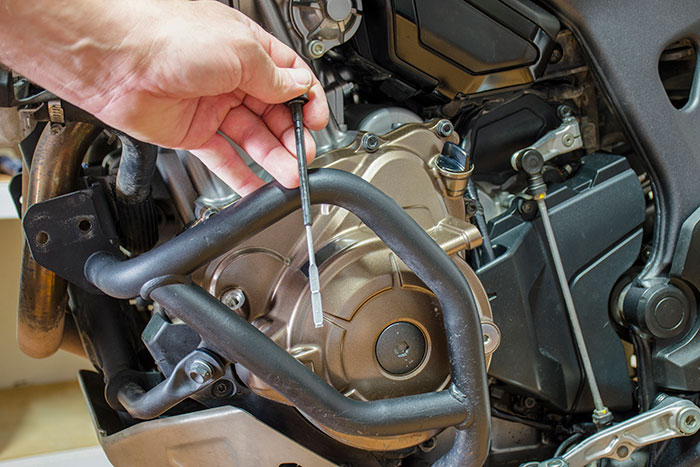
Motorcycles can be equipped with a dip stick.
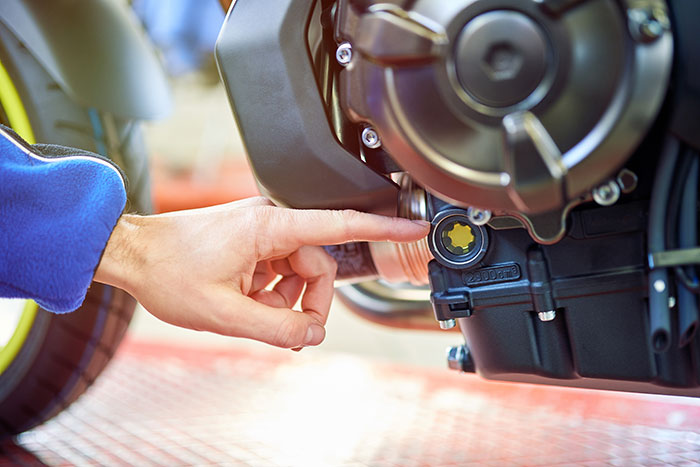
But a lot of motorcycles have an oil level gauge.
Other checks
Battery
These days, you cannot tell much from the battery. As soon as it starts to get weaker, you will notice this by the poor starting of the motorcycle. To extend the battery life, it is wise to connect it to a trickle charger during longer periods of inactivity (such as during winter). This prevents the battery from draining.
Suspension
You can check the front fork suspension by pushing down and releasing the front fork. This should give sufficient resistance, and the front fork should rebound once and not keep ‘bobbing’. Make sure that the front fork is cleaned after every ride. Dead insects and dirt on the front fork can cause damages to the front fork seals. You can check the rear suspension by sitting on the motorcycle and standing up again. The rear should also rebound once. Set the suspension more firmly if you decide to ride with a passenger or heavy load. This prevents the suspension from ‘sagging’ when you ride over a speed bump with a heavy load.
Cooling
The engines of motorcycles can be cooled in several ways. There are air-cooled and liquid-cooled engines. Air-cooled engines can be recognised by the ribs (ridges) on the engine block. The air is blown past the engine block between the ribs while riding, thus cooling the engine.
For the cooling, it is important that the engine block does not get too dirty. After all, the air must make contact with the metal and flow freely between the ribs to be able to cool the engine properly. One downside of an air-cooled engine is that the engine block has reduced cooling while stationary (for example during a traffic jam or an opened bridge). When standing still, turn off the engine in time to prevent overheating. The engine will also have reduced cooling in hot weather.
Liquid-cooled engines are cooled as fluid is pumped around the cylinders of the engine block. This system is more expensive, more complicated and more prone to problems than an air-cooled engine. However, the cooling is better and more even. While stationary, a liquid-cooled engine stays cooler with the engine running, although it does eventually need some riding wind to cool the radiator through which the coolant runs. This radiator is in front of the engine block immediately after the front fork.
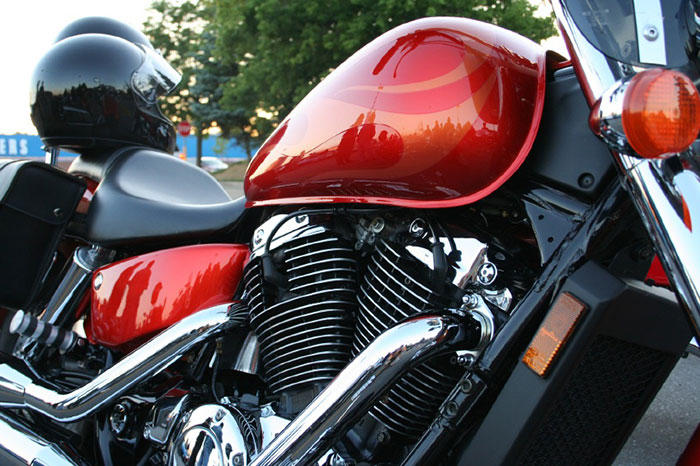
Air-cooled engine.
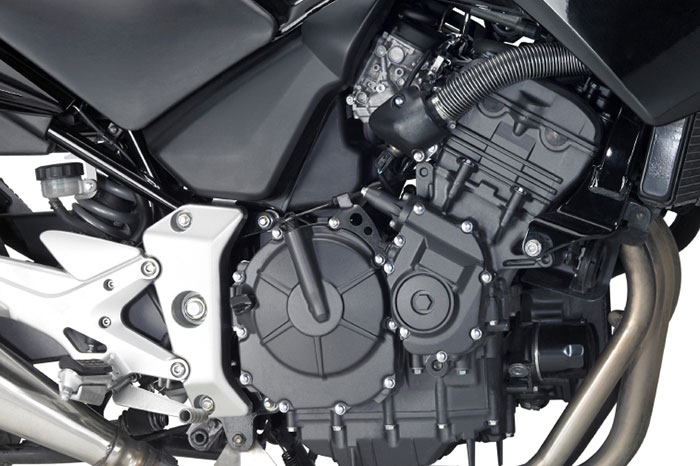
Liquid-cooled engine.
With a liquid-cooled engine, check the coolant level before a ride. If it is too low, then the chance of overheating while riding is present. If necessary, top it up with the correct coolant. In addition to that, keep the radiator as clean as possible. Only in case of emergency can you top the coolant up with water, to be able to reach a safe place as quickly as possible.
In addition, every engine is cooled by the oil in the engine and by the fuel. An air-cooled engine can also have a radiator on the motorcycle, to cool the engine oil. Make sure that this radiator also does not become too dirty. A dirty radiator cools les effectively than a clean one.
Control unit and emergency stop switch (killswitch)
Before a ride, check whether all levers, grips (think of the grip of the throttle!) and buttons are properly secured and working well. Also check if the emergency stop switch is in the correct position. This switch is usually red and is on the right side of the handlebars. The function of the switch is to turn off the ignition of the engine in case of emergency.
If you fall with the motorcycle, the turning wheels, cogs, chain or belt could cause extra injuries. By flipping the emergency stop switch, the engine and therefore the wheels, chain or belt will come to an immediate stop, without turning off the lighting. The latter is important regarding visibility. Sometimes you do not realise that this switch is flipped (on accident) and you therefore cannot get the engine started.
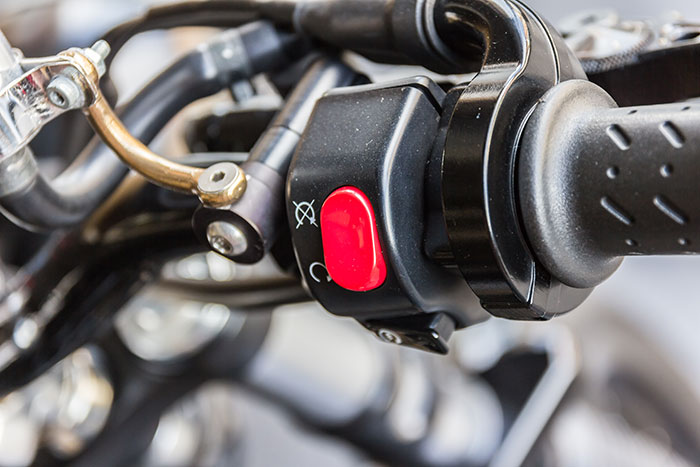
The red button is the emergency stop switch or killswitch.
Other technical matters
In addition to the fixed checks, you can also notice other things while riding. For all applies: if the motorcycle suddenly rides differently than you are used to, if it suddenly makes a weird noise or if something does not feel right, then stop in a safe place and check the motorcycle. Think of an unbalance in the wheels, strange jolts while braking and last but not least: lit dashboard lights. With a motorcycle, almost all problems have a direct or indirect impact on safety. Therefore, always take the safe bet.
Anti-lock braking system (ABS) and combined braking system
While braking with a motorcycle, you normally combine the front brake and the rear brake, where the front brake has the most braking force. While braking, you usually use a distribution of 70-80% front brake and 20-30% rear brake. The front brake is operated with the brake lever on the right side of the handlebars. The rear brake is operated with the brake pedal on the right side, in front of the footstep. Dispersing the braking force well can be quite difficult, especially in the beginning. Also, because this may be highly dependent on the circumstances, such as the kind and state of the road surface or taking a passenger with you.
Modern motorcycles may be fitted with a combined braking system. This system disperses the braking force in the correct ratio over the front and rear brake. Depending on the system, this is only when braking with the rear brake, or with both the front and rear brakes. Because the brake force is dispersed better, you are less likely to brake hard with the rear brake and you are less likely to have a locked rear wheel. Such a system is often combined with an ABS. An ABS prevents both wheels from locking up while braking. An ABS is even more important with motorcycles than with cars. If the front wheel of the motorcycle locks up, this usually means that the motorcyclist will fall. These days, ABS is also increasingly more common on motorcycles without a combined braking system.
Minimum braking deceleration
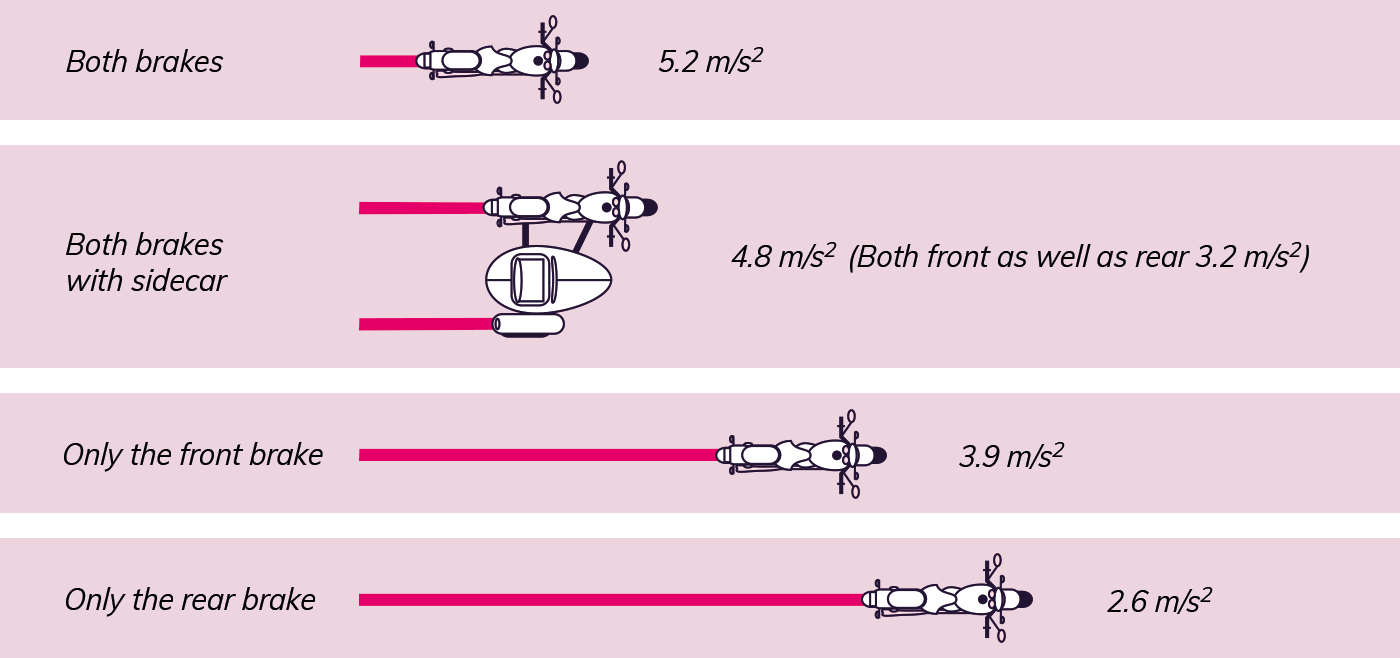
Every motorcycle must meet a minimum braking deceleration. This means that when fully squeezing the brake(s), the motorcycle must decelerate sufficiently per second (in m/s2). A heavily loaded motorcycle or a motorcycle with a (loaded) trailer will have a longer braking distance than normal.
Tyres and rims
If you experience an imbalance in the motorcycle while riding, then this may be due to a problem with your tyres or rims. In that case, check if the spokes (if present) are all still whole and properly tensioned, or that there might be a knock in the rim. Rims may also not show tears or breaks. A too low tyre pressure or a wheel that is not properly balanced could also cause the motorcycle to sway, especially at higher speeds. Irregular wear and tear of the tyres is always a reason to have the motorcycle checked.
Mirrors
If you ride on a motorcycle, good view in the mirrors is important. Therefore, always check the position of the mirrors while sitting on the motorcycle, while stationary. If the mirrors adjust themselves while riding, then stop in a safe place and readjust them. If this happens more often, then it means that your mirrors are loose. In that case, tighten them better, or have it done at a motorcycle shop.
Exhaust
If you notice that your motorcycle suddenly makes more noise while riding, then this could indicate a problem with the exhaust. It could be leaky or loose. It is prohibited to ride with a loose or leaky exhaust. Have it fixed as soon as possible.