

Environment
Riding a vehicle with a combustion engine (usually running on petrol) is by definition not good for the environment. There are more and more vehicles with an electric motor. This sounds very environmentally friendly.
However, electricity must also be generated, and this does not always happen in a clean way. The batteries of these vehicles do not have an unlimited lifespan and must also be disposed of after this. That is why it is important, in all cases, to ride as economically as possible and not waste energy, regardless of whether this is energy of a combustion engine or an electric motor.
Purchase and maintenance
When purchasing a motorcycle, you can keep the environment in mind. Newer models are often more economic and less harmful to the environment than older models. In addition to that, keeping your motorcycle in good condition is also very important to preserve the environment.
Poorly maintained motorcycles with a combustion engine often use more fuel and the emission of harmful substances such as carbon dioxide (CO2) may be a lot higher when the combustion is no longer optimal. Maintenance also includes keeping the tyres inflated. A too low tyre pressure causes more fuel consumption and puts a strain on the environment.
Noise pollution
Noise pollution also falls under environmental strain. It can arise when mounting a different exhaust. Try to prevent this nuisance by checking whether the noise production is still within the margins after modifying. In addition, do not accelerate unnecessarily.
Because there sometimes is so much inconvenience to local residents from motorcyclists on nicer days, a number of municipalities choose to close dyke roads and other popular motorcycle routes to motorcyclists during the weekend.
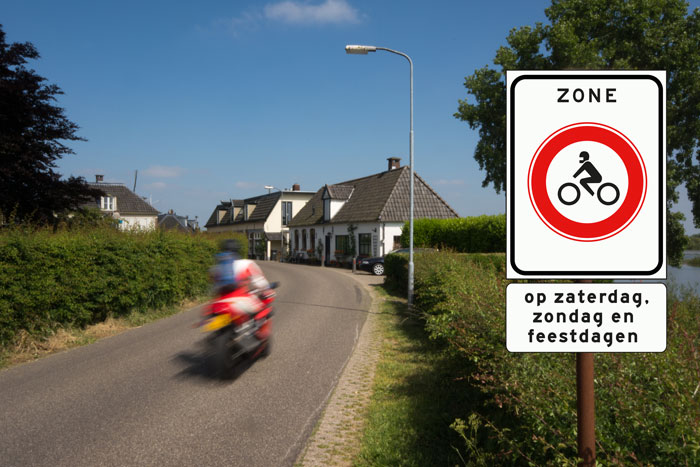
Some (dyke)roads are closed during the weekends due to the nuisance from motorcyclists.
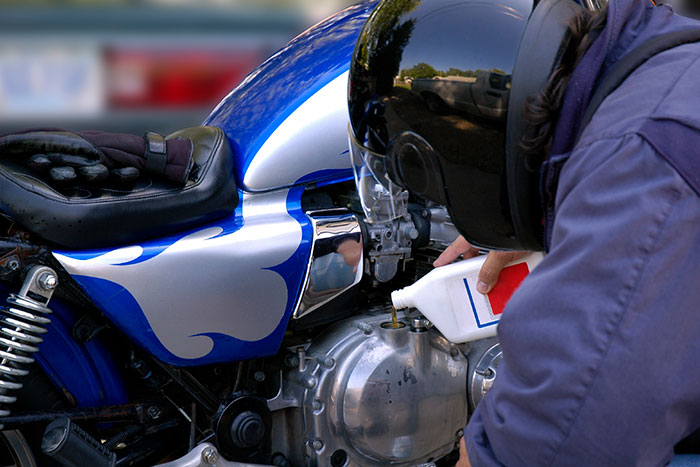
Good maintenance prevents a higher energy consumption and unnecessary emission of harmful gases.
Riding behaviour
With the correct riding behaviour, you can save a lot of fuel. Not only good for the environment but also for your wallet. A lot of motorcyclists like riding a motorcycle because of the quick acceleration and the high engine speed that comes with it. Unfortunately, this way of riding off and accelerating causes more energy consumption and more emission of harmful substances. Always ride off calmly and timely shift to a higher gear when riding a manual motorcycle.
The catalytic converter in a combustion engine reduces the harmful emissions. But it only works properly when it is up to temperature. This takes 10-20 minutes. With this type of motorcycle, therefore, ride a little calmer at the start of the ride.
Defensive riding behaviour and anticipating
Defensive riding means looking far ahead, timely adjusting your speed to the situation and keeping in mind unexpected situations. Preparing for an action you may need to perform is called anticipating. If you anticipate well, then you will notice that you need to brake less and that you can keep to a more constant speed. All this ensures a reduction of consumption and therefore less impact on the environment.
Large following distance
The larger the following distance, the less you need to brake and the more you can catch the speed differences of traffic in front of you by letting your motorcycle roll out. Not only is it safer but is also ensures a reduction of consumption and therefore less impact on the environment.
Ride preparation
A good ride preparation ensures less energy consumption. A lot of motorcyclists plan their route beforehand, and the use of a navigation system is becoming more common. Such a system ensures that you generally ride more consistently because you are less doubtful about your route. You are also less likely to ride the wrong way, which means fewer ‘useless’ kilometres. Some navigation systems also have an ‘Eco’-route. This calculates the most energy friendly route to your destination.
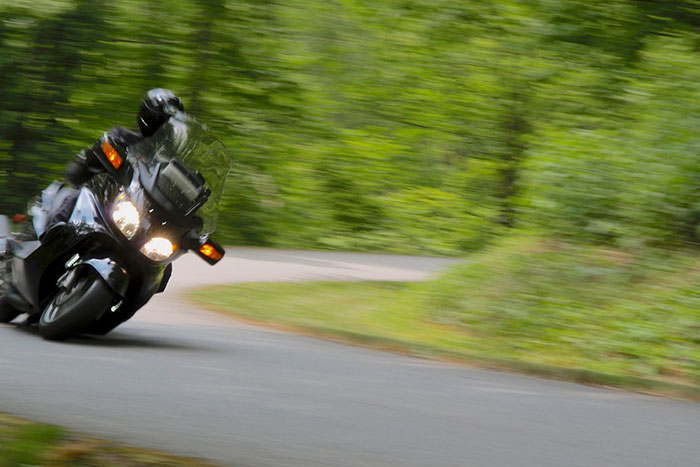
Good riding behaviour, anticipating and defensive riding ensure a reduced energy consumption.
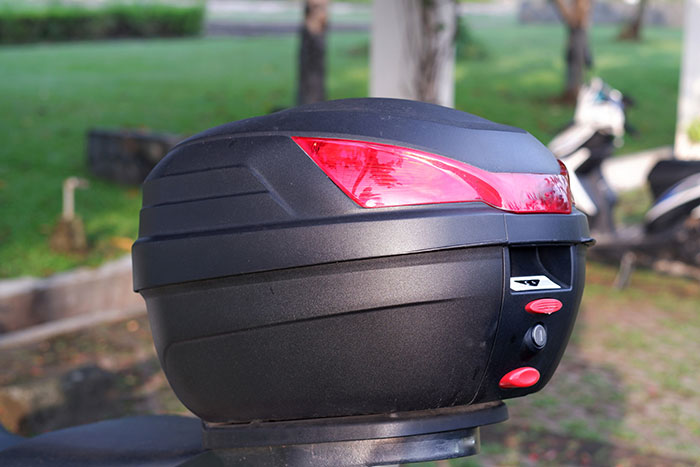
By removing accessories such as cases from the motorcycle when they are not needed, saves you fuel.
Accessories on the motorcycle
A motorcycle is generally less streamlined than a passenger car. Windshields and streamline caps may, if they are adjusted properly, ensure that the motorcycle ‘catches less wind’, but they could also have the opposite effect. The less streamlined your motorcycle is, the higher the energy consumption. This naturally also applies to cases, luggage and passengers on the motorcycle. The increased weight causes a higher energy consumption, but also, for example, the shape of the cases will influence this. In the end, a motorcycle without cases or luggage will also consume less energy than one with cases or luggage. If you do not need the cases during a ride, then remove them (if possible) from the motorcycle.
Riding in a traffic jam
A motorcyclist may ride in between the lanes of slow moving or stationary traffic jams. This ultimately ensures shorter traffic jams and less stationary traffic. It is also better for energy consumption.
- Tips for riding environmentally friendly
- Start the engine without accelerating.
- Ride off calmly immediately after starting.
- With a combustion engine:
- Ride more calmly at the start of the ride. The catalytic converter only starts working efficiently after about 10 to 20 minutes.
- Do not accelerate (hard) unnecessarily and do not let the engine run stationary unnecessarily.
- Shift to a higher gear in time.
- If you need to wait for a long time, such as at a bridge or level crossing, then turn of your engine.
- Ride calmly and consistently and do not overtake forcibly or unnecessarily.
- Prevent abruptly accelerating and/or decelerating, let the motorcycle roll out.
- Look far ahead and anticipate on what may come.
- Ensure a good following distance.
- Maintain the motorcycle well.
- Always ride with the correct tyre pressure