

Obstacles to visibility
Rain, wintry precipitation and fog can significantly limit the field of view. But other circumstances can also make perceiving more difficult. Both at night as well as during the day.
Low sun
Low sun is particularly an issue during spring and autumn. It is mostly an issue in the morning and late afternoon. If you have the sun in your face, it can limit your field of view significantly. If you also have a dirty or scratched visor, then your visibility can become dangerously bad. You may overlook other traffic, bends and traffic lights. If this occurs, immediately lower your speed by releasing the accelerator.
Regularly clean your visor. During long rides, take a cloth and a bottle of water with you so you can also clean the visor on the go. Use sunglasses or the sun visor of your helmet if necessary.
If you have the low-lying sun at your back, do keep in mind that oncoming traffic can see you poorly because they have to face the sun. The advice is to always run dipped headlights while riding. At a low sun it is even more important, to ensure that you are better visible.
Schadow under the trees
On sunny days, it can also become necessary to run dipped headlights, for example when you are riding on a road with a lot of overhanging trees and branches. The sunlight that shines through the trees can create a glare that greatly impacts the visibility. Vehicles without dipped headlights are less noticeable. If you want to overtake on these kinds of roads, then look extra carefully whether no oncoming traffic (with dipped headlights turned off) are approaching.
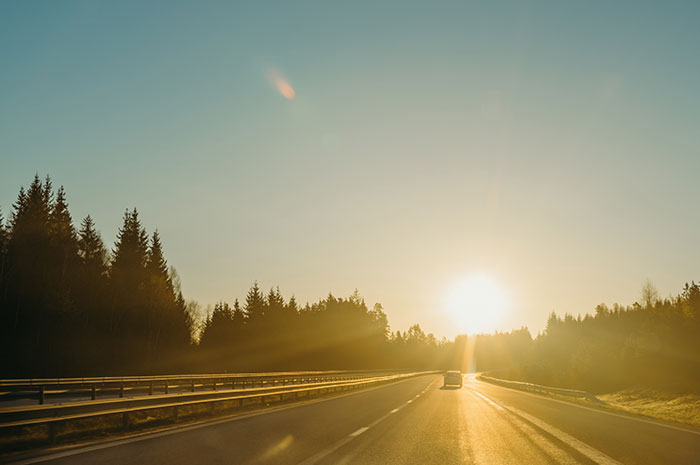
Low sun can be blinding.
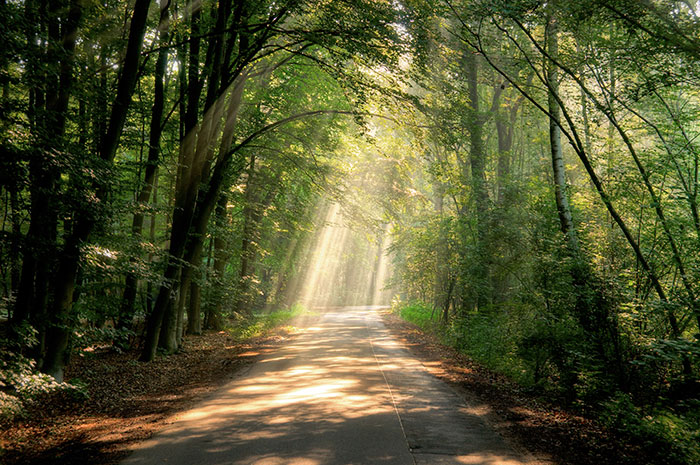
The glare of the sun’s rays between the trees can seriously obstruct the view during the day.
Twilight
Your vision is always reduced in twilight hours, when the colours begin to fade. Your eyes must adjust to the diminished light. This happens more quickly for some than others. Because you have the idea that you can still see reasonably well during twilight, you are less likely to turn on your dipped headlights. That is why you will encounter poorly lit and with thus barely visible vehicles more often during twilight.
Dark
Of course, the vision is much worse in the dark than during the day. Even when you use sufficient lighting, many areas remain unlit and therefore more difficult to see. In addition to that, pedestrians, poorly lit cyclists and obstacles on unlit roads are often not immediately visible. Some people also suffer from night blindness, which makes their vision in the dark even worse. Riding a motorcycle in the dark is then not advised.
Adjust your speed to the view you have. Try to anticipate the course of the road using the roadside posts, streetlamps, road markings, signs and lighting. Use the full-beam headlights when necessary, buy dim these immediately when you encounter oncoming traffic or if there is a vehicle in front of you. Do not ride against the verge on roads without a pavement or lighting. Remain closer to the middle of the road as much as it is safe to do so. This also safer for pedestrians or cyclists that walk or cycle on the side of the road.
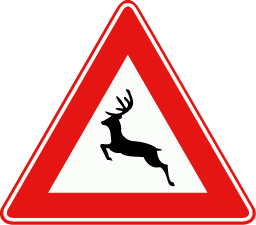
J-27 - Crossing wildlife
In the evening and during the night, the chance of crossing wildlife is also the biggest. Keep this in mind on places where this is common by lowering your speed. If you run your full-beam headlight, switch it off as soon as possible if you see wildlife running. They become disoriented by the bright light and then have no opportunity to flee.
Polder blindness and tunnel vision
Polder blindness arises when you look too far into the distance on long straight and monotonous roads. You will then stare, and your field of view becomes narrower. This is called ‘tunnel vision’. Side roads are then less noticeable. You can easily overlook vehicles that are approaching on these side roads. This sometimes causes accidents on intersections where you would not immediately expect this due to the good visibility. Stay aware of your viewing behaviour and avoid staring by shifting your gaze every few seconds.