

Communication in traffic
To let other road users know what you are about to do, it is important that you communicate. You can also do this to warn other traffic for imminent danger. Depending on the situation, you do this with light signals, sound or gestures. It is important to know that you cannot just use these signals. There must be a valid reason to do so.
Antisocial hand gestures or unnecessary flashing of the full-beam headlight is not the intention and can be punished. Excessively using the horn, throttle or indicators is also not allowed.
You are not allowed to produce unnecessary sounds by means of the horn or in other ways. Think of a broken or unoriginal exhaust, or unnecessarily squeezing the throttle when standing still in tunnels.
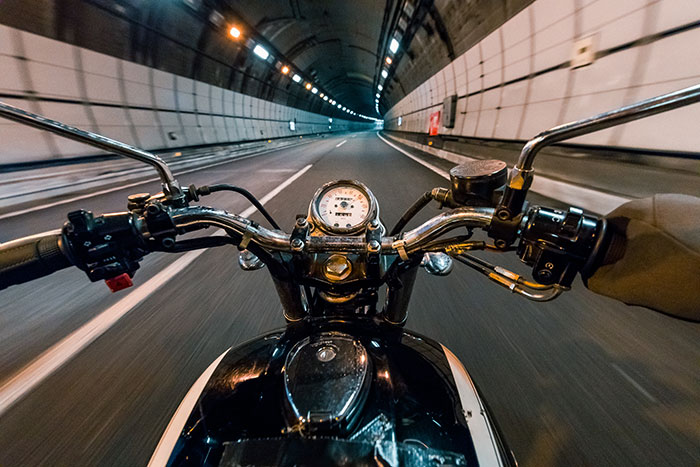
Accelerating in tunnels may sound nice to you, but it can cause dangerous startled reactions.
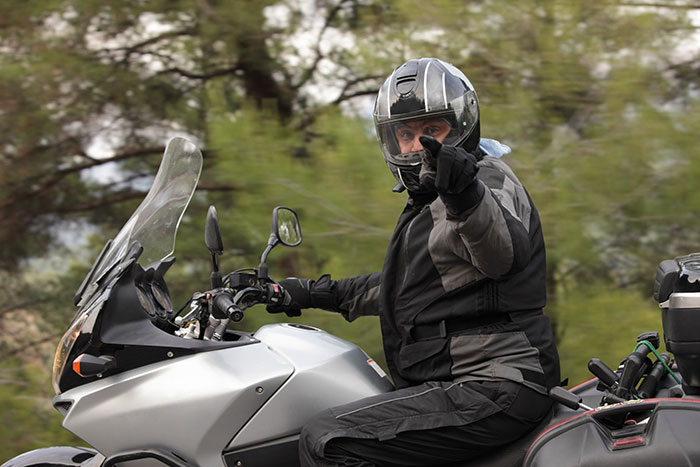
Do not take your aggression out on other road users and do not make frustrated gestures.
Hand gestures
Sometimes it may be necessary to point out to someone that you have seen them and that you stop for them. Or that you waive your right of way, for example, because it is more convenient in that situation.
Pedestrians often do not dare to suddenly cross at a pedestrian crossing. Usually out of fear of not being seen. In that case, you can indicate that they can cross by means of a friendly hand gesture.
You might encounter drivers of larger vehicles making a hand gesture towards you, to let you know that they will wait for you. For example, because they cannot enter the road you are coming from, until you are gone.
The important thing is that you never take your anger out through hand gestures. Do not raise your middle finger and do not make aggressive gestures. Count to ten and resolve the situation as safely as possible. This prevents aggression and therefore danger in traffic.
The horn

The horn must be present on every motorcycle. If it is not working, you are not allowed to ride. You are only allowed to use your horn to avert imminent danger. You are not allowed to sound your horn to someone you know, or as a greeting when riding off. Using your horn is also not allowed if you solely do it because you are angry or frustrated. You are allowed to use your horn when you almost get hit because someone did not see you.
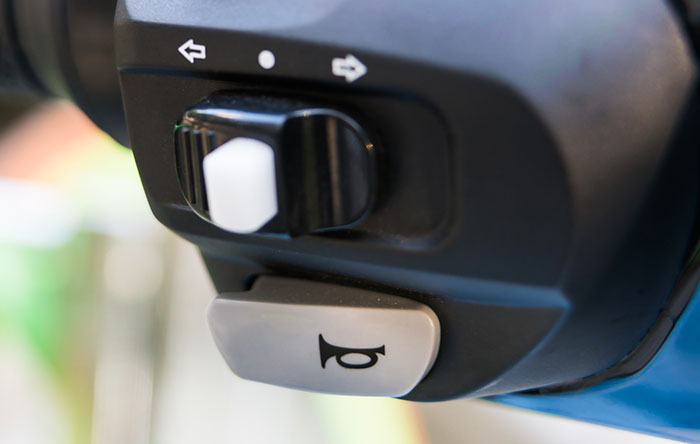
You may only use your horn to avert danger.
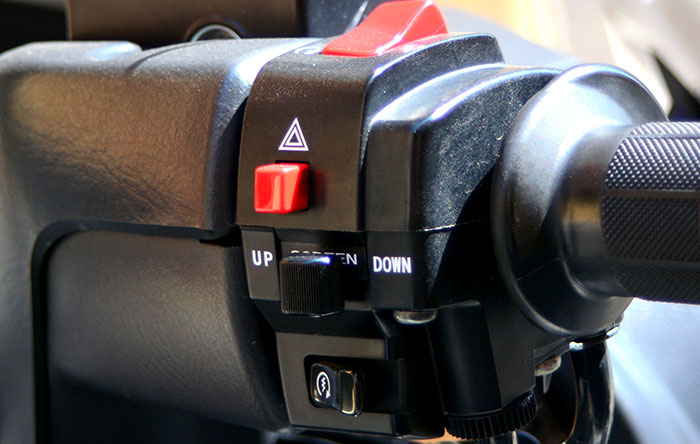
Hazard lights should also never be used just like that, you may only use them during emergency situations.
Hazard lights

On many motorcycles, hazard lights (also known as warning light) are present. You may only use these lights to avert imminent danger. If you are standing somewhere with a breakdown, you may not be seen in time without the hazard lights. Then the use of hazard lights is very wise.
When approaching a traffic jam, you are allowed to use your hazard lights to warn traffic behind you. As soon as you start riding between the traffic jam, you must turn them off again.
It is not meant to use the hazard lights when loading or unloading. Stopping and parking may only be done in places where it does not cause danger. Using your hazard lights when there is no danger is not allowed.
Indicators

Using the indicators is required before and during turning off and during the following special manoeuvres: riding off, overtaking, getting in lane, changing lanes and important lateral movements. Both not using your indicators when required as unnecessarily using your indicators may have dangerous consequences.
If you indicate direction that you want to turn off too early, then it can create confusion for other road users. But not indicating direction that you want to turn off, can also result in danger. Incorrectly using or not using your indicators is punishable. These lights must therefore always be in working order.
Flashing signal with full-beam headlight

Another way of warning someone is by means of a flashing signal with the full-beam headlight. You are also only allowed to do this if it allows you to avert imminent danger. For example, you may warn an oncoming driver if they have their full-beam headlights that blind you.
It is not allowed to flash your full-beam headlights to warn oncoming traffic of a police check. And it is also not allowed to use them to let the driver in front of you know that you want to pass them.
Use of brake lights
As soon as you use the brake pedal or the brake lever, the brake lights turn on. Unnecessarily using the brakes is bad for the energy consumption of the motorcycle and causes extra wear of the brakes. In addition, it is also quite annoying for traffic behind you.
You could use the brake lights as a pre-warning. You do this by lightly and shortly squeezing or pressing the brake before actually braking. For example, when you want to turn off or when you want to stop at a pedestrian crossing. Traffic behind you is then warned that they must also decelerate. They also have the possibility to increase the following distance before you actually start braking.
However, never use your brake lights to deliberately scare tailgaters. This can be extremely dangerous and encourages aggressive behaviour. If you cause an accident when doing so, then it is a crime. If you are bothered by a tailgater, then it is best to increase your own following distance so that you do not have to brake abruptly.
Warning triangle
Using a warning triangle is never required for two-wheeled motorcycles. But as soon as you go out on the road with a trike or a motorcycle with sidecar, it could be required. This is the case if you are standing somewhere inconvenient or dangerous due to a breakdown and your hazard lights are not working. In that case, you must place a warning triangle at a distance of 30 metres from your vehicle. Do this in the direction of traffic for which your vehicle forms an obstacle.
If you have a problem with your two-wheeled motorcycle and are you in an awkward position, then it is allowed to use a warning triangle. You are also allowed to use a warning triangle in combination with the hazard lights.
If you see a warning triangle, then take into account a stationary vehicle further down the road. Sometimes you cannot immediately see the vehicle. Decrease your speed if necessary and ensure sufficient (swerving) space.

You can see from the warning triangle that there is someone with a breakdown after the bend. Make sure that you can pass this safely.