

The safest place for motorcyclists
For motorcyclists, the position on the road is an extremely important factor for safety. Because of the small contours of the motorcycle, you are easily overlooked as a motorcyclist. Wearing striking clothing only helps a little. By riding in the correct position, you make sure that you stand out more. For motorcyclists, the correct position is generally in the middle of, or just left of the middle of the lane.
In addition to better visibility, this has a few other reasons:
- On the right side of the lane there is often more rubbish.
- This way, you have more space around your vehicle for potential evasive manoeuvres.
Your practical course will go into much more detail on handling the correct position. Outside the standard position in the middle of, or just left of the middle of the lane there are also reasons to deviate from this. As a motorcyclist, you will have to be constantly engaged in deciding your most ideal position, where visibility and being visible are paramount.
Slippery road sections
As a motorcyclist, you must pay extra attention to slippery road sections such as manhole covers, cobblestones, white road markings and black tar snakes. Also keep in mind loose sand or gravel, which can lie in the middle of an intersection, especially on T-junctions in rural areas. In the big cities, tramrails can also be a risk, so try and avoid driving longitudinally as much as possible.
Adjust your position on these road sections as fluently as possible by recognising them in time and to weigh in other circumstances as well. Think of, for example, oncoming or following traffic.
Ride over the white markings as little as possible. Are there arrows applied on the road surface, then never ride over the longitudinal line of the arrow. At an arrow for straight ahead or left, ride past it on the left side. And at an arrow to the right, ride past it on the right side. Always make sure that you leave enough space between you and the traffic on the other lanes or pre-sort areas. Do not ride on the edge of the lane. For example, you may also ride over the triangle at the arrow for straight ahead, to avoid getting too close to the traffic left of you. But always avoid the longitudinal line.
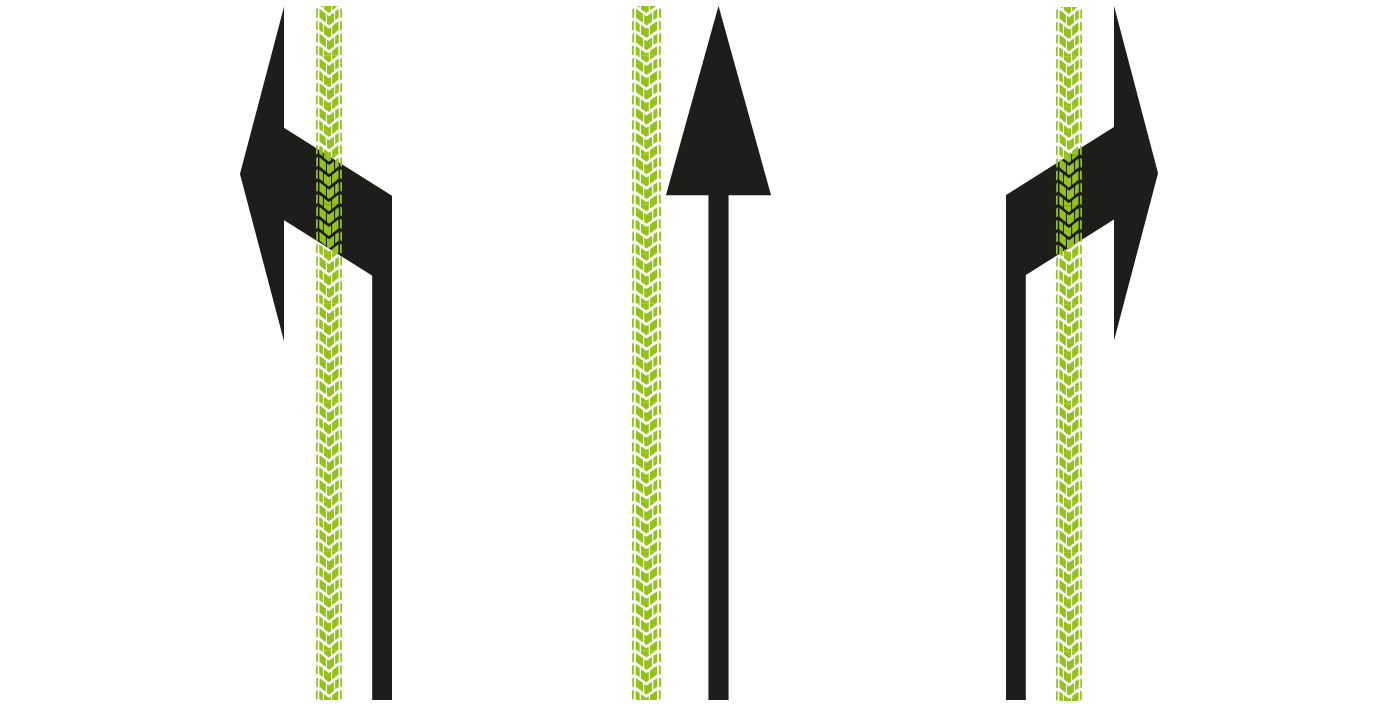
The green tyre tracks indicate where it is best to ride over the road markings.
Position in bends
When negotiating bends, your position on the road is also extremely important your own vision and to be visible. However, this position is also dependent on multiple factors, such as the vision through the bend, the presence of oncoming traffic and the state of the road surface. Keep to the following ground rules:
- Adjust your speed and gear to the sharpness of the bend and the (possibly obstructed) view of the bend well before the bend.
- Look through the bend as much as possible, also keep an eye out for dirt and damage on the road. Avoid riding over manhole covers and road markings.
- Start the bend to the outside as much as possible. You start a bend to the left on the right side of the lane and a bend to the right on the left side of the lane. Do keep enough lateral distance to oncoming traffic when doing so.
- When there is sufficient visibility during the bend, pull your riding line a little bit inwards. With a bend to the left, this is towards the axis line. With a bend to the right this is towards the verge. But never hang your upper body over the axis line or verge.
- Take into account pinching bends (bends that become sharper) or S-bends (a bend that changes into another bend in the other direction).
- When entering a bend with the correct speed, it is possible to slowly accelerate immediately after exiting the bend. We call this the slow-in-fast-out principle.
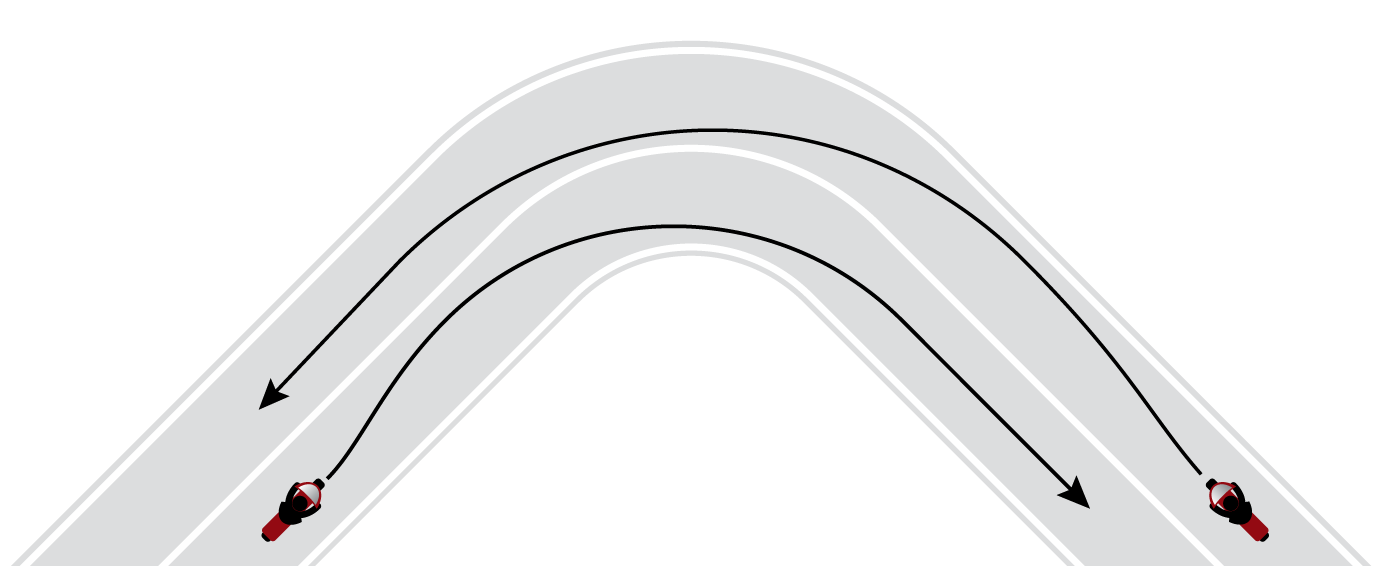
During negotiating a bend, you choose the most ideal riding line. The ideal riding line makes it possible to ‘look through the bend’ as much as possible.
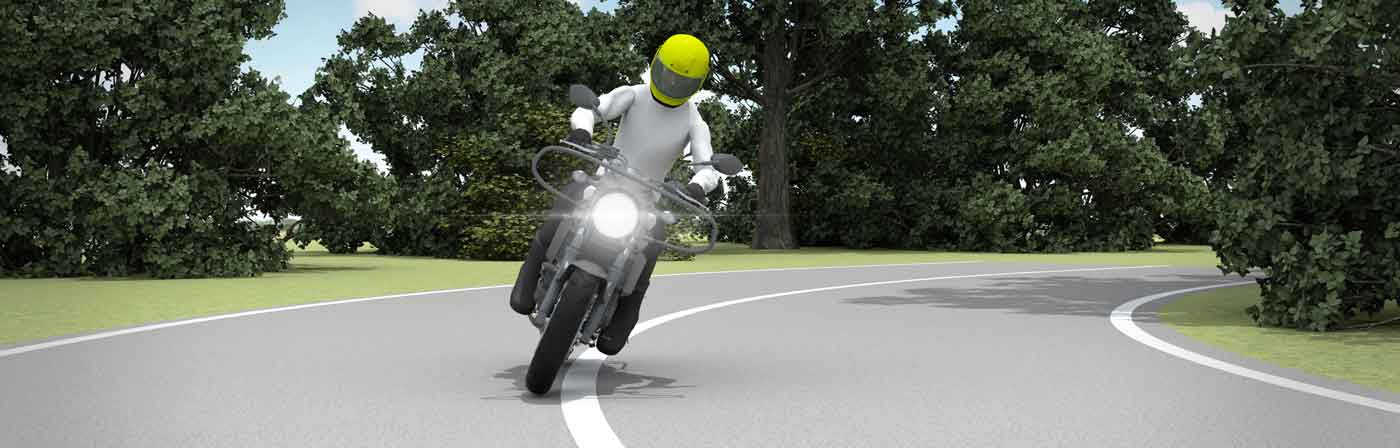
If you take the bend like this, you hang over the road half of oncoming traffic. Oncoming traffic may be startled by you and hit you. Above all, swerving in a bend is an extremely dangerous manoeuvre.
Posture in bends
Steering on a two-wheeled motorcycle mostly happens by shifting your bodyweight. You can lean in, lean along or lean against. When leaning in, your body is more slanted in the bend than the motorcycle is. This is wise when, for example, roads are slippery. On extra tight bends, it is better to lean against the bend, making your motorcycle go through the bend more slanted than you do. During the vehicle control lessons (AVB-lessons) you will learn this during the half turn. You could possibly use the rear brake for better balance when doing so. In most normal situations, you lean along the bend. You are then in line with the motorcycle.
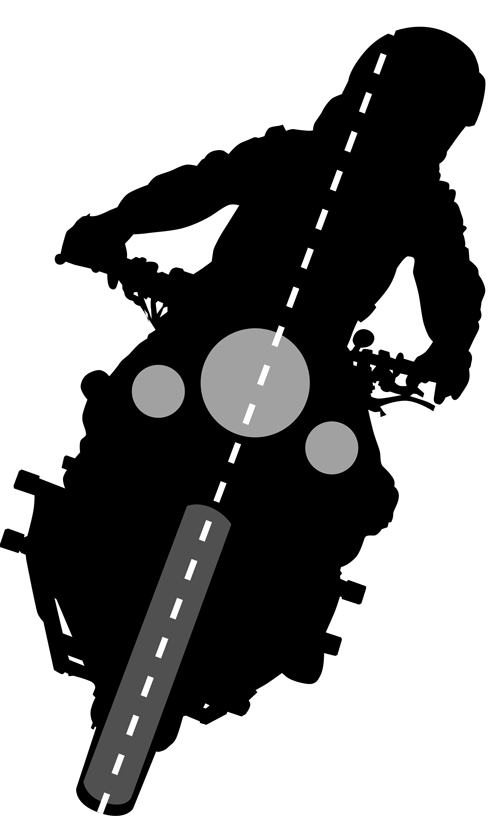
Leaning in
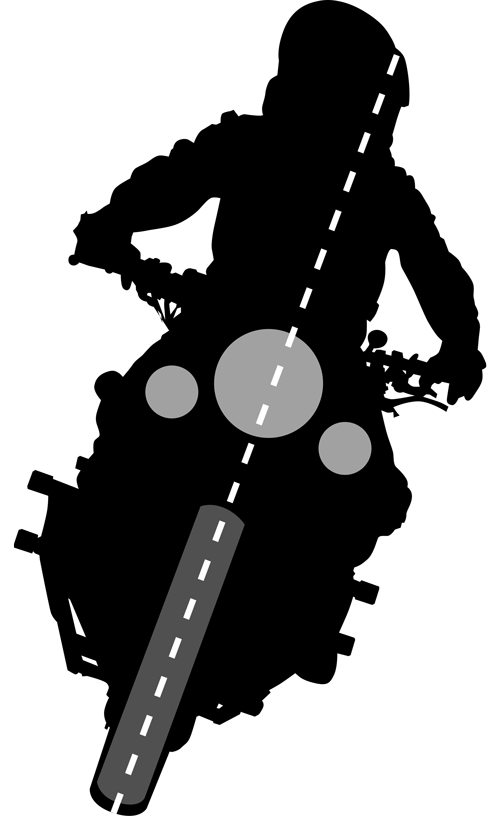
Leaning against
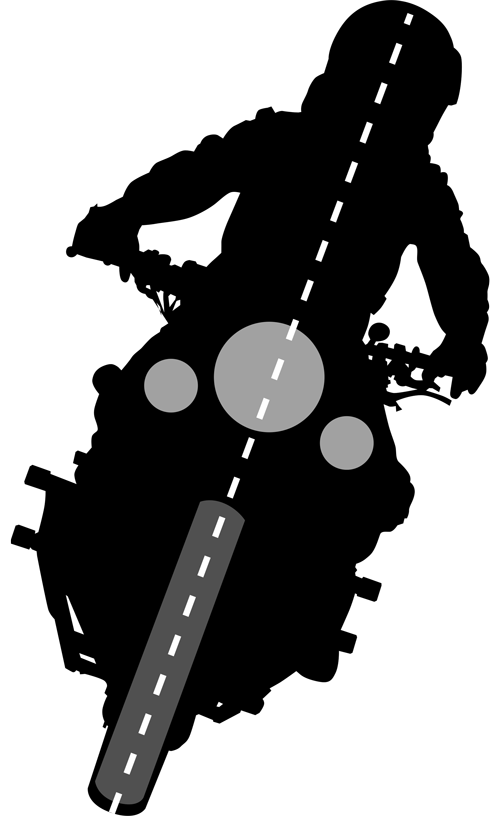
Leaning along
Space cushion
Because you are vulnerable as a motorcyclist, your space cushion is extremely important. This is the free space around your motorcycle. When choosing your position, always try and disperse this space as much as possible. You do this, for example:
- by not riding too far left on the left lane when there are several lanes, but rather more in the middle of the lane;
- by ‘taking’ enough space when passing obstacles and waiting a moment when this space is not there;
- by not locking yourself in behind a vehicle or obstacle if you have to wait for oncoming or following traffic;
- by always creating extra swerve options when conditions are worse. For example, when it rains heavily, do not ride in the left lane on the motorway, but use the lane immediately next to the hard shoulder.