

General requirements - part 2
- Main grooves
The widest grooves on the running surface of a tyre. Here you can find the wear indicators.
- Running surface
Part of the tyre that comes in contact with the road surface.
- Casing
Part of the tyre, under the rubber layer, that gives the tyre its strength. Usually featuring plastic (nylon, polyester) and steel wiring.
- Wear indicators
Raised sections in the main grooves. As soon as they wear with the running surface, the tyre no longer meets the minimum profile depth.
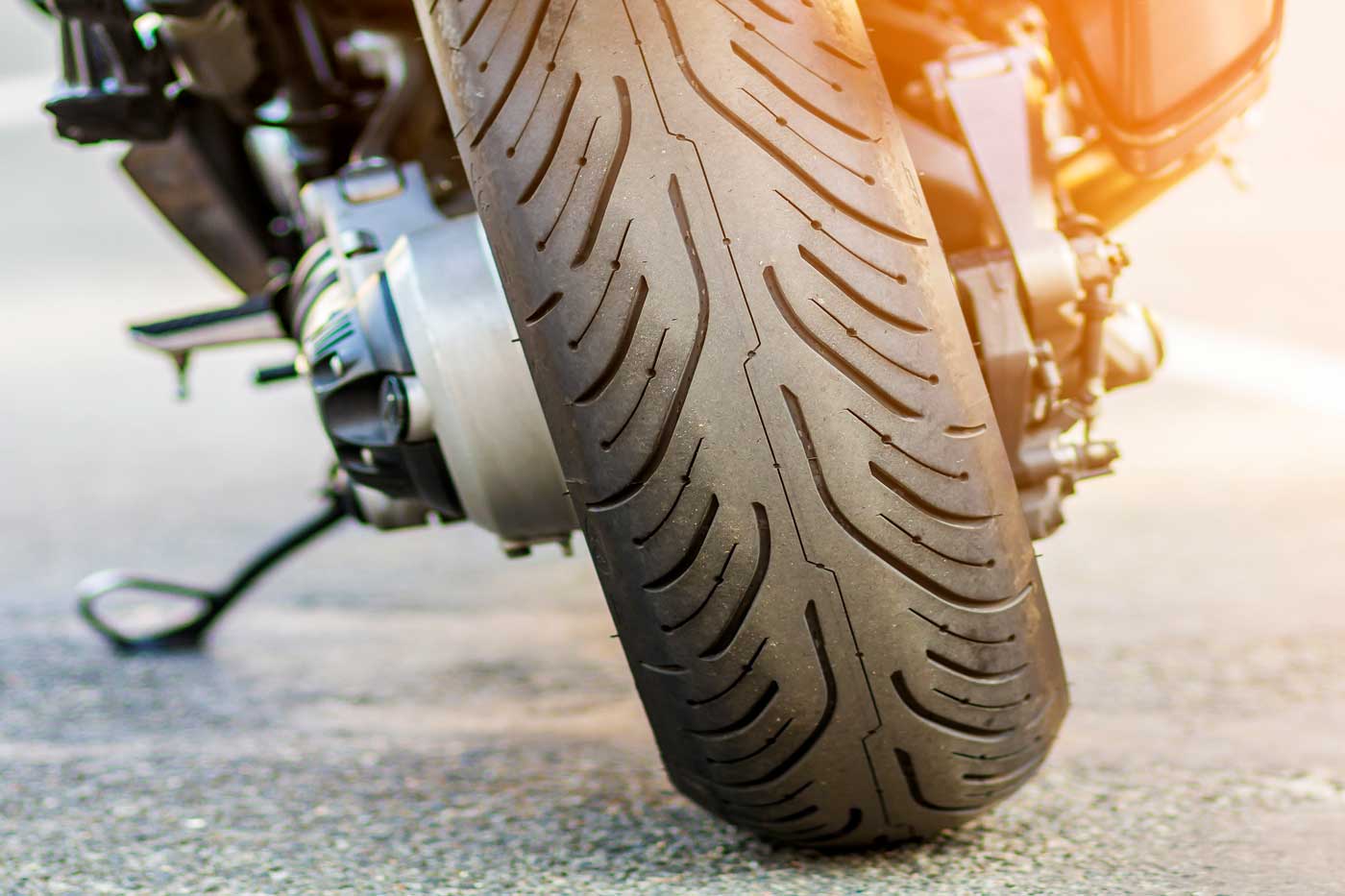
Good tyres with sufficient profile depth are of great importance for safety.
Tyres
The tyres must be air tyres and may not show visible damage where the casing is visible. They also may not show bulges. The profile on the main grooves must be a minimum of 1.0 mm over the entire circumference. Also take note that the tyres are mounted in the correct direction. Metal elements in the running surface (such as studded tyres) are not allowed. The tyres may not grind against other parts. Older tyres could suffer from dry cracks. Take not of this with motorcycles that are not ridden often. Tyres with dry cracks are weaker and must therefore be replaced.
Steering system
The handlebar must be able to turn back and forth smoothly and there should not be any slack at the steering head bearing. This is located at the connection between the handlebar and the front fork. If there is slack, then the handlebar can move a little relative to the front wheel. Then the motorcycle steers and brakes less fluently.
Brake system
All parts of the brakes must be in good condition and properly mounted. The brake discs may not be too worn that they can break. The brake pedal and the brake handle may not be able to be pressed or squeezed all the way.
The surface of the brake pedal must be rough so that you will not slip off. The brake lines may not grind against other parts or malformed and the brake cables may not be frayed.
Besides that, a drum brake may not grind when unbraked. A disc brake may ‘drag’ slightly when unbraked, meaning that you can hear the brake pads sliding slightly over the disc brake, especially after the motorcycle has been standing still for a while. If you hear a scraping sound during braking, this can mean that your braking pads need replacement.
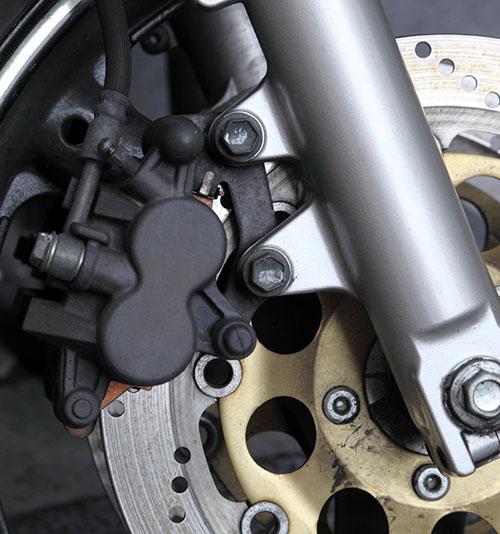
Brake discs and brake pads must be in good condition.
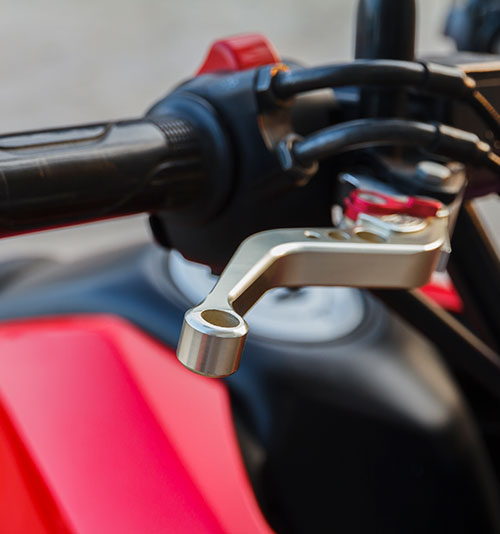
The brake handle may not be able to be fully squeezed.
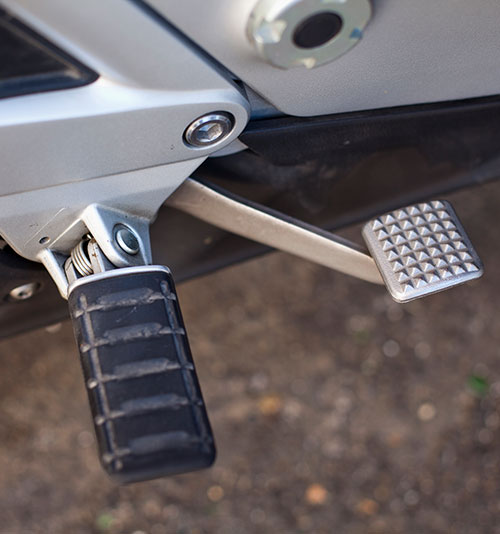
The surface of the brake pedal must be rough.
The minimum deceleration rate of the front brake must be 3.9 m/s2. This means that when braking heavily on just the front wheel, the motorcycle should slow down at least 3.9 m/s per second (14 km/h). When braking with just the rear brake this is at least 2.6 m/s2. Both brakes together should have a deceleration rate of at least 5.2 m/s2. To give you an idea: this would mean that, at 100 km/h, you would need around 5 seconds to completely come to a standstill. Luckily, most motorcycles have a higher deceleration rate.
Windscreens and cases
Some motorcycles are equipped with windscreens or fairings in relation to riding comfort. These may never impair the handling of the handlebar, clutch, or brake. In addition, they must always be mounted properly. The latter also applies to possibly present cases and case supports.
Mirrors
Motorcycles must be equipped with a left and right mirror. These mirrors must be mounted properly and may not be damaged or weathered.
Sharp parts
Motorcycles and coupled trailers and sidecars may not have sharp parts that can pose extra danger to other road users in case of a collision. Also, parts may not just fall off the motorcycle because they are, for example, damaged or worn.