

Environment
Driving with a vehicle with a combustion engine (usually running on petrol) is by definition not good for the environment. More and more vehicles have an electric motor, such as the electric moped, snorfiets and speed pedelec. This sounds very environmentally friendly.
However, electricity must also be generated and this does not always happen the clean way. The batteries of these vehicles do not have an unlimited lifespan and must also be disposed of after this. That is why it is important, in all cases, to ride as economically as possible and not waste energy, regardless of whether this is energy of a combustion engine or an electric motor.
Purchase and maintenance
When purchasing a vehicle, you can take the environment into account. Newer models are often more economic and less harmful to the environment than older models. In addition to that, keeping your vehicle in good condition is also very important to preserve the environment. Poorly maintained or boosted vehicles often consume more energy (fuel or electricity) and emissions of harmful substances can be significantly higher if the combustion engine is no longer operating optimally. Maintenance also includes keeping the tyres inflated. A too low tyre pressure causes more fuel consumption and thus puts a strain on the environment.
Noise pollution
Noise pollution also falls under environmental strain. It can arise when, for example, mounting a different exhaust. Try to prevent this nuisance by checking whether the noise production is still within the margins after mounting a different exhaust. If the exhaust is broken, have it repaired as soon as possible. Riding with a broken exhaust or with a vehicle that produces too much noise is not allowed.
Environmentally conscious riding behaviour
With the correct riding behaviour, you can save a lot of energy. Not only good for the environment, but also for your wallet.
If you have a vehicle with which you need to shift gears, then try not to ride in a low gear for too long but shift up quickly. Also ride off without accelerating unnecessarily. There is also a safety aspect to consider here: as sudden increases or decreases in speed increase the risk of falls due to loss of grip.
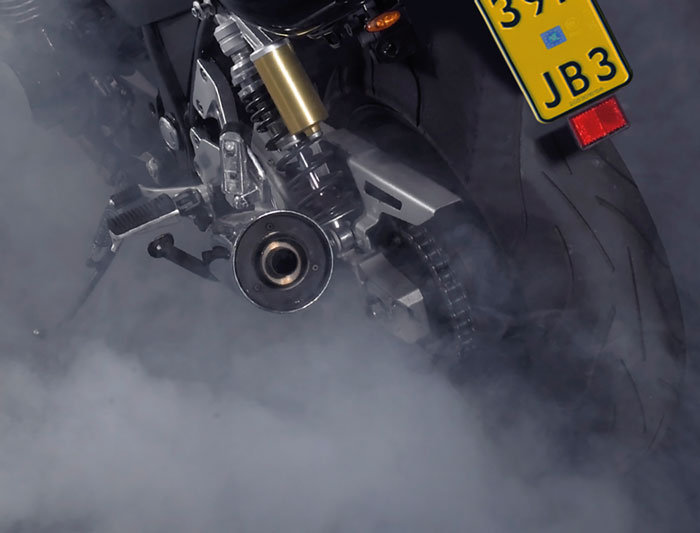
Do not accelerate too quickly when riding off and turn off your moped if you are waiting for a while.
Defensive riding behaviour and anticipating
Defensive riding means looking far ahead, timely adjusting your speed to the situation and keeping in mind unexpected situations. Preparing for an action you may need to perform is called ‘anticipating’. If you also maintain a safe following distance, you will find that you need to brake less often and can maintain a more constant speed. All this reduces fuel consumption and therefore reduces the impact on the environment.
Ride preparation
A good ride preparation also ensures less energy consumption. Usually, you ride the same route to school or work, which requires little preparation. But if you go somewhere where you do not know the way, make sure that you check the best route beforehand, for example, with Google maps or a different app. This preparation ensures that you generally drive more consistently because you are less uncertain about the route. You are also less likely to take wrong turns, which means you drive fewer ‘useless’ kilometres.
Accessories on the moped
A moped is generally less streamlined than a passenger car. Windscreens and streamline caps may, if adjusted properly, ensure that the moped ‘catches less wind’, but they could also have the opposite effect.
The less streamlined your moped is, the higher the energy consumption. This obviously also applies to cases, load and passengers on the moped. The increased weight ensures a higher energy consumption but, for example, the shape of the cases will also influence this. Ultimately, a moped without cases or load will always consume less energy than one with.
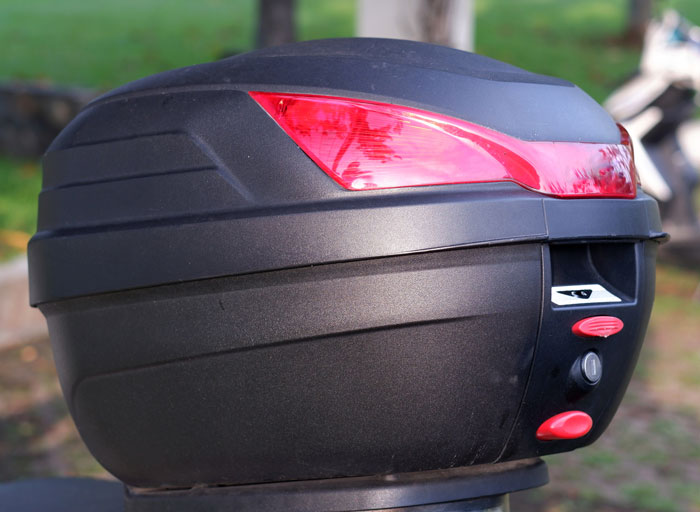
A case on the back of a moped ensures that you consume more fuel. Remove it if you do not need it.
- Tips for riding environmentally friendly
- With a combustion engine:
- Start the engine without acceleration too much and calmly ride off.
- Ride more calmly at the start of the ride. The catalytic converter only starts working efficiently after about 10 to 20 minutes.
- Do not accelerate (hard) unnecessarily and do not let the engine run stationary unnecessarily.
- Shift to a higher gear in time.
- If you do need to wait for a long time, such as at a bridge or level crossing, then turn off the engine.
- Ride calmly and consistantly and do not overtake forcibly or unnecessarily.
- Prevent abruptly accelerating and/or decelerating; let the vehicle roll out.
- Look far ahead and anticipate on what may come.
- Ensure a good following distance.
- Maintain the vehicle properly.
- Always ride with the correct tyre pressure.
- With a combustion engine: