

Inexperienced, vulnerable and large road users
In traffic, you sometimes encounter other vulnerable road users. With these vulnerable road users, such as pedestrians and children, you have the responsibility to keep it safe. Even if they do not adhere to the rules, you should solve this as best as possible to prevent accidents. In addition, you should also account for large vehicles and their limitations.
Children
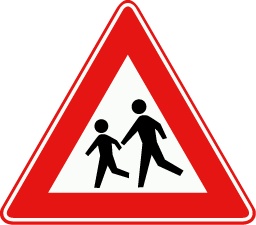
J-21
Children
Participating in traffic is usually much more unsafe for children than it is for adults. Especially when they are still little, they have much less overview than adults. In addition, they also do not have the experience yet and the brain is not yet sufficiently developed to be able to understand all the risks. They sometimes play on the pavement or on the carriageway, hide between parked cars and cross the road without looking, chasing their soccer ball.
So, always be careful when riding through a residential neighbourhood. Take unexpected situations into account and look carefully between and under parked cars to see (the feet of) playing children. If there are children on the pavement, always keep in mind that they can cross the street and reduce your speed.
Pedestrians
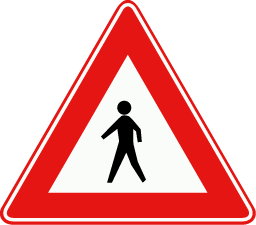
J-23
Pedestrians
Pedestrians are poorly visible in the dark. Keep this in mind when you are driving on roads where no footpath or pavement is present and, if possible, do not ride completely to the right. In addition, pedestrians are not always consciously involved in traffic. Always keep an eye on pedestrians, even when they are walking on the footpath or pavement. Recognise pedestrian crossings in time.
Cyclists and snorfietsers
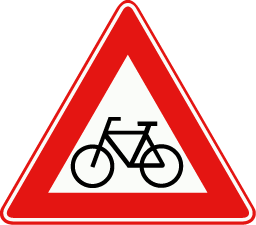
J-24
Cyclists and moped riders
Are you driving in a brommobiel or riding on a moped or speed pedelec, keep in mind cyclists and snorfietsers when turning right. They are allowed to pass you on the right and can be in your blind spot. If you overtake them, maintain enough lateral distance between your vehicle and the bicycle or snorfiets. Also pay attention to crossings of cycle paths. In the dark, always consider that cyclists are difficult to see.
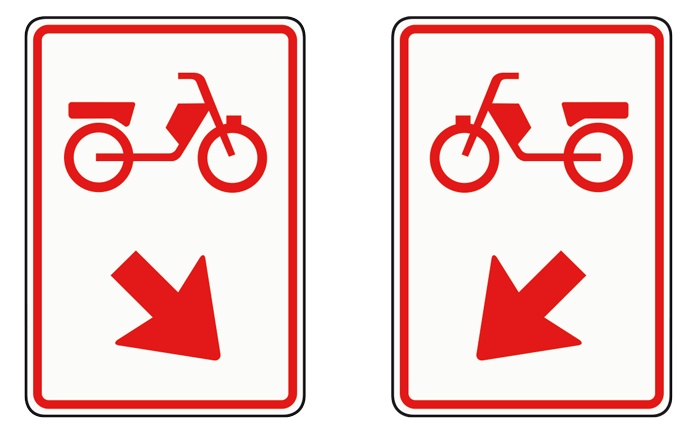
Moped riders to the cycle/moped path or the carriageway.
As a driver of a moped or speed pedelec, you often ride on the carriageway inside the built-up area. Signs indicate when you must return to the cycle path/moped path. When changing lanes, pay close attention to cyclists and mopeds on the cycle path/moped path. If you have to change to the road, pay close attention to the drivers there and let them go first.
Horse riders and horse transport
As horses are flight animals, they are naturally startling animals. This can be very dangerous for the rider or handler of the horse. If you approach a horse rider or a handler of a horse, reduce your speed and keep your distance when you stay behind it. Only pass when you can do so calmly and spaciously. Never sound the horn when riding near a horse and never unnecessarily accelerate.
Crossing wildlife
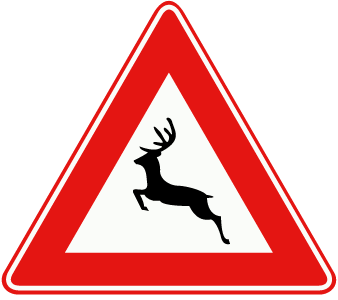
J-27
Wild animals
Also consider crossing wildlife during twilight or in the dark. In places where this occurs frequently, sign J-27 is often placed. The risk of crossing wildlife is greatest in the evening and at night.
Reduce the risk of a collision by reducing your speed. If you come across big game, do not try to just avoid it. Prefer braking and always dim your full-beam headlight if you have it turned on.
Most accidents occur because people try to swerve. The driver then loses control, falls or collides head-on with an oncoming vehicle or a tree.
For small game, such as rabbits or hares, it is also safer not to make an emergency stop. Suddenly braking hard increases the risk of rear-end collisions. In addition to that, you can also fall while braking. Traffic behind you often has not seen the animal and therefore cannot anticipate for this. Release the throttle and ride straight on as much as possible.
If you have had a collision with an animal, you are required to call the (animal) police. There is a special emergency number for this: 144. The police can then take measures to help the animal or to put it out of its misery. This is also mandatory for a pet when the owner is not present.
In the event of a collision with an animal, always contact the police. For accidents with animals, they can be reached on the phone number 144.
Drivers of vehicles with a limited speed
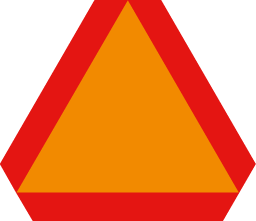
Through this truncated triangle you can recognise vehicles with a limited speed.
The most well-known vehicles with a limited speed are agricultural vehicles. But road sweepers and lawnmowers from the municipality can also be vehicles with a limited speed. Vehicles with a maximum construction speed of 25 km/h or less are recognisable by a truncated triangle on the rear of the vehicle.
Faster vehicles that may go up to 40 km/h can be recognised by a number plate starting with a T (or an L if you are dealing an agricultural vehicle).
Agricultural vehicles are often very large. This makes overtaking them more difficult. Consider the sometimes limited view of the driver. This could be obstructed by coupled machines or large trailers. Agricultural vehicles turning left or right can be particularly dangerous if you are just about to overtake them on the left or right.
Drivers of lorries
Due to their size, these vehicles have more and bigger blind spots. These are right in front, beside and at the rear of the vehicle. A good rule of thumb is: if you do not see the driver, (directly or through the mirrors), the driver does not see you. You are then standing or riding in their blind spot and this increases the chance of a collision. Therefore, stay out of the blind spots as much as possible. In addition, bigger and longer vehicles also need more space to negotiate bends. Give them this space by maintaining sufficient distance.
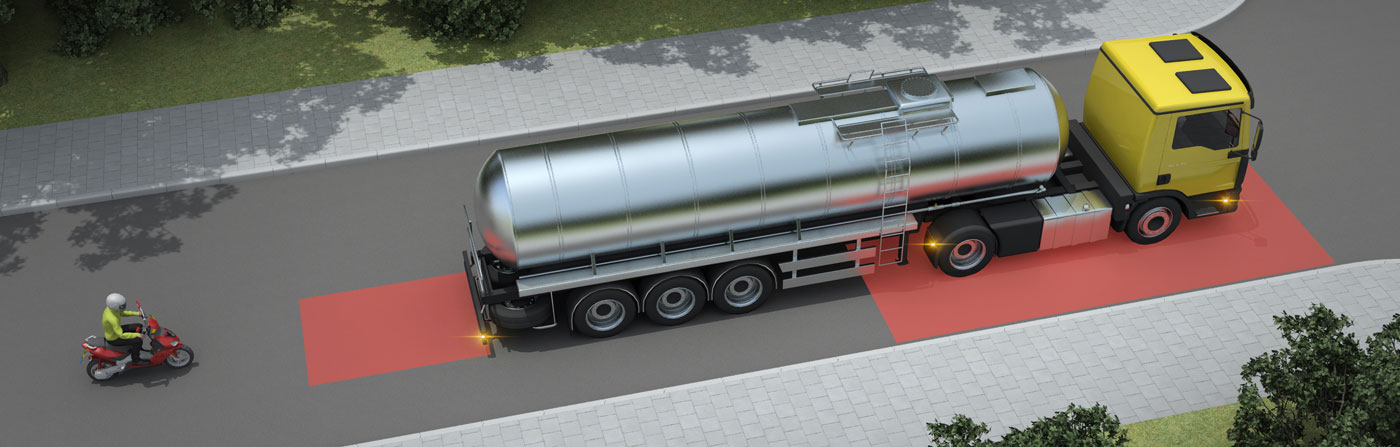
The red areas are the spaces the driver can oversee poorly or not at all (blind spots). Make sure that you keep out of these areas as much as possible.

You can find this warning sign on the rear of an LZV vehicle.
LZV vehicles, or Long Heavy Vehicles, are extra long. These lorries may be 25.25 metres long instead of the normal 18 metres. They are therefore not allowed everywhere and are mainly intended for longer trips on flow roads.
The elderly and the disabled
Elderly persons are often more afected by certain conditions such as poor eyesight, a poorer mobility and a slower response. Hearing may also become impaired. This makes participation in traffic more dangerous. Therefore, consider the elderly in traffic and give them more time to cross.
Older drivers can also drive hesitantly. Do not react frustrated, but give them space.
Persons with a disability may be less mobile, visually impaired or blind, or hard of hearing or deaf. All these factors make traffic participation more difficult.
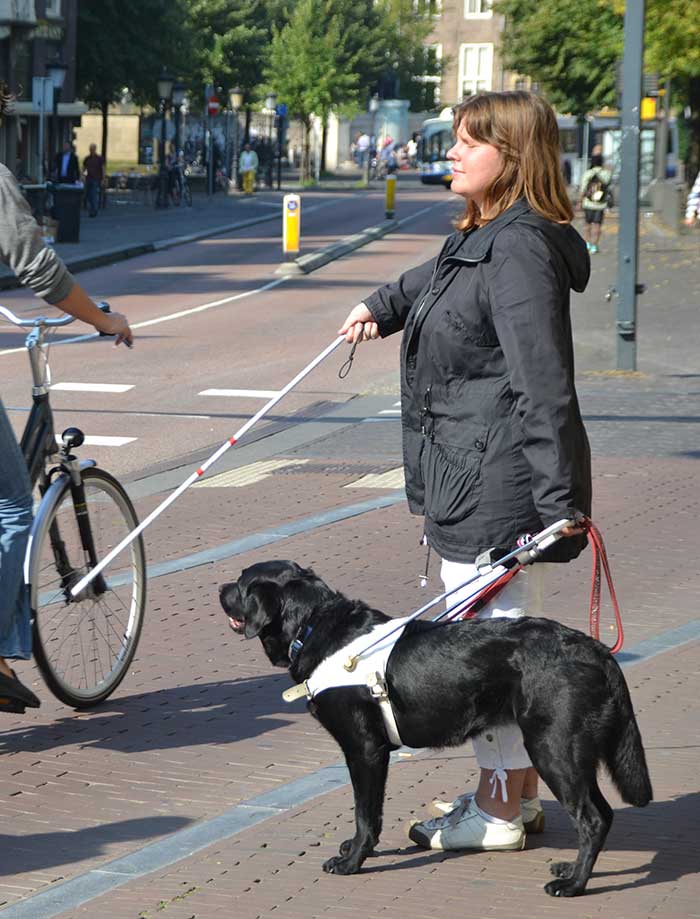
You can recognise blind people by a white cane with red rings and/or a guide dog. The blind, but also people walking with crutches, a walker or walking frame may always go first when they indicate they want to cross.
The blind and visually impaired indicate thet want to cross by sticking their cane forward.
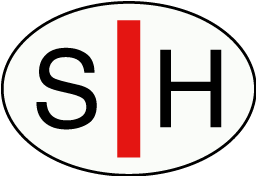
These letters stand for ‘SlechtHorend’, which is Dutch for hearing impaired.
Deaf and hard of hearing people can sometimes be recognised when they ride with on a vehicle with a little plate with the letters SH on the rear. This stands for ‘slechthorend’ which is Dutch for hearing impaired. Hearing impaired and deaf people cannot hear you coming and can therefore be startled, or they have not noticed you at all.