

Traffic behaviour and safety
Yearly, more than 600 people die as a result of a traffic accident. Almost three-quarters of these victims are male and a quarter is younger than 29 years.
If you look at the accident risk per driven kilometre, it is by far the highest for motorised two-wheelers such as mopeds and motorcycles. The risk of something happening to you as a moped rider in traffic is actually around ten times higher per kilometre than for motorists. This is due to the poor visibility of you as the driver and the lack of safety features such as a crumple zone or airbags. But it definitely also has something to do with the mentality of the driver. Moped riders are usually between the ages of 16 and 25. It is known that this age category often takes more risks. In addition to that, peer pressure and the use of alcohol and drugs also play a big role.
| Cause of accident in % | |
|---|---|
| Human error | about 92% |
| Vehicle malfunctions | about 5% |
| Road and weather conditions, situational factors | about 3% |
So, most accidents are caused by human error. You might miss something, not know the traffic rules or misjudge something. A very small part of the accidents are caused by the vehicle, such as poor maintenance, a manufacturing error or technical defect.
In an even smaller proportion of cases, accidents are caused by environmental factors, such as poor visibility due to, for example, fog, a collision with crossing game, or other road or weather conditions. However, with this, you can ask yourself whether you should have reacted differently to prevent accidents.
Risk factors
A lot of human mistakes occur because drivers do not pay attention. This is often not on purpose, but it can usually be prevented. How well you pay attention is influenced by a few different factors.
State of mind
Your thoughts can stray because you are sad or angry, or because you are happy or enthusiastic about something you have just heard. Because our brains can do much less at once than we think, you are less focused on driving at those times. Your driving style is also influenced by your emotions. For example, angry people often drive more aggressively.
Fatigue
You are also less attentive when you are fatigued. You react slower and you think less clearly. Fatigue has the same effect on your driving style as the use of alcohol.
So, do not go driving when you are tired. Stay home if you do not have to go. When driving long distances, you prevent fatigue by having a 15-minute break at least every 2 hours.
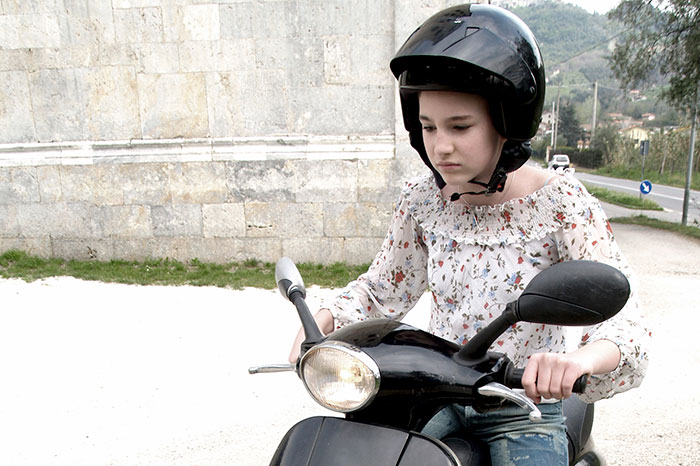
If you are tired, it is better to not go riding.
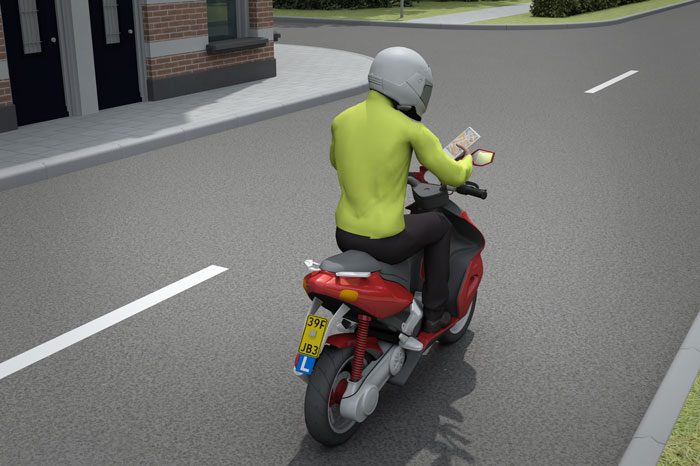
While operating a moped, you are not allowed to hold a phone in your hands.
Distractions
Most accident in traffic occur due to distractions. In traffic, the mobile phone is usually the cause of this. Holding a phone (or other mobile communication devices) while driving is therefore prohibited for all drivers. This includes not only making calls, but also everything else you do with your phone. Texting, setting the navigational system or scrolling through your music playlist is not allowed. If you really need to do something with your phone, briefly stop in a safe place.
Calling handsfree (for example with earbuds) is allowed, but it causes just as much distraction. The same goes for listening to music. You also hear ambient noise less clearly, which means you notice some things too late.
Illness or physical impairments
Physical impairments or illnesses can also make you less able to ride. For example, if you have broken or bruised your wrist, you can no longer properly operate a moped. You are then not allowed to ride. Driving is also not advisable when, due to illness, it is harder for you to concentrate. For example if you are feverish, have a headache or do not feel good overall.
Distraction, stress, emotions, peer pressure and fatigue are all significant risk factors in traffic. The dangers of them are often underestimated. The biggest problem with these factors is that they cannot be measured in the way that alcohol for example can be measured.
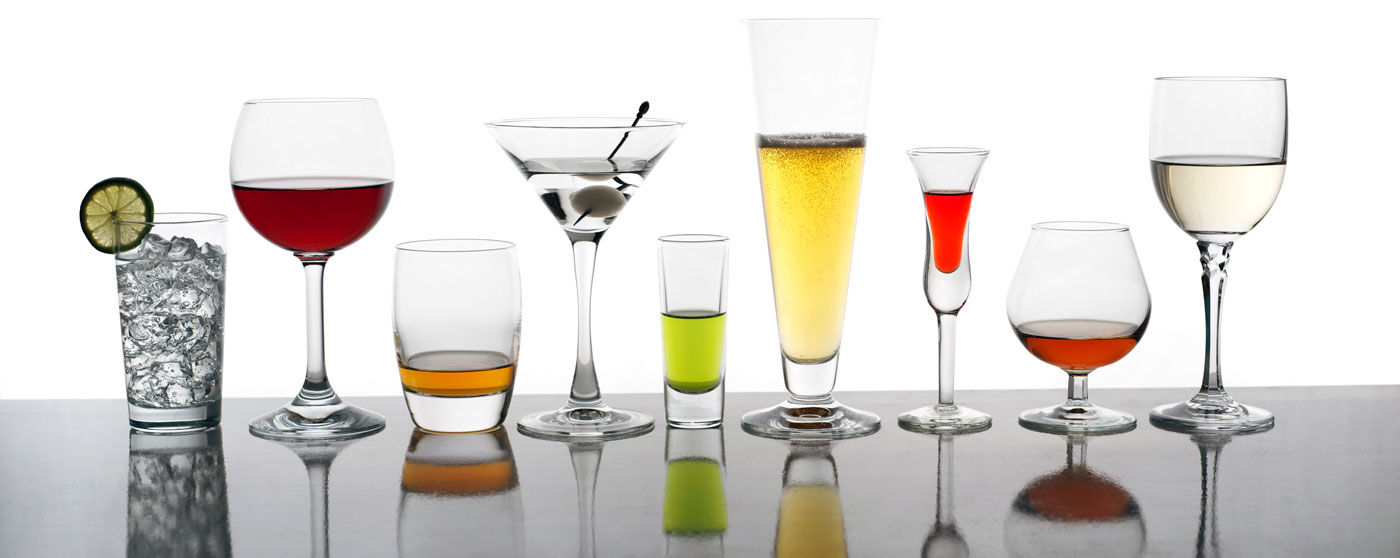
- A standard glass of an alcoholic beverage
One standard glass of wine contains as much alcohol as one standard glass or beer or one standard glass of spirits.
Alcohol
Alcohol is, in every way, very bad for your driving style. You think that you can drive better, while you actually start driving worse. Your perception becomes worse, you react less quickly and take more risks.
One standard glass of an alcoholic beverage only leaves your system after about 1 to 1.5 hours. In the meantime, the accident risk is significantly higher depending on how much you drink. From four times as high after three or four glasses, to twenty times as high after five or six glasses.
Drugs
All types of recreational drugs have a negative effect on your riding style. How exactly depends on the type. For example: drugs like weed and hash make you concentrate less and react more slowly. On the contrary, stimulating drugs make you ride more aggressively and faster because you think you can handle anything and are super sharp. With drugs, it can take up to multiple days before you are below the limit at which you can ride again. The police can check this through a saliva test.
Medications
It is also a criminal offence to ride under the influence of certain medications that can impair your ability to ride. For example, sleeping pills. But these also includes antidepressants, heart and blood pressure medications, and even eyedrops that temporarily reduce vision. This does not only apply to medications prescribed by a physician.
Medications to which this applies usually feature a yellow warning sticker. The accompanying leaflet will also contain a warning.
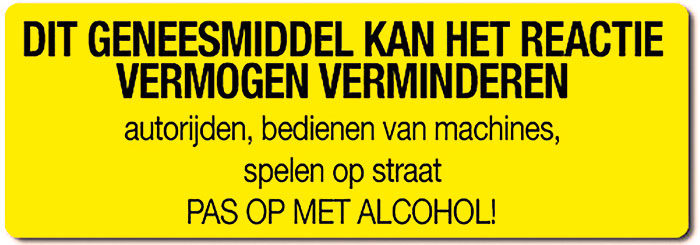
It is your responsibility to handle this properly. Consult your doctor about how to proceed if you need to start taking this type of medication or if you are already taking it. If you cause an accident and it is clear that this is due to your medication use, you may be liable to prosecution.
More information is available on www.rijveiligmetmedicijnen.nl.