

Use of lights during riding
Vehicles are provided with lights to be able to see better in the dark, but also to be seen better by others. Sometimes, lighting is required and sometimes it is not. But the advise is to run lighting both during the day and at night.
- Day
The period between sunrise and sunset.
- Night
The period between sunset and sunrise.
Dipped headlights

The dipped headlight is a white or yellow light at the front of the vehicle and illuminates a good portion of the road surface in front of the vehicle. It does not shine straight ahead and, normally speaking, it is not blinding. Running dipped headlights is always allowed.
Using the dipped headlight is required with poor visibility during the day and at night. This applies to drivers of motor vehicles (including brommobielen), moped riders (including speed pedelecs), snorfietsers, and drivers of motorised disability vehicles. You also turn on the dipped head light well before entering a tunnel. Using the dipped headlight is always allowed, even when it is not required.
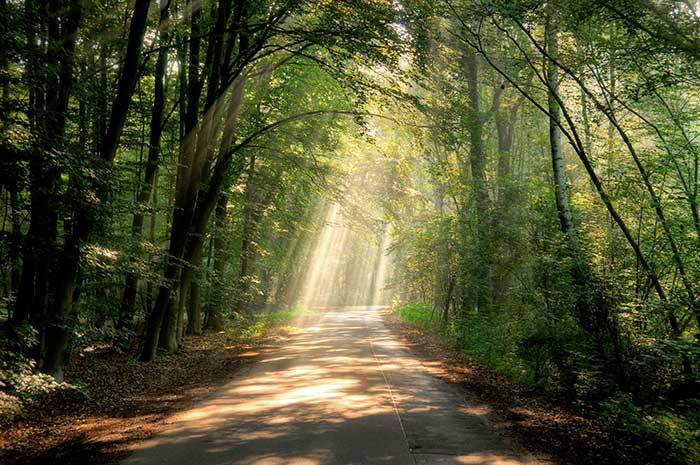
Even in sunny weather conditions dipped headlights could be required, for example, when the visibility is obstructed by the glare of the sun’s rays between the trees.
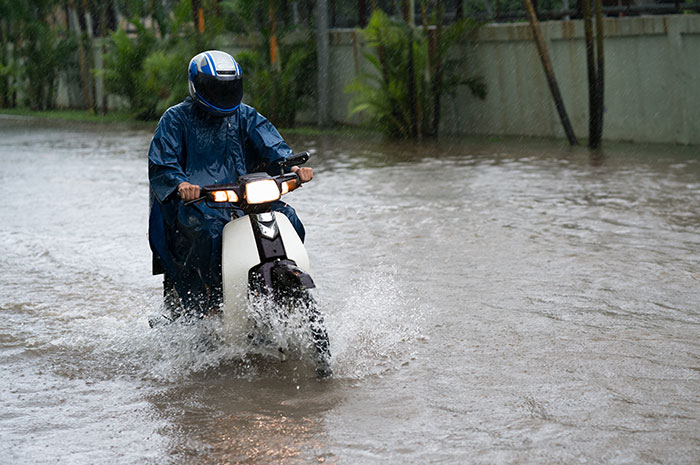
Using the dipped headlights is also required during poor weather conditions.
Daytime running lights
Daytime running lights may be present on two-wheeled vehicles, but it is not required. It may only be used when it is not required to run the dipped headlights and when no other lights are turned on at the front of the vehicle.
Do note that when the daytime running lights are turned on, the rear lights are not. This causes poorer visibility at the rear. In normal circumstances, the dipped headlight is always safer.
Full-beam headlight

The full-beam headlight is also not required, but may be present on your vehicle. If there is insuffisient visibility with just the dipped headlights, then you are allowed to run the full-beam headlight instead of the dipped headlight. But, turning on the full-beam headlight is only allowed:
- at night;
- when there is no oncoming traffic;
- when there is no vehicle in front of you.
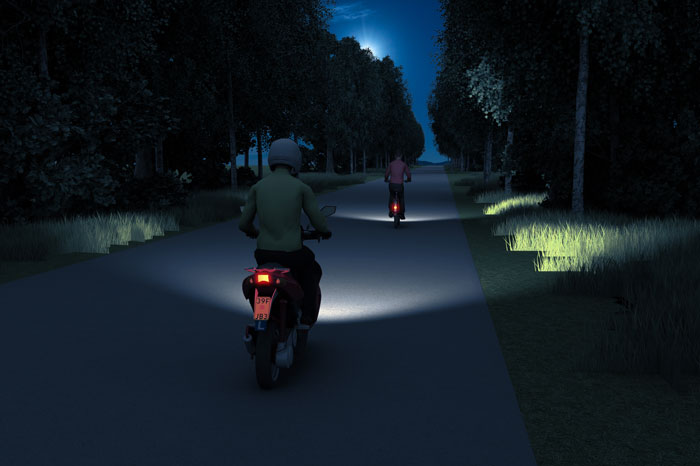
If you are riding behind another vehicle, you are not allowed to use the full-beam headlights.
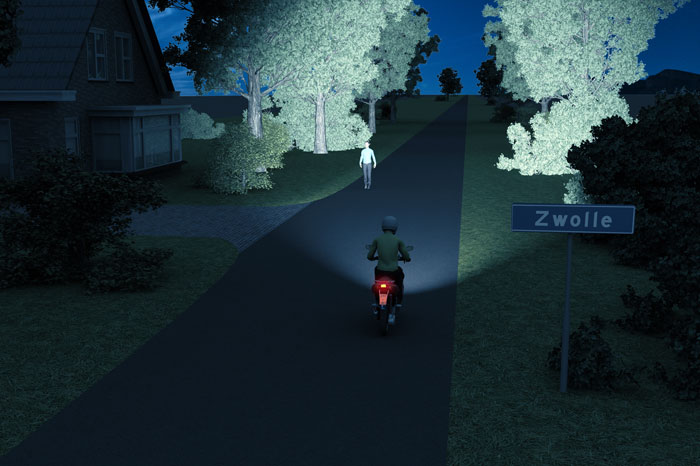
When there are oncoming road users, such as pedestrians, you are also not allowed to use the full-beam headlights.
In addition, the use of the full-beam headlights is not wise during poor weather conditions, such as heavy rainfall, snow or fog. In that case, there is a high chance that you are blinded by your own lights.
The full-beam headlight is a bright light that shines straight on. Which is why it quickly works blinding. If you are blinded by oncoming traffic yourself, flash your full-beam headlight to warn them. If that is not effective, make sure not to look straight into the light, but try to look past it. If you see less due to the blinding light, lower your speed.
Fog light at the front and back side
As the name suggests, these lights are primarily meant to be used during fog. The fog light is not allowed to be present on mopeds, snorfietsen and speed pedelecs. It may be present on a brommobiel. The fog lights may not be used in good visibility.
Side lights

The sidelights emit little light. They are white or yellow lights at the front of the vehicle. As already mentioned, side lights may be used in combination with fog lights at the front. It is hardly ever used, at most as parking lights.
Rear lights
This is the normal red light at the rear of the vehicle. It must always be on if, at the front, the full-beam headlight, dipped headlight, side light or fog light is turned on. Normally speaking, the rear light is not blinding and less bright than the brake light and the fog light at the rear side.
Brake lights
The brake lights consist of a bright red light that lights up as soon as the brake pedal or brake lever is used. Because the brake light is that bright, you should avoid unnecessary braking as much as possible.
Lighting on a trailer
A trailer must also have lights during the day in poor visibility and at night.
Lighting on snorfietsen and special mopeds
On snorfietsen and special mopeds without a dipped headlight, lighting is still required, both during the day and at night. It could be a fitted headlight and rear light, but they may also be loose lights that are mounted to the vehicle or to the driver. They must be clearly visible and may not be covered by, for example, a hood, sjawl or backpack. They may also not be flashing.