

Approaching intersections, junctions and crossings
- Intersection
Gathering or splitting of roads. At an intersection, it is possible to change direction. With that, it is meant that you are allowed to and able to turn left or right. Intersections can be designed in a wide variety of ways.
- Crossing
Gathering of roads where it is not possible or allowed to change direction. You are only allowed to continue straight on.
- Level crossing
Crossing of a road and a railway. A railway vehicle such as a train or metro always has priority at a level crossing.
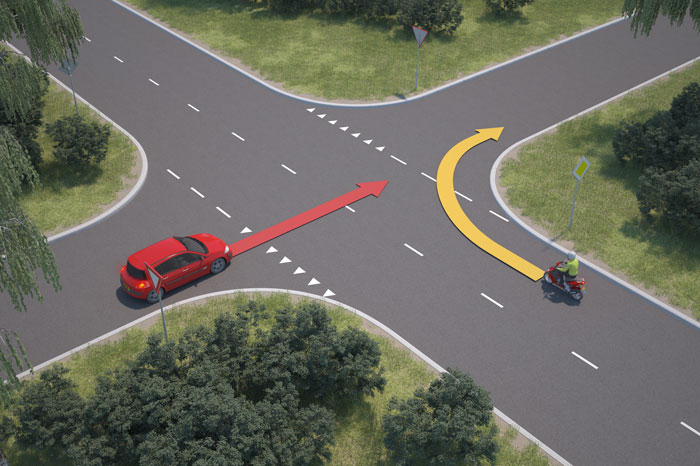
At an intersection you can and are allowed to change direction.
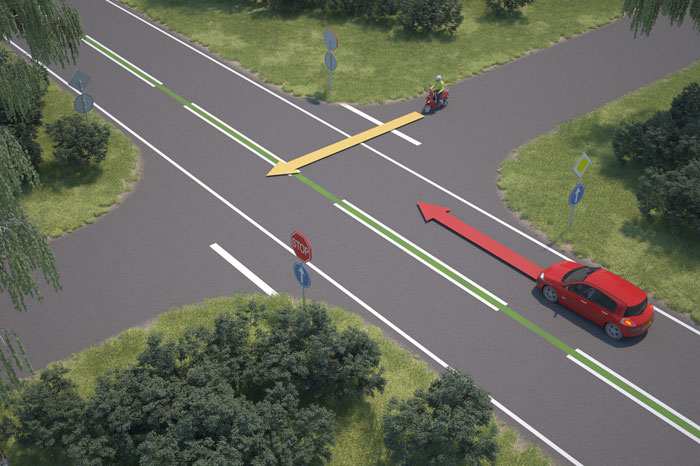
At a crossing, you cannot, or are not allowed, to change direction.
Intersections, crossings and level crossings are places where you as a driver can encounter or intersect other road users. An important rule is that you are never allowed to block an intersection, crossing or level crossing. This means that you are only allowed to enter it when you can immediately clear it again after. If you have doubt about this, wait before the intersection, crossing or level crossing until there is enough space after that point.
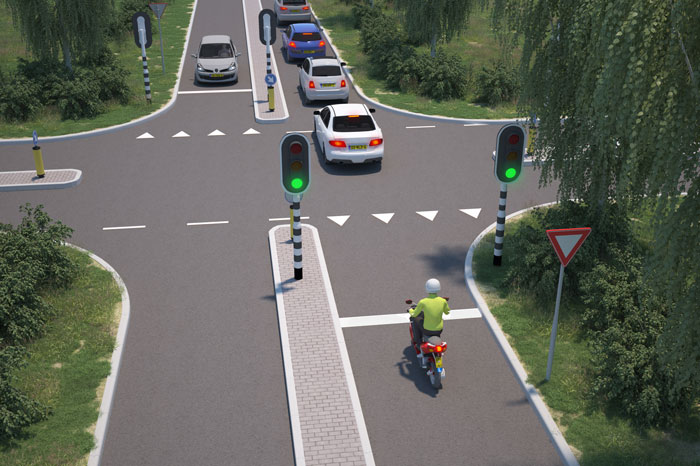
The moped rider is not allowed to enter this intersection. Only when they can immediately clear it again, are they allowed to ride on.
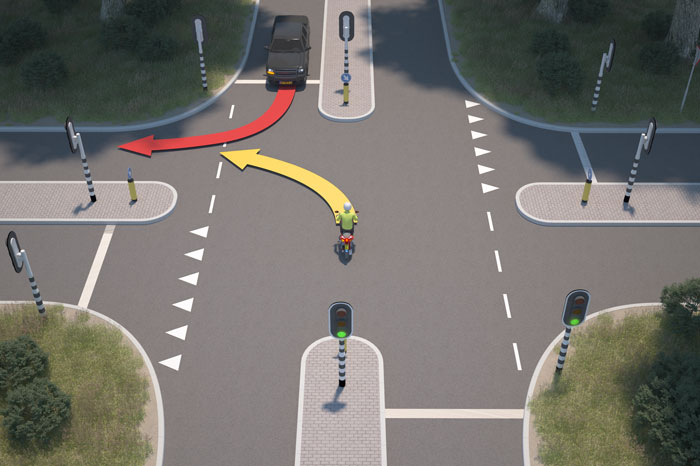
To improve traffic flow, the moped rider that is turning left is allowed to enter the intersection. However, they must wait for the oncoming black car here.
An exception to this is an intersection where you can pre-sort in between the two traffic flows. This may be possible due to the presence of a wide central reservation, or due to spave between pedestrian crossings or cycle paths and the carriageway. Even if you are turning left and must wait for oncoming traffic, it may be necessary for the traffic flow to already enter the intersection. This is only allowed if you do not block traffic flows or cause danger or hindrance.