

General requirements – part 2
- Tyre tread
The grooves in the tyre that ensure grip and water drainage on a wet road surface.
- Main tread grooves
The widest grooves in the running surface of a tyre.
- Tread
Part of the tyre that comes in contact with the road surface.
- Casing
Part of the tyre, under the rubber layer, that gives the tyre its strength. Usually featuring plastic (nylon, polyester) and steel wiring.
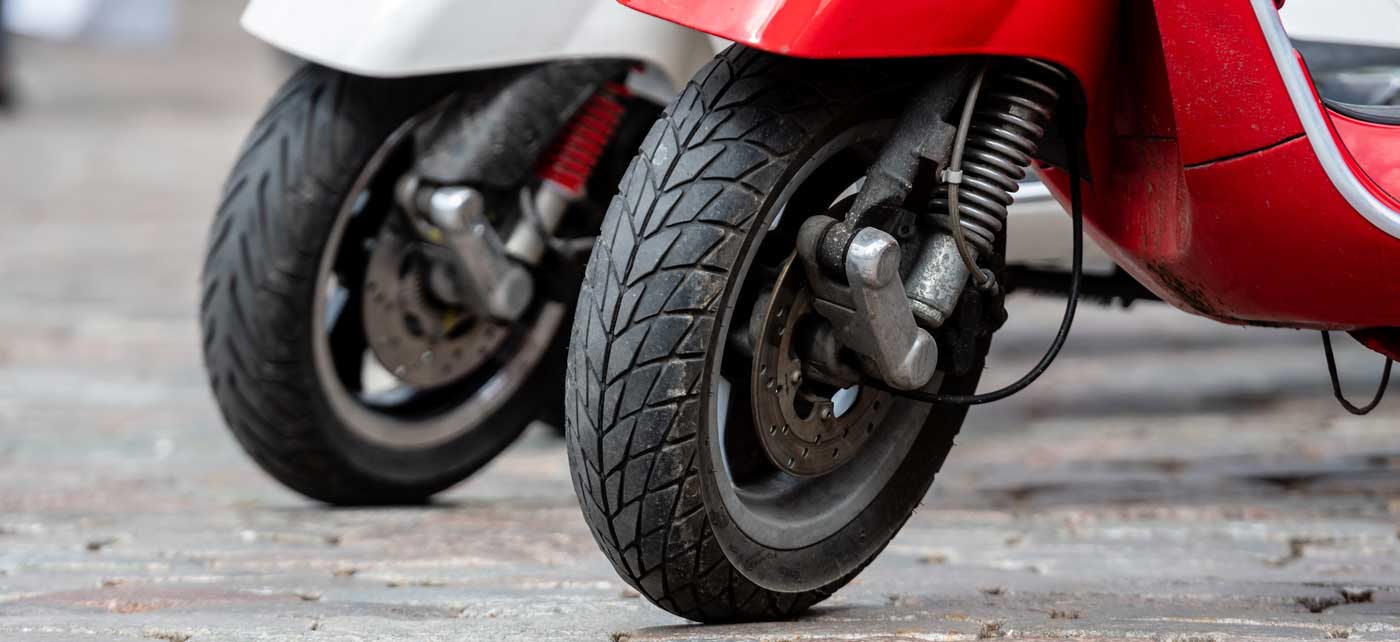
Good tyres with sufficient tyre tread are of great importance for safety.
Tyres
The tyres must be air tyres and should not show damage where the casing is visible. They should also not show any bulges. The tyre tread in the main grooves must be sufficient over the entire circumference of the tyre. The law does not specify a minimum tread depth for this. But if the tyre tread has worn too much it no longer falls under ‘sufficient tyre tread’. This is dangerous and you can get fined for this. This applies even if only a small part of the tyre does not have tyre tread anymore. Also take note that the tyres are fitted in the correct direction.
Metal elements in the tread (such as studded tyres) are not allowed. The tyres may not grind. Grinding means that they rub along another part of the vehicle and cannot rotate freely.
Besides the tread depth, you should also consider the condition of the rubber. If the vehicle is not driven much, then the tyre tread may still be fine after years. However, the rubber may then have become too dry and too hard. This can be recognised by dry cracks. Then too, it is better to replace the tyres.
Steering system
The handlebars should rotate back and forth smoothly and there should not be any slack at the steering head bearing. This is located at the connection between the handlebars and the front fork. If there is slack, then the handlebar can move a little relative to the front wheel. The vehicle then steers and brakes less fluently.
With a brommobiel, the steering wheel should be able to be turned as far as it will go without any problems, with the wheels not turning against the wheel arches or other parts. They should respond well to turning the steering wheel.
Brake system
All parts of the brakes must be in good condition and be mounted properly. The braking discs should not be too worn that they may break. The brake levers and a possible brake pedal may not be able to be squeezed or pressed all the way.
The surface of the brake pedal must be rough so you do not slide off. The brake lines may not grind against other parts or be malformed and the brake cables should not be frayed.
Besides that, a drum brake should not grind if no brakes are applied. A disc brake may ‘drag’ slightly when no brakes are applied, meaning that you can hear the brake pads sliding over the disc brake. If you hear a scraping sound while braking, it could mean that your brake pads need replacing.
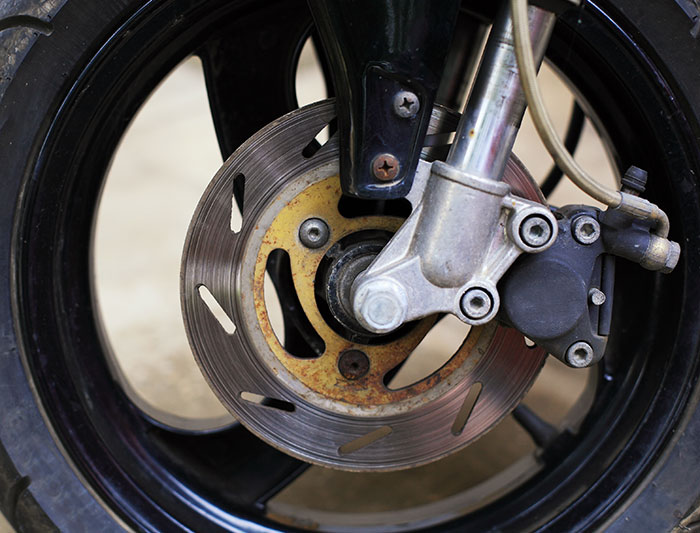
Brake discs and brake pads must be in good condition.
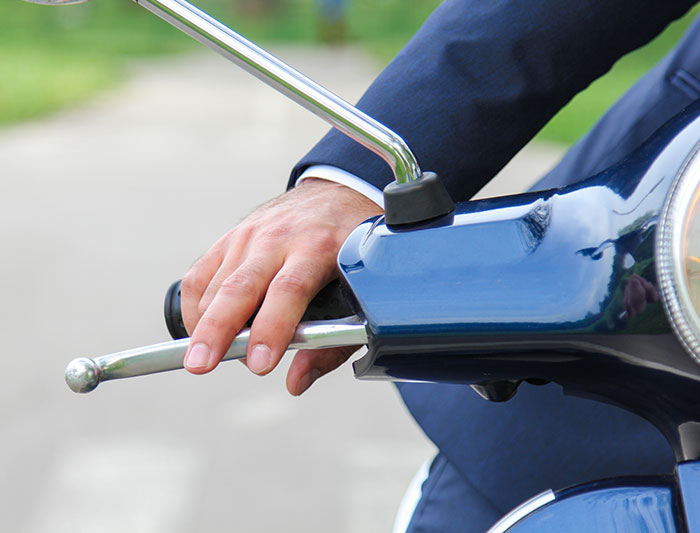
The brake lever may not be able to be fully squeezed.
On mopeds, snorfietsen and speed pedelecs, the minimum braking deceleration of the front brake must be at least 2.5 m/s2. This means that, when braking heavily using only the front brake, the vehicle must slow down at least 2.5 m/s (9 km/h) per second. When braking with just the rear brake this is at least 2.4 m/s2.
Both brakes together must have a braking deceleration of at least 4.0 m/s2. This is also the minimum braking deceleration a brommobiel should have. To give you an idea: this would mean that, at 45 km/h, you would need around 3 seconds to come to a complete stop.
Bear in mind that the braking distance on two-wheeled vehicles also has a lot to do with how well you have mastered braking. A moped with a good braking deceleration does not always mean you will also stop quickly.
Windscreens, cases and doors
Some vehicles are equipped with windscreens or fairings in relation to riding comfort. These may never impair the handling of the handlebars, the possible clutch or brakes. In addition, they should always be mounted properly. The latter also applies to possibly present cases and case supports.
With a brommobiel, the doors should be easy to open from the inside and outside. They are not allowed to suddenly open while driving. The bonnet and the boot lid must also close properly.
Mirrors
Two-wheeled mopeds, snorfietsen and speed pedelecs must be provided with at least a left mirror.
Brommobielen must be provided with at least a left wing mirror and a rearview mirror, or a left and right wing mirror.
All these mirrors must be secured properly and may not be damaged or weathered.
Sharp or protruding parts
Vehicles and coupled trailers may not have sharp parts that can pose extra danger to other road users in case of a collision. Neither should any parts protrude that could cause additional danger. In addition, parts may not just fall off the vehicle because they are, for example, damaged or worn.