Limitations to field of view
If you walk or cycle somewhere, you can observe almost everything well by turning your head. Of course, there may be buildings, bushes or vehicles in your sight, which can make you less able to see. But beyond that, there is little to obstruct your view. This changes when you get into a car. Suddenly you have window pillars and other vehicle parts that get in the way and limit your view. You have to be aware of this to ensure that you continue to participate in traffic safely.
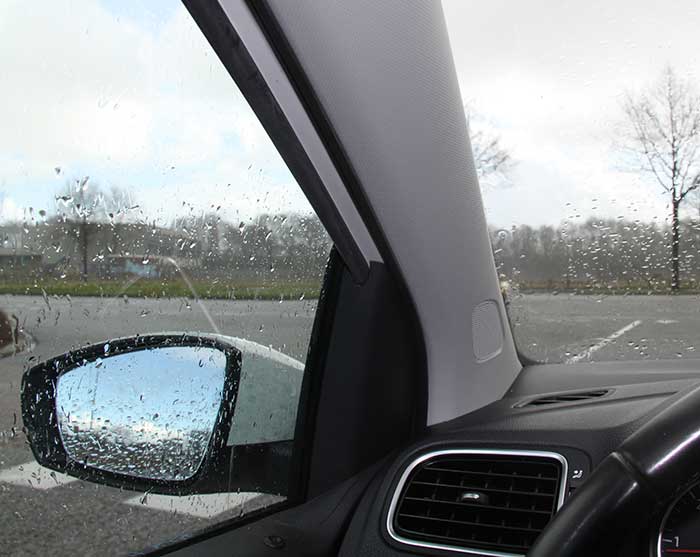
At first you think you have seen everything.
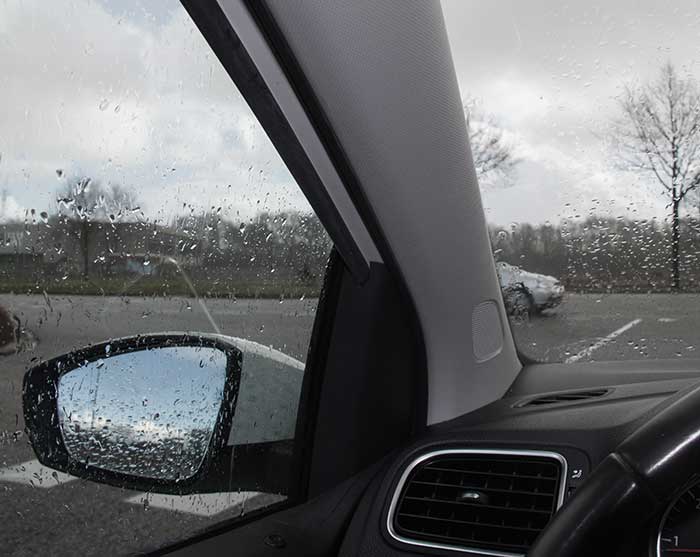
But that other car was completely hidden behind the window pillar!
Driver’s field of view
Many drivers do not notice how much vision is lost behind, for example, a window pillar or a window-mounted navigation system. But here cyclists and even motorcyclists and passenger cars can fall behind.
That is why you should consciously look around the window pillars and also check the part of the road behind the navigation system. You do this by moving your body and head back and forth while watching.
The space in front of, next to and behind the car is also difficult to see. This can sometimes cause problems, especially during tight manoeuvres. Many modern passenger cars are equipped with sensors or even cameras to monitor these areas.
Obstruction of view caused by environment
In addition to being obstructed in your view as a driver by parts of your own vehicle, it can also be obstructed by buildings, trees, and other vehicles. You can see an example of this in the following picture, where the driver of the white car is not able to see an arriving passenger car from behind a turning lorry.
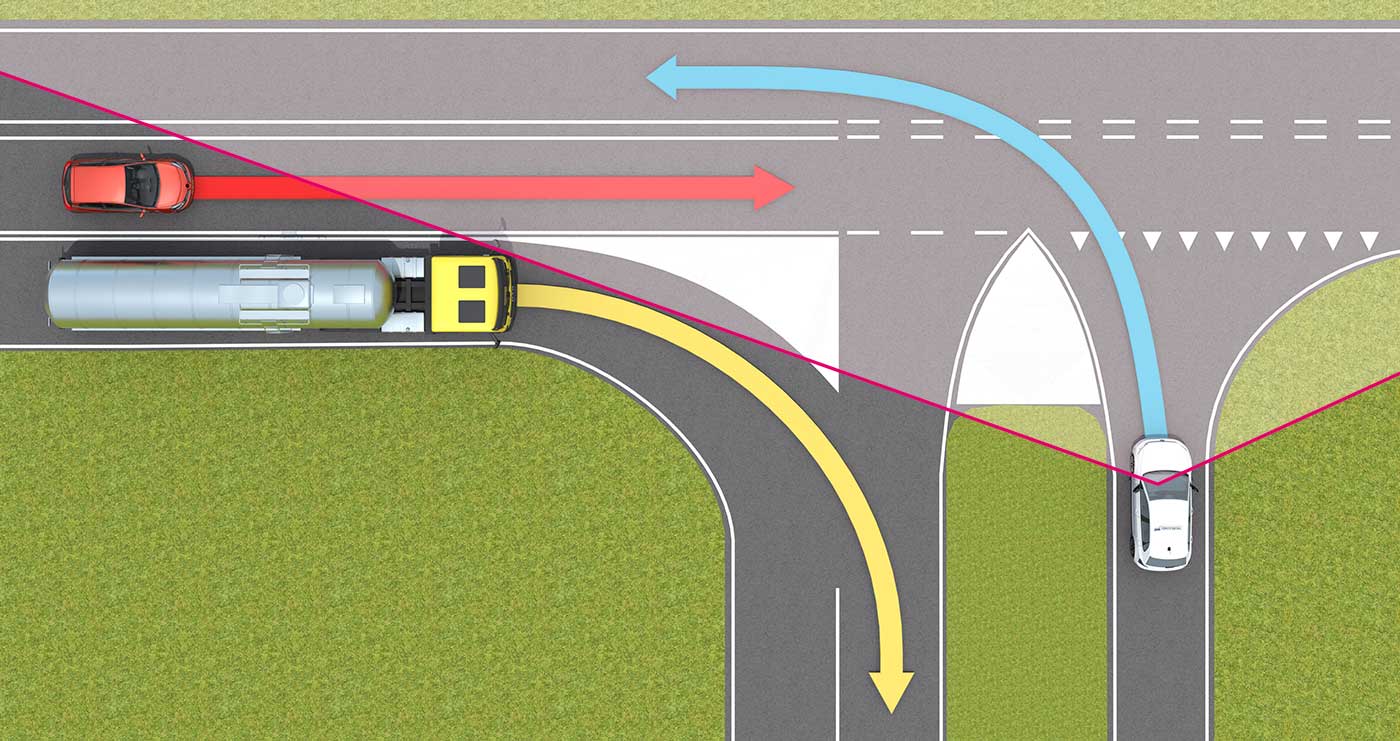
The white lesson car cannot see the red car coming because of the lorry. If the driver of the lesson car is not consciously involved in this, this can lead to an accident.
Unfortunately, this is a situation where our brains can deceive us. What you do not consciously think about and what your eyes do not perceive is not there for your brain. This can lead to dangerous and sometimes fatal situations.
As a driver you can do something about this yourself. Be aware of the places you cannot see. Assume vehicles can come from here. Adjust your speed to this, so that you can stop in time.
Other road users’ field of view
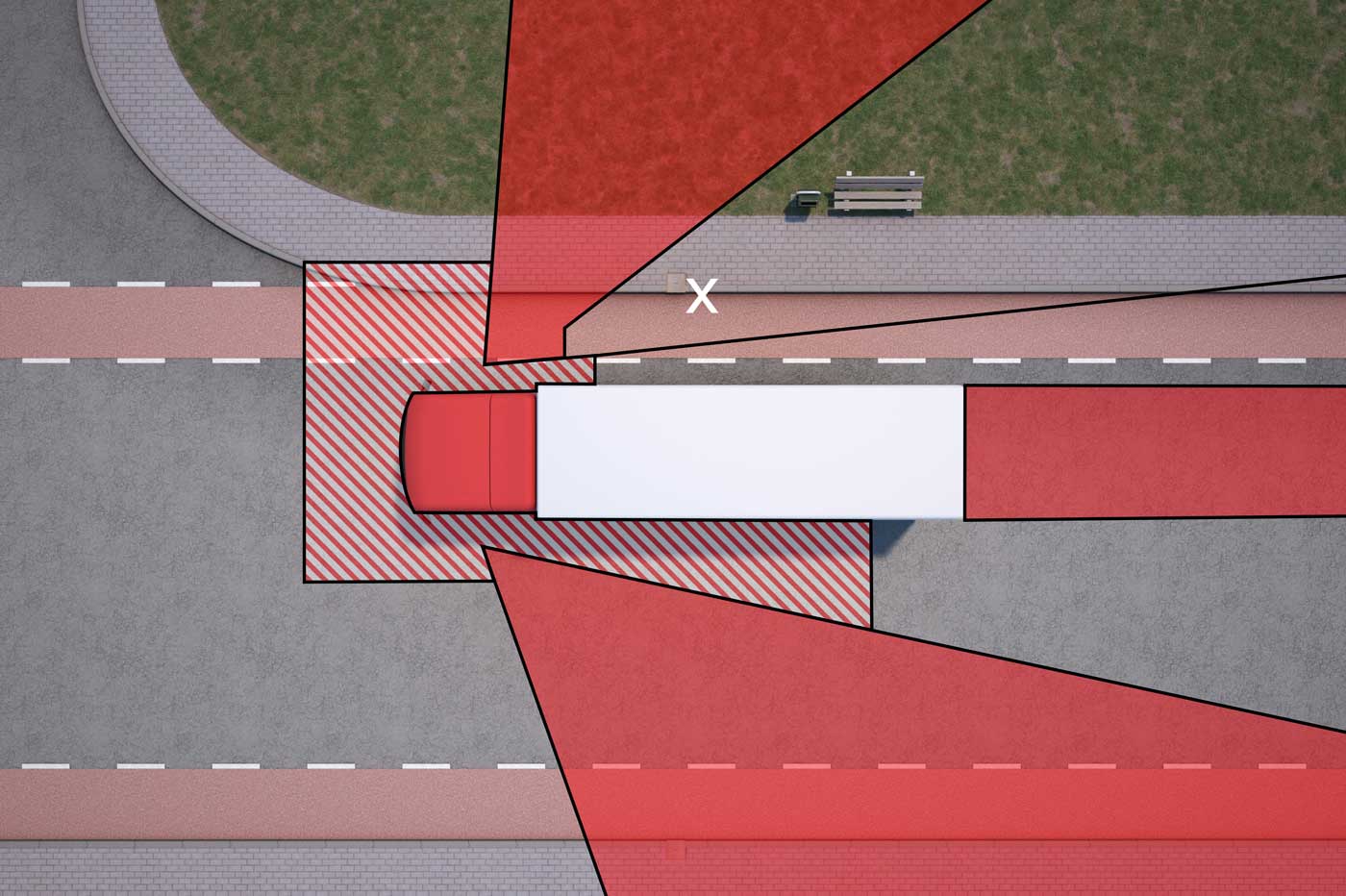
Some drivers already have poor all-round visibility purely because of their vehicle, such as lorry drivers and drivers of longer combinations. Give these vehicles the space they need and assume that someone will not see you if you cannot see them. Stay out of the blind spots and keep your distance, especially with lorries that are turning or backing up.
The picture shows the lorry’s blind spots. The plain red areas cannot be seen by the driver. The striped areas are partly surveyable for the driver, but not low to the ground. Smaller road users such as pedestrians and cyclists can still not be seen here. The area marked with the letter X can be seen through an additional mirror, but is greatly scaled down by the bulging of the mirror. This makes it difficult to estimate how far away traffic is.