

Advanced Driver Assistance Systems (ADAS)
Modern cars are increasingly likely to be equipped with technical gadgets that make driving safer and easier. These systems are called ADAS, or Advanced Driver Assistance Systems.
Understanding what these features do is crucial to taking full advantage of them. However, it is important to know the limitations too.
One significant disadvantage of ADAS is that it helps us feel increasingly safe on the road. This can lead to what is known as a false sense of security. For example, in a car with an automatic braking system, it is easy to assume you can maintain a shorter following distance. In reality, these systems do nothing to decrease braking distance and should not be seen as a substitute for manual braking.
Another drawback is that the more the vehicle takes over from the driver, the less you have to focus and think for yourself. This can lead to distraction, which can have serious consequences if you react to a situation too slowly.
ADAS is classified from level 0 to level 5. At level 0, the system only provides warnings, while at level 5 the car drives fully autonomously. Most systems you’ll encounter during driving lessons are level 0 or 1. Some lesson vehicles may also be equipped with level 2 systems.
Level 0
The systems can provide warnings, for example with sounds, or lights in the dashboard. They require the driver to intervene if necessary. If the driver does not do so, the system will at most start beeping louder or the lights will flash faster, but it will not intervene itself.
Level 1
At this level, the system can intervene or take over separate tasks. For example, it can brake, accelerate, or adjust the steering itself. You can overrule this at any time by doing the opposite.
Level 2
At this level, the systems are a lot more advanced and can take over several tasks from the driver at once. However, the driver must remain available to intervene immediately if necessary. So you still have to keep your hands on the wheel and cannot do anything else.
Level 3
Systems of this level can drive autonomously on certain roads and in certain situations where the driver does not need to be able to intervene immediately, but within a certain time. The driver must therefore remain available, but does not have to hold the steering wheel or continuously watch the road. These systems only work within certain conditions. If these conditions (partially) disappear, the driver should be able to take over the driving task within a certain time.
Level 4
Systems of this level are similar to level 3 systems, but slightly more advanced. If, with a level 4 system, you leave the conditions under which it can operate, the system can independently park the vehicle in a safe place. From there, you as the driver can take over the driving task again. So should you fall asleep, this poses less risk than with a level 3 system.
Level 5
This is the highest level. This includes fully autonomous driving, where the driver no longer needs to intervene and there is not even a need for a steering wheel or pedals in the car.
Different ADAS features
There are many different systems, and sometimes multiple names are used for the same feature, depending on the car manufacturer. The most common systems are explained on the following pages.
Adaptive cruise control
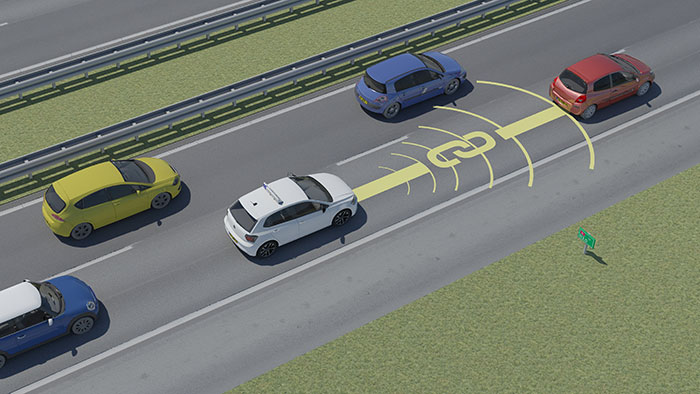
Standard cruise control is a system that allows you to lock the vehicle’s speed, so you do not have to keep accelerating. Adaptive cruise control adapts your speed to the traffic around you, monitoring your following distance and braking automatically once that distance becomes too short. Braking manually will disable cruise control. The use of cruise control is not recommended during bad weather and slippery road conditions.
Adaptive light control
Adaptive lighting is, for example, the cornering lights that extends your visual range when entering a bend, or headlights that turn into the bend. This lighting also reduces the risk of blinding oncoming traffic when cornering.
Automatic lighting

Automatic full-beam headlights
Automatic lighting refers to daytime running lights that automatically switches to dipped headlights at nightfall. There is also automatic full-beam lighting, whereby the full-beam headlights will be dimmed when you drive below a certain speed, when you encounter oncoming traffic, and when there is a vehicle in front of you.
Unfortunately, however, the sensors that regulate automatic lighting do not pick up on everything. Fog often goes unnoticed, and dipped headlights are therefore not switched on. The system may miss traffic that is further away, so full-beam headlights are not dimmed in time. The responsibility to keep an eye on traffic remains with you, the driver, at all times.
Automatic navigation system with TMC and internet connections
Navigation systems are increasingly being upgraded with extra features that alert drivers to traffic jams and detours. Depending on settings, the system may independently adjust navigation.
Autonomous emergency braking (AEB, including forward collision warning)
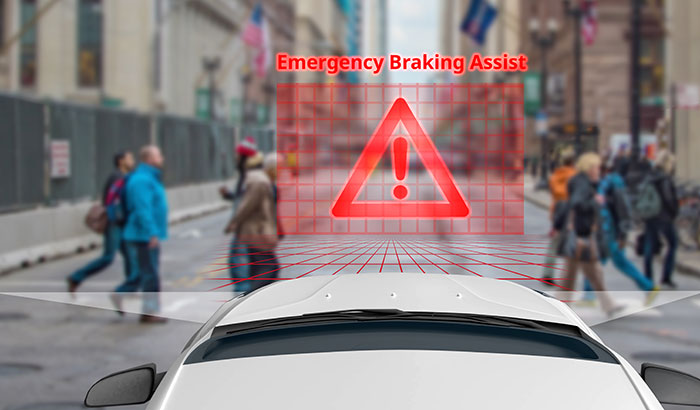
There are various systems designed to warn and intervene if you, as a driver, are about to encounter a dangerous situation. These systems work with cameras, sensors, and other detectors that can intervene in the event of a delayed reaction on your part.
Automatic braking systems may be linked to seat belts or other safety systems designed to prevent damage and injury to the extent possible upon impact.
Automatic braking does not aim to prevent accidents – rather, it should be seen as a last resort in minimising the consequences of an accident. The forward collision warning is a tool primarily intended to encourage the driver to take action. If this does not happen, the system will brake automatically.
The Pedestrian protection system is another safety system designed to protect (crossing) pedestrians.
Blind spot warning (BSW)
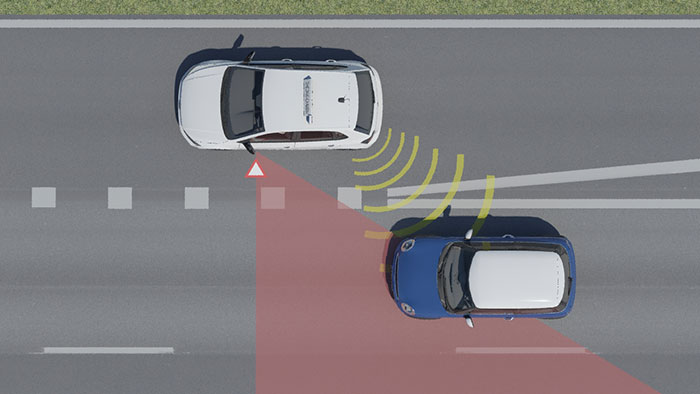
Blind spot warning systems alert you to other vehicles in your blind spot. An example of such a system is a light in the wing mirror that illuminates when a vehicle enters your blind spot. If a blind spot detector notices a vehicle in your blind spot, and you use the turn signal in the same direction, a warning sound will advise you not to move in that direction.
While these systems are convenient in not requiring drivers to check their blind spots as often, they often fail to detect smaller vehicles and motorcycles. It is therefore important to make sure you continue to check your blind spot independently.
Crosswind stabilisation
The crosswind stabilisation system keeps your vehicle stable during severe crosswinds. This system is mainly used in passenger cars with active suspension and works by gently applying the brakes on the side the wind occurs and adjusting the suspension to reduce the wind’s impact on the vehicle’s movements.
Drowsiness detection
This system monitors the driver and their behaviour to ensure they are actively driving. A camera monitoring the driver’s face detects reduced attention, while the system monitors steering movements and lane positioning (for example via the lane support system).
If the system detects fatigue or reduced concentration, an alert will sound and the dashboard will advise you to take a break from driving. This does not mean you should drive while fatigued until these warnings occur. Drivers are therefore advised never to drive while tired and to take regular breaks when driving longer distances.
Electronic stability program (ESP/ESC)
Warning ESP disabled
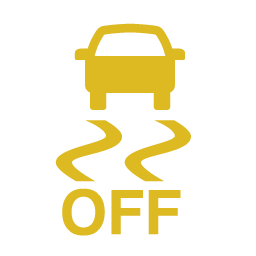
This system ensures that the direction your vehicle is travelling is the same as the direction in which you are steering. If this does not line up, for example when slipping, the system will correct this where possible by applying brakes to wheels individually. This stabilises the vehicle to facilitate steering control.
This makes it sound like cars equipped with ESP cannot slip. This is certainly not true. While ESP can correct a slip when it starts, it cannot help you when your vehicle is slipping severely.
ESP can usually be disabled, but this is not recommended when driving on public roads.
Emergency call system (eCall)
The eCall system automatically sends a message to emergency services in the event of an accident. This message includes important information such as your location and the number of occupants in your vehicle.
Hill descent control
This system helps drivers descend steep slopes and is mainly used on four-wheel drive vehicles designed for rough terrain. If the vehicle accelerates itself, the system will apply controlled braking to the set speed.
Intelligent speed assistance (ISA)
This system has been developed to prevent speeding. This can be done with the help of a speed sign-recognition system or GPS-linked speed limit data. The system compares this speed limit with the driven speed. The signs can be displayed in the dashboard to advise the driver about the speed limit, but it can also be combined with adaptive cruise control to adjust the vehicle’s speed automatically.
This system works well in some areas but not in others, and not all systems are sufficiently developed for Dutch roads. For example, ‘zone’ signs are often not detected, and the system occasionally picks up signs from parallel roads or side roads that do not apply to the road the vehicle is currently on. Drivers are therefore advised not to trust speed assist systems blindly, and to remain aware of signage on the road at all times.

Lane support systems
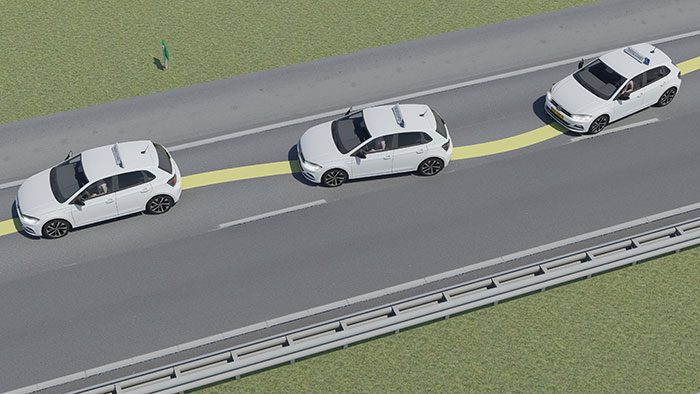
These tools alert drivers who are veering offcourse with a beeping sound or a vibration on the steering wheel, or via automatic course correction.
One drawback of the lane keep assist and lane departure warning system is that rush hour lanes with lines and road markings at exits can confuse it. This means the system may erroneously direct you from the rush hour lane to the exit or onto another lane. The system works primarily based on line markings. Without these, it will not work as well – or possibly not work at all.
Night vision
This is a thermal imaging or infrared camera on the vehicle that projects an image to a monitor in or on the dashboard, allowing drivers to see obstacles and other road users while driving at night or during bad weather.
Parking sensors, assisted parking en automatic parking
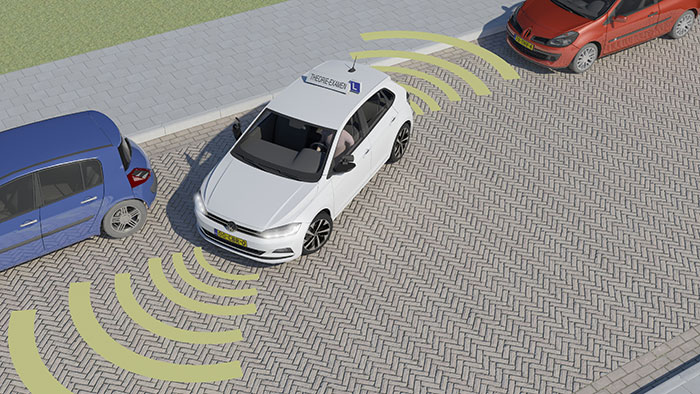
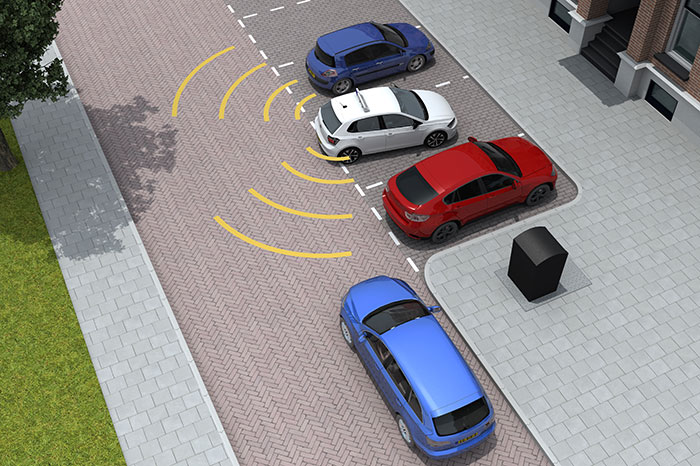
The simplest parking systems consist of sensors and will emit beeping sounds when your vehicle is too close to an obstacle. More advanced systems are also equipped with cameras to provide you with a better view of the road around your vehicle.
The most sophisticated systems take over parking completely, which means you do not have to do anything. In this case, however, you are still responsible for any damage and you must maintain awareness of the situation around you.
Rain sensor
This sensor, which is usually built into the windscreen, activates the windscreen wipers when rain is detected. It also controls the speed of the wipers.
Rear cross traffic alert (RCTA)
The rear cross traffic alert system detects traffic approaching from the left or right while driving backwards, including traffic not yet visible to the driver, and alerts the driver with a sound signal.
Some systems can also automatically apply the brakes if the driver fails to react. This system is often combined with the rear collision warning system.
Speed control function

This function allows you to a set a maximum speed yourself. You will not be able to drive faster than the set speed. This is different from cruise control, whereby the vehicle itself controls the speed. You must maintain acceleration when using the speed control function.
Start-stop system

System that makes it easier for a driver to turn of the engine at involuntary stops in traffic. For instance, at a traffic light or a level crossing. With a car with manual transmission, you usually have to put the gear in neutral and release the clutch pedal. The engine will then shut down automatically. As soon as the clutch pedal is pressed again, the engine will restart immediately.
With a vehicle with automatic transmission, the start-stop system will normally shut down the engine as soon as the car comes to a stop with the use of the brake pedal. As soon as you let go of the brake pedal, the engine will restart again.
Tyre pressure monitoring (TPM)
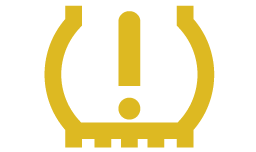
Low tyre pressure warning
In some vehicles, tyre pressure is monitored by sensors. If the tyre pressure deviates, a warning light in the dashboard will alert the driver. If you see this warning light, stop in a safe place and check your tyre pressure.
Tyre pressure monitoring systems are not a substitute for monthly tyre pressure checks. These systems often only detect a difference between tyres, and are thus unlikely to notice if all tyres have decreased pressure simultaneously. Tyre pressure systems can also give false alerts in colder weather.
Vehicular communication system
This system allows modern vehicles and other pre-determined points to communicate regarding congestion and safety warnings. For example, if an accident occurs 300 metres ahead of you, the vehicle can respond to this by warning you or even braking. These types of systems are becoming increasingly important with the advent of selfdriving cars.
Warning sounds on electric vehicles
These are warning sounds that occur when a (partly) electric vehicle is driving or reversing slowly (up to 25 km/h). As these vehicles are usually difficult to hear, the sound signals warn other road users of their presence.