

Use requirements
Use requirements govern the use of a car, such as how to transport passengers and load and how far load may protrude.
Towing
If you have to tow a vehicle due to a breakdown, or if your vehicle has to be towed, you must comply with certain rules:
- The distance between the two vehicles should not exceed 5 meters.
- A motor vehicle may not tow more than one motor vehicle, nor may you tow an assembly of vehicles.
- A combination of vehicles may not tow a motor vehicle.
- You cannot tow a two-wheeled motorcycle or moped with a passenger car, nor can a passenger car be towed by a two-wheeled motorcycle or moped.
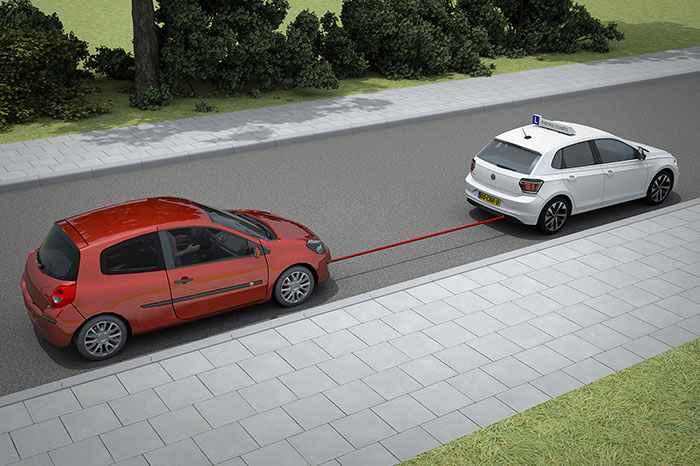
The distance between two vehicles, of which one is being towed, may not be more than five metres.
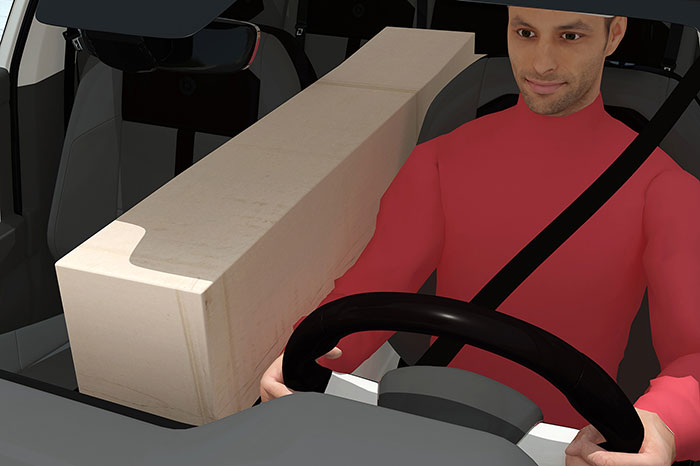
When transporting a load it may not obstruct the driver’s manoeuvrability in any way. Transporting goods like in the picture above is therefore not permitted.
Hinder caused by load or passengers
The driver of a passenger car must not be hindered by passengers or load while operating the vehicle. Driving is prohibited if load is blocking, for example, access to the gear stick or the view of the right wing mirror.
Adequate view of surroundings
The driver of a passenger car must have sufficient visibility of the vehicle’s immediate surroundings at all times. This also applies when transporting a trailer behind the vehicle or load in or on the vehicle. Visibility through the windscreen and front side windows should never be obstructed. The wing mirrors must also provide sufficient visibility alongside and behind the car or trailer. If this is not the case, then trailer or caravan mirrors or a camera monitor system must be used.
These rules do not apply to the rearview mirror.

If you cannot look past the trailer or caravan with the normal mirrors, extra mirrors are required. The yellow lines indicate the width of the caravan. If this is wider than the width of the normal mirrors, then the normal mirrors are not sufficient.
Securing load
Load being transported in or on a passenger car or trailer must not be able to shift or fall off the vehicle. It is therefore mandatory to properly secure all load before driving. This also applies to load inside the car, which must not be able to hinder the driver.
Load must be secured in line with a number of requirements:
- The method of securing must be able to withstand sufficient forces, both in the direction of travel and to the side, backwards and upwards, such as with speed bumps.
- Loose cargo that cannot be secured (e.g. sand or leaves) must be covered with a net or tarp if it could fall or blow off the vehicle.
- The securing devices must be suitable for the purpose for which they are being used.
You are liable for any damage caused by cargo shifting or falling off your vehicle.
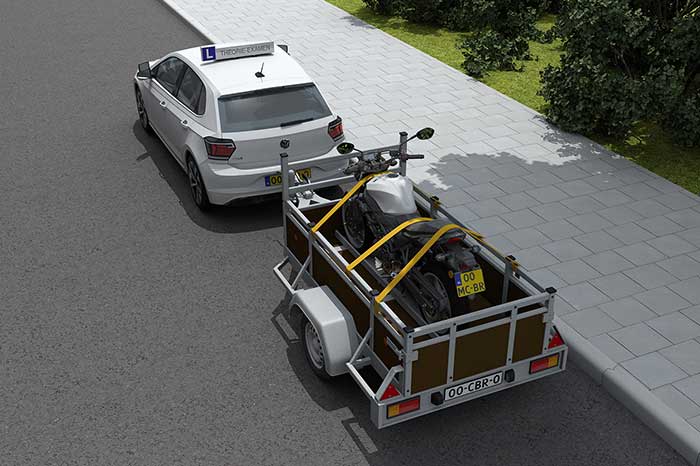
If you are transporting a large load in the trailer, you must secure it well with, for example, lashing straps or ropes.
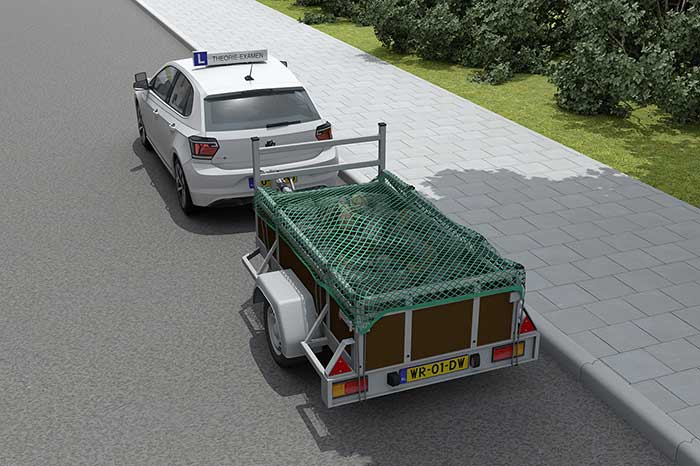
If you are transporting loose cargo in the trailer, it must be covered with a net or tarpaulin. No cargo should be able to blow off or fall off.
Overhanging load
Just like with vehicles, load may not contain any sharp objects that could cause injury in the event of a collision. Protruding blunt objects must be covered if leaving them uncovered increases the risk of injury.
Load carrier
Transporting load on a load carrier is only permitted if the load carrier is intended to hold that load. A bicycle carrier, for example, may only be used to transport bicycles – and only the intended number of bicycles according to its design.
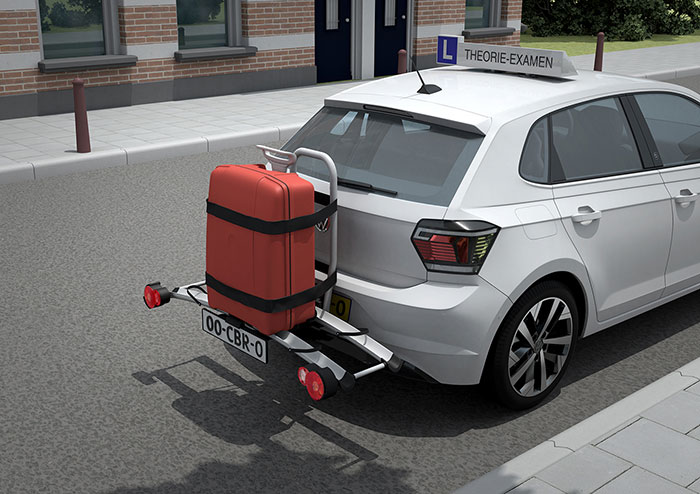
You may only transport bicycles on a bicycle carrier. Transporting a suitcase is not permitted.
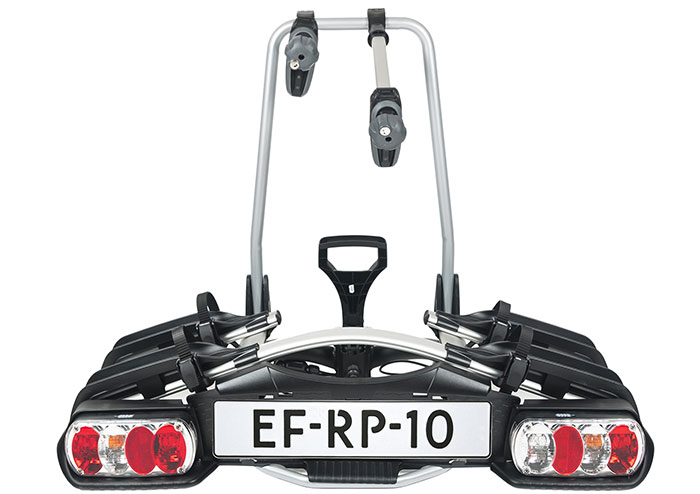
When a load carrier obscures the number plate and rear lights of a passenger car, it must have integrated lighting and a white number plate.
The load and the load carrier must also meet the following requirements:
- The goods and the load carrier itself must be properly secured.
- The load carrier, including the load, must not protrude more than 20 centimeters from the sides of the vehicle.
- If the lighting of the passenger car is obscured by the load carrier, the following
lighting must be present on the load carrier:
- two red rear lights;
- two red brake lights;
- two red retro-reflectors;
- two amber indicators.
- If the number plate of the passenger car is obscured by the load carrier, a white number plate with the same registration number as the passenger car must be affixed to the load carrier. This must have an approval mark and number plate lighting must be present.
If the load carrier is mounted on the tow bar or on the front of the trailer, it must meet the following requirements:
- The weight on the tow bar (also referred to as the tow ball weight) must not exceed that specified for this passenger car. If it has not been recorded, it must never exceed 75 kg.
- The load carrier itself, or parts thereof, must not touch the road surface during normal use.
- The load carrier or (remaining) parts thereof must not hinder a coupled trailer’s manoeuvrability.
If goods are transported on the roof of a passenger car, this must be in accordance with the following requirements:
- Transport must be by means of a load carrier that is intended for this.
- The load carrier and goods must be properly secured.
- The maximum authorised roof load (the weight on the roof) must not be exceeded.
The maximum authorised roof load and tow ball weight can be found in the vehicle’s owner’s manual (or on the tow bar).
Detachable tow bar
An unused tow bar must not obscure the vehicle’s number plate. Therefore, vehicles where this is the case are equipped with a detachable tow bar. If a tow bar is located in front of the number plate, it must be removed as soon as you have finished using it. The car’s number plate must always be legible.
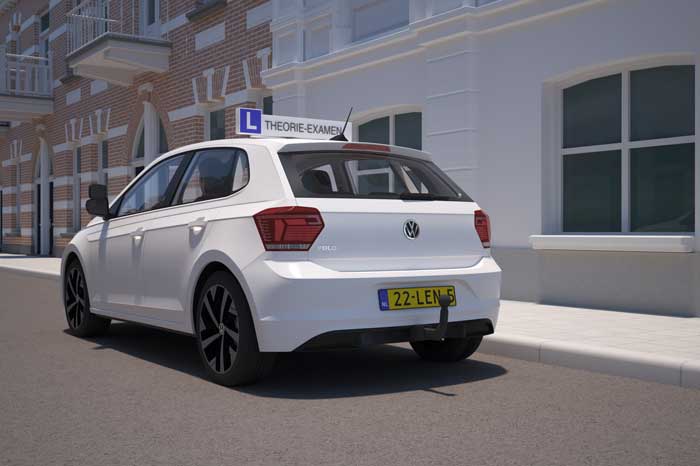
Driving like this is not permitted.
Overhanging load in passenger cars
When loading load on or in a vehicle, we distinguish between divisible and indivisible loads.
- Divisible load
Load that can be transported in several parts and can therefore often be loaded into or onto a vehicle in several ways.
- Indivisible load
Load that cannot be divided into smaller pieces during road transport without causing damage or unnecessary costs. This can include ladders, glass plates, or long wooden planks.
Load must always be transported in the best possible way, so that it causes as little inconvenience as possible to other traffic. The maximum overhang (how far something may protrude outside the vehicle) for different loads are as follows:
- Sides
If you transport a wide load on the roof of your passenger car, this load may protrude a maximum of 20 centimetres on each side. It makes no difference whether it is a divisible or an indivisible load.
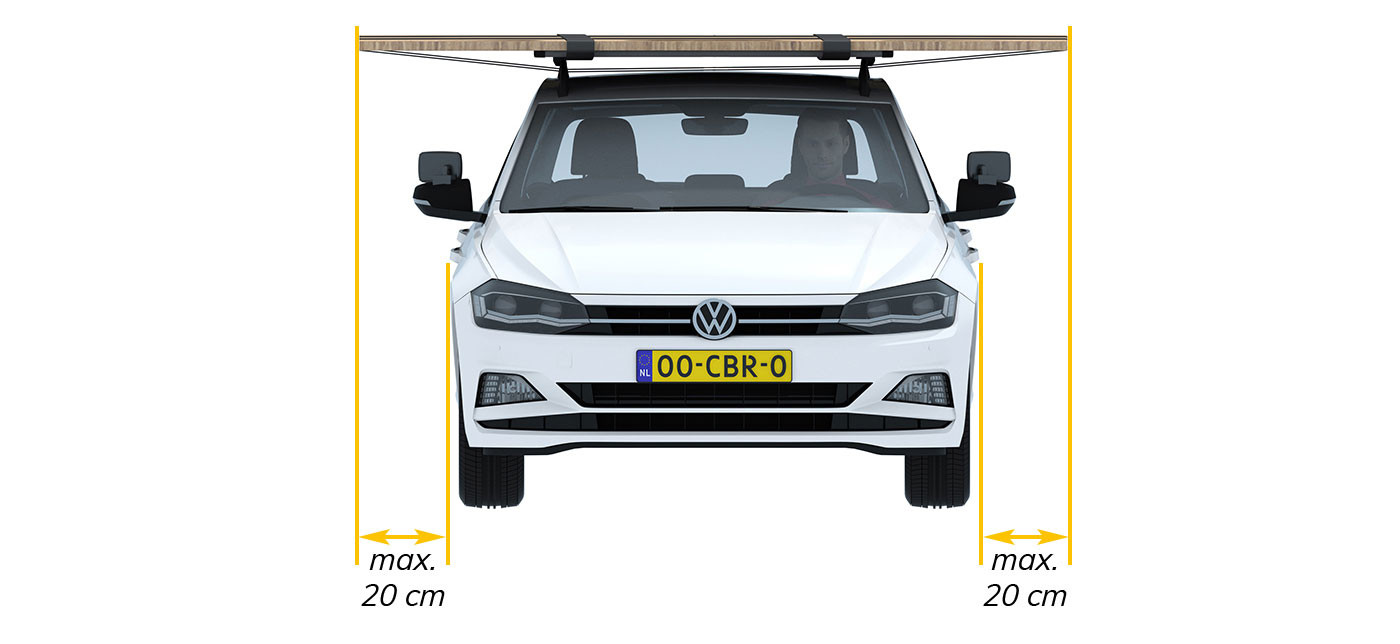
- Front
Load must not protrude from the front of a passenger car – unless the load is indivisible lengthwise, in which case it may protrude by a maximum of one metre. - Rear
Load may protrude by a maximum of one metre from the rear of a passenger car. The distance between the rear axle and the end of the load must never exceed five metres. This applies to both divisible and indivisible load.
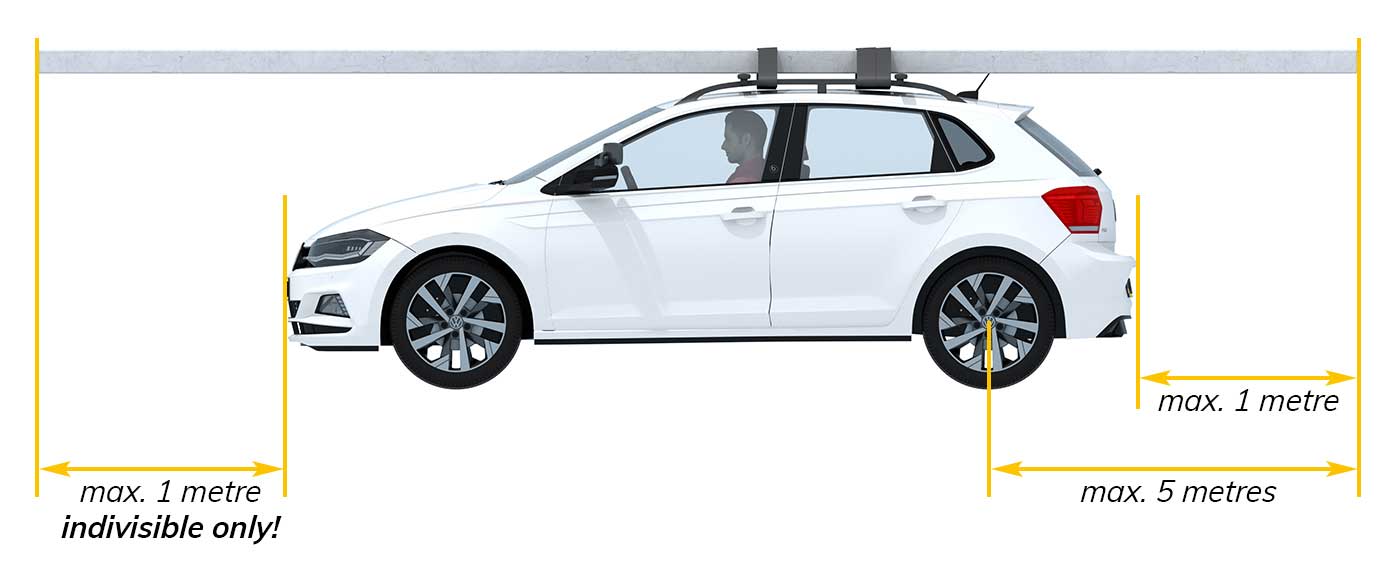
The main difference between divisible and indivisible load is that indivisible load may protrude in front of a passenger car whereas divisible load may not.
Load may never protrude too much that it makes a passenger car longer, higher or wider than is permitted. So load may not exceed:
- 12 metres in length;
- 4 metres in height;
- 2.55 metres in width.
Combinations (passenger car plus trailer) may not exceed 18 metres.